Startup profile: DreamVu
- Founded by: Rajat Aggarwal, Anoop Namboodiri and Sashi Reddi (CEO)
- Year founded: 2017
- Headquarters: Philadelphia, PA
- Sector: Robotics
- Funding and valuation: $4.56 million raised
- Key ecosystem partners: SRI Capital, Ben Franklin Technology Partners
For many robots, cameras serve as eyes. But navigating a workspace full of people and obstacles takes more than a simple video feed.
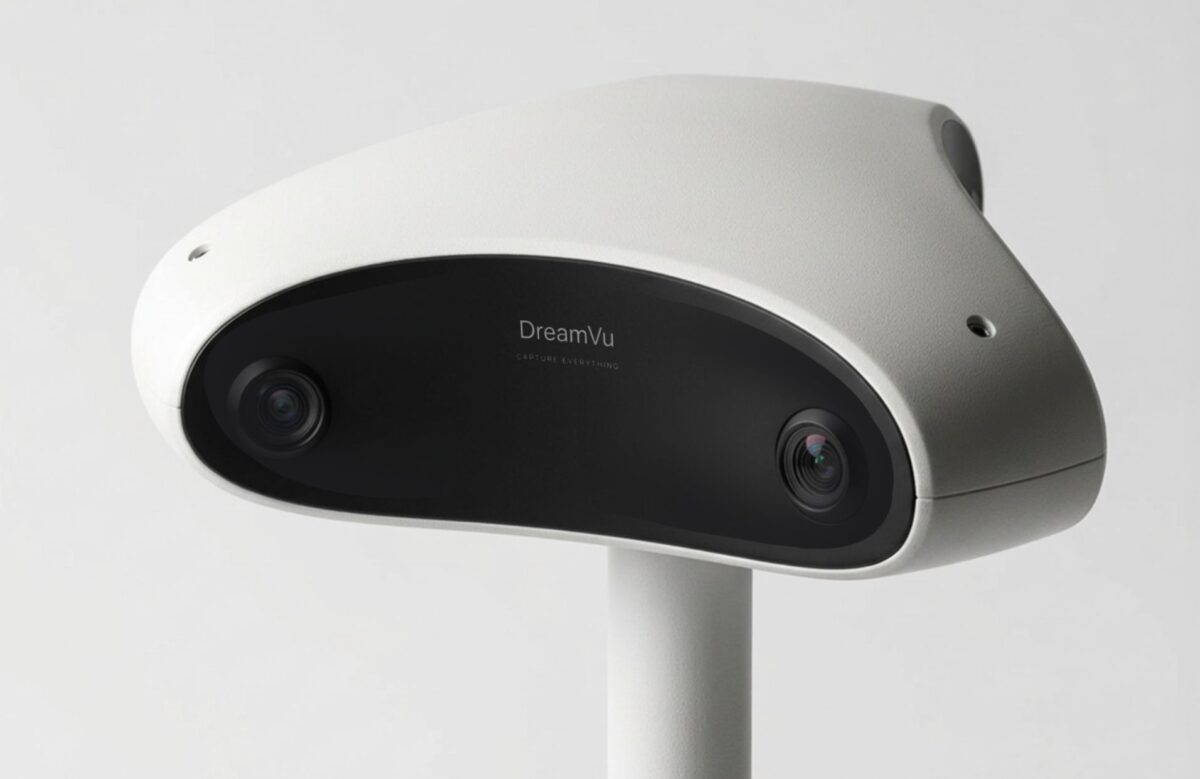
Philadelphia-based DreamVu makes cameras designed to give robots a 360-degree 3D view of their surroundings.
“The only way [for robots] to be safe to work near humans is to be able to see everybody around the machine,” CEO Sashi Reddi told Technical.ly.
DreamVu has been developing its technology for years, but at the end of 2025, the company was running out of money. Now, it’s redesigning its cameras for a robotics market that has taken off since the company was founded.
That was enough to get investors interested again. This spring, it announced a $2 million funding round led by SRI Capital with participation from Ben Franklin Technology Partners of Southeastern Pennsylvania and angel investors.
DreamVu plans to introduce its redesigned camera at CES in January, hoping to reach a new generation of robotics companies.
An add-on for existing robots
DreamVu’s technology grew out of research at the International Institute of Information Technology Hyderabad in India. Professor Anoop Namboodiri and students Rajat Aggarwal and Rohan Bhatial developed a system for capturing 360-degree, 3D imagery, eventually launching the company in 2017.
Reddi’s Philadelphia-based venture fund, SRI Capital, invested in DreamVu in 2018. At the time, robotics was a much smaller market. DreamVu sold cameras to small robot manufacturers, but Reddi said selling hardware was difficult, and it struggled to attract more investment.
“The company was, at the end of last year, at the end of its runway,” he said.
Despite those struggles, Reddi believed the technology still had potential. He decided to take over as CEO earlier this year, invest some of his own money and rethink the company’s approach.
“This year, 2026, we saw it as a year of the reset,” Reddi said.
DreamVu has sold more than 2,000 cameras over its history, according to Reddi. Now, the company is using what it learned from those earlier products to develop a camera better suited to today’s robots.
RELATED NEWS


Industrial robot manufacturers typically pair cameras and other sensors, such as LiDAR, which uses laser light to measure distances. Boston Dynamics’ robot dog Spot, for example, uses five pairs of stereo cameras to detect obstacles.
Instead, DreamVu’s device captures everything in a single unit, including the 360-degree view and the depth measurements. Reddi said that makes it easier to track people and objects moving around the robot without having to combine several camera feeds.
The technology isn’t intended to give robots capabilities they couldn’t have otherwise, Reddi said. Its big advantage is a simpler setup. DreamVu’s camera is designed as an add-on to a robot’s existing systems. The system also includes software that lets operators monitor cameras and watch live feeds from a central dashboard.
Potential early customers are manufacturers of four-legged bots like Boston Dynamics or makers of the autonomous mobile robots used in warehouses and factories, according to Reddi. Humanoid robots are another potential market, although he expects those to take longer to become widely used.
A Philly-based manufacturing operation?
In September, DreamVu released Liberty3D, a sample dataset of high-resolution 3D imagery and depth information captured at real-world locations, including Philadelphia landmarks.

DreamVu’s 360-degree camera captures both color imagery and depth information, allowing developers to reconstruct real-world locations in 3D. (Courtesy DreamVu)
The data demonstrates how developers could recreate a physical environment in a computer simulation. A company preparing to deploy robots in a factory, for example, could scan the space and let its robots practice navigating a virtual version before sending them onto the actual floor.
Reddi said conversations with prospective customers have revealed other possibilities, including using high-resolution cameras to detect drones in defense settings.
For now, the priorities are getting DreamVu’s redesigned Alia360 3D camera in front of robot manufacturers and expanding its US team.
DreamVu currently has four employees in Philadelphia, with additional operations in Palo Alto, California, and Hyderabad, India. Reddi hopes to eventually manufacture the cameras in Philadelphia, but the company needs additional funding to make that happen.
“Right now my job is to just get the prototype done, show it to folks, raise a good round of money,” Reddi said. “And then we can set up the manufacturing base in Philly.”