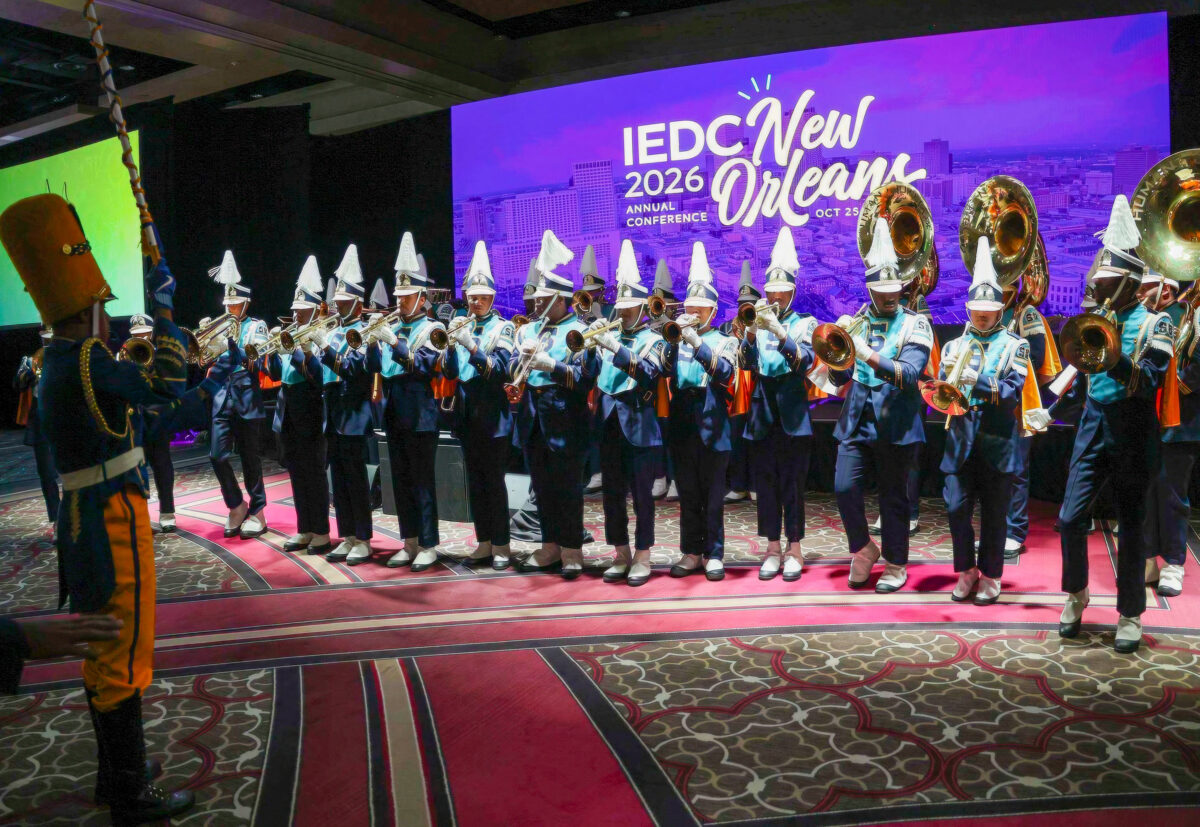
• The International Economic Development Council’s centennial conference highlighted a shift away from the idea that economic developers should spend heavily to attract and retain established companies, and toward supporting homegrown founders.
• IEDC chief Nathan Ohle and Director of Entrepreneurship Zachary Barker are advancing this change by heavily centering new firms in conference programming, even as government funding still overwhelmingly favors corporate attraction over new business creation.
• Pro-entrepreneurship leaders note that while progress is clear, the movement faces new battles, such as federal ecosystem funding being captured by traditional institutions that use standard top-down grant administration.
When a boss sends you to a conference, you get a hotel room. When you’re the boss, you pile into whatever is cheap and share it with whomever else is paying their own way.
This week in New Orleans I did the second, sharing a rented house with other founders a long walk from the conference hotel by the Superdome. Ever the penny-pinching networkers, entrepreneurs who pack houses for tech affairs like SXSW know the arrangement. It’s rarer around the International Economic Development Council’s annual conference, where most of the roughly 1,800 attendees come on organizational budgets with a badge, a per diem and a block rate at the Hyatt Regency.
This year those two styles of business travel landed in the same city in the same week. IEDC’s centennial-celebrating conference ran Oct. 25 to 28, and Elevate, a separately ticketed entrepreneurship summit, opened on its heels. The overlap symbolized a defining question for the field:
How far along is the pro-entrepreneurship movement in economic development?
The conference moved faster than the money
As far back as the 1990s, economic development training to create local jobs frequently cited the three-legged stool of attraction, retention and creation, West Virginia SBDC deputy director Mark Burdette told me. In practice, retention got most of the effort and attraction got most of the money. Creation, meaning new companies built by locals, was left untended — and was in freefall.
Between 1978 and 1982, the share of all US employers that were newly started fell by close to 20%, and just kept declining. It hit an all-time low in 2010. That troubled policy leaders like the Center for Entrepreneurship’s John Dearie and researchers like Dane Stangler, who argued widely for entrepreneurship’s dynamic effects.
Their cause is gaining steam, as I reported in a three-part series ahead of the IEDC conference. Governments still spend roughly eight times as much on incentives to attract and retain companies as on supporting new ones. That even though one Upjohn Institute analysis puts the cost of an incentive-bought job at 3-5 times more expensive. Meanwhile, research has identified smarter ways to help new firms grow bigger and faster.
Open questions remain, but bipartisan, federally-funded experiments are underway nationwide, from EDA Tech Hubs and NSF Engines to the Treasury’s State Small Business Credit Initiative. They’re being served by a growing class of national resource providers filling gaps in the shift to “ecosystem building,” or what IEDC chief Nathan Ohle calls “systems stewardship.”
Programming at IEDC’s annual conference has moved faster than the money. Director of Entrepreneurship Zachary Barker, who helped advance the change, said two-thirds of this year’s conference sessions focused more on homegrown entrepreneurs than chasing established companies. Technical.ly’s own analysis confirms the change: 55 of 74 sessions this year in New Orleans used an “entrepreneur”-related term in its title or description, compared to just 14 back in 2018. Across all programming descriptions, sessions focused on homegrown new firms nearly tripled, while attraction and retention sessions remained flat. Only the terms “ecosystem” and “artificial intelligence” grew faster.
To those behind a decades-long push to transition state and local economic strategies, like longtime advocate Andy Stoll of the ESHIP Alliance, that looks like progress. Like other movements before it, the reward for progress is new demands from the next generation.
Barker, southern folksy and sweating in a sharp blue suit, spent Wednesday afternoon as a New Orleans levee between the orderly grid of traditional economic development and a demanding storm of grassroots “ecosystem builders.”
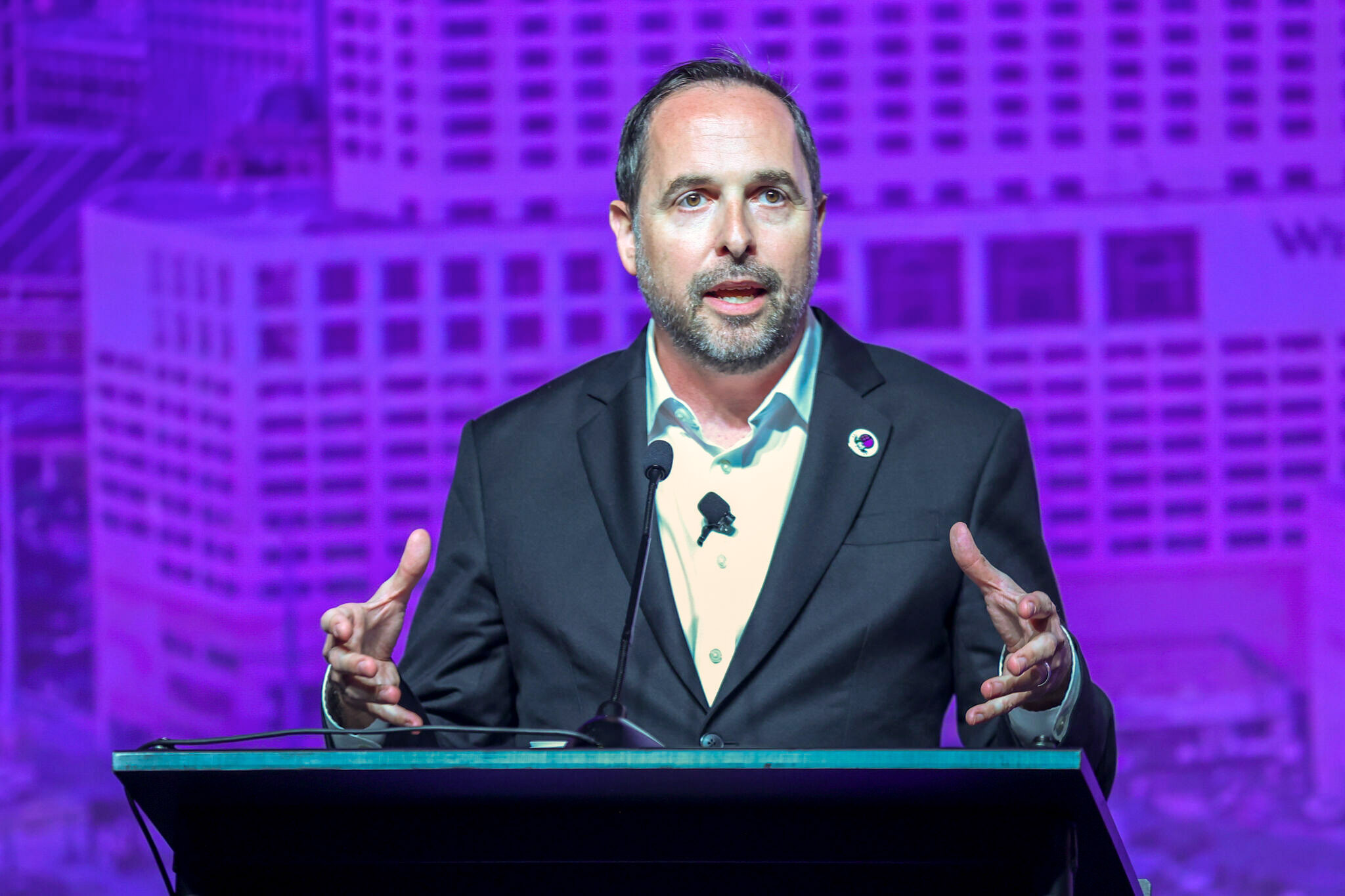
That morning, a marching band played IEDC’s 1,800 attendees out of the formal program. In the afternoon, Barker co-hosted a summit for 150 people at $200 a ticket (compared to $1,500 for the main conference), built to introduce local entrepreneurship organizers to the more established field. He handed the mic to Ohle, who swapped his suit for a startupper’s branded vest to field questions from small community nonprofits, volunteer organizers and founders selling to economic developers — hailing from Texas and New York, Kansas, Louisiana and more.
Audience questions for Barker and Ohle had more heat than one might imagine for a wonkish, fluorescent-lit conference. Why? Because the stakes of economic development are quite literally who gets access to opportunity and who doesn’t, argued Grace Belangia, a UC Berkeley professor who cofounded Make Startups, which supports place-based startup programming and works to redirect federal workforce funding toward entrepreneurship training.
As her Georgia-based cofounder Eric Parker put it to IEDC leadership, representing that grassroots storm and acknowledging the separation between the field’s mainstream and Elevate’s smaller room: “Why am I here and my local economic developers aren’t?”
Colorado: An early testing ground that still does it well
Amid Great Recession-era economic frustrations, Make Startup’s Parker, now bespectacled and gray-speckled, was torn between activating for Occupy Wall Street revolution or the rebuilding project that became “entrepreneurial ecosystem building.” He chose the latter. Some 15 years later, he joined the private dinner I moderated between IEDC and Elevate with Kimberly Gramm, who in 2022 became Tulane University’s inaugural Chief Innovation and Entrepreneurship Officer.
We were hosted by Tim Williamson, a repeat entrepreneur who co-founded startup support nonprofit Idea Village in 2000 and later ran NOLA Media Group, then the publisher of The Times-Picayune. He presents like a fatherly bulldog for New Orleans, instrumental in the region’s early 2000s entrepreneurship organizing, especially post-Katrina. He now holds court behind the bar at the Nieux, a portfolio of companies that made in 2022 a headquarters out of a St. Charles Avenue events venue assembled from a restaurant that once sat on the Eiffel Tower.
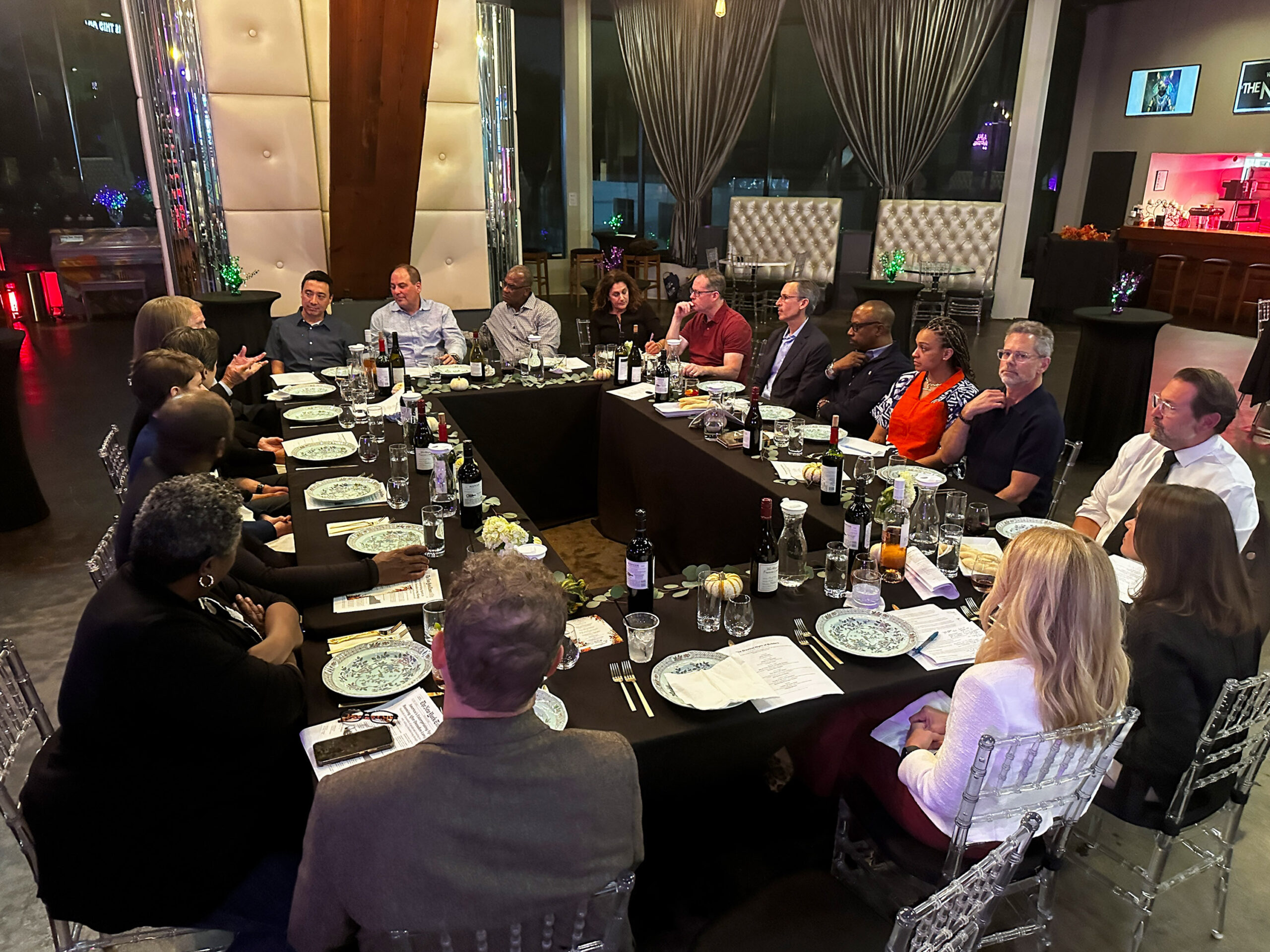
This new career chapter made him nostalgic, Williamson told me over tequila earlier this week, hence the convening. At that dinner, Parker told 18 of us that he felt like after decades of brandishing the pro-entrepreneurship jolly roger, this group of pirates was confronting whether to join the economic development navy.
This long rebellion began not on the seas but in the Colorado mountains.
In 1982, Chris Gibbons, now 79, was working in Leadville as the town’s molybdenum mine shut down, and the job was to recruit employers to replace the lost work. It went nowhere. Gibbons met two miners who had invented a resin bolt for holding up mine roofs, and suggested the town try growing companies like theirs instead of importing new ones. That also didn’t go anywhere, but the idea stuck.
Five years later, Denver suburb Littleton’s largest employer cut 7,500 jobs, and Gibbons, by then the city’s director of business and industry affairs, got another chance. Under his guidance, Littleton stopped recruiting and offering incentives. It started helping local companies grow, and Gibbons called the approach “economic gardening,” an early marker of the culture that would help define Colorado’s dynamic startup economy. Fast forward four decades to this autumn’s Technical.ly analysis, which found the states that spend the most on incentives tend to produce the fewest high-growth firms per capita. Colorado is among those spending least and producing most.
Back in the 1980s and 1990s, Gibbons and his small tribe identified themselves as the “rebel force,” fighting against the growing incentive strategies of economic development. His lonely affair became a bit less lonely in the early 2000s, when Williamson and Victor Hwang, among others, started stitching together networks as the dot-com bubble burst.
From those dark days, progress is clear — Ohle repeatedly asked entrepreneurship organizers to hold IEDC to his ambition for change.
But Hwang, now an influential pro-entrepreneurship leader, my Builders Live co-host and founder of Right to Start, says that though the pirates might have boarded the naval ships, the work is far from done.

Lessons from Lafitte? The evolution from disruption to standards
Victory in one war brings new battles in another. At last week’s dinner, one builder said federal money for ecosystem building that finally arrived in his region went to a university system that had ignored entrepreneurship for years, not to the groups doing the work.
“All we did was we taught them a language,” the builder said of institutions that then captured the budgets. Too few are truly embracing an ecosystem-style approach, he said, but following standard top-down grant administration. New approaches require new leadership, he added.
That’s a familiar pattern across fields undergoing change. Max Planck’s famous line that science advances one funeral at a time has been tested: When star life scientists died early, newcomers from outside their circles moved into the field and produced more of their highly cited work. Behavioral economics, started by rebellious young academics, had a recurring column in the staid American Economic Association’s own journal more than a decade before its first Nobel Prize.
The economic development handoff is well underway. New Orleans itself is filled with new entrepreneurship organizers, not least of all is Gramm, who has considerably more institutional authority at Tulane than Williamson initially had. Longtime organizer Stoll is stepping back at the ESHIP Alliance, which he founded, and Fay Horwitt is stepping up. (They’re hosting virtual conference CONVERGE this month to advance the conversation.)



Before the dinner, two dozen industry veterans were interviewed by agentic AI-interview platform Decision Lab, which Williamson cofounded with Lindsey Roussel. From those interviews, Roussel reported that those newest to the field were most impatient with its progress. Taylor Eubanks, the founding director of the Kansas state government’s small business office, was among those interviewed. She argues the “ecosystem building” term should be retired so that this tribe can properly lay claim to economic development as a whole.
Post-government, Eubanks founded BlendHQ, a “capital architecture” firm that helps clients fund impact, and was one of my IEDC housemates. Her host was Heidi Knoblauch, a former economic developer with a Yale PhD in philosophy, who rented the house for the team of her startup Homefield, which sells a platform to track the economic impact of entrepreneurship — much like big firms do on their own.
“We may know what works, but plenty of economic developers still don’t,” Knoblauch said. “Our communities don’t have time to spend another 25 years on the wrong ways to get more people more opportunity.”
The pirate age may not be done after all, just transitioning to a new wave.
Fittingly, the metaphor even has New Orleans history. For the War of 1812, Jean Lafitte’s smugglers in Barataria Bay offered their men, guns and flints to President Andrew Jackson. They fought at the Battle of New Orleans in January 1815, and President James Madison pardoned them a month later. It’s the best-known case of pirates becoming the navy. But Lafitte didn’t stay legitimate. Within a few years he was running a privateering colony out of Galveston.
Poolside at that house near the conference, I sat in the warm New Orleans sun alongside Knoblauch, Eubanks and other entrepreneurs with laptops and opinions. All fashioned themselves rebellious outsiders, pitted against a big establishment and with the eventual goal of becoming the new standard.
Look no further than IEDC itself, today the standard-bearer of a trade that quietly shapes the streets and the economies of places worldwide. Before he retired in 2021 after close to 40 years leading IEDC, Ohle-predecessor Jeff Finkle told Right to Start’s Hwang that in the 1970s what is now called economic development was itself the rebellion against entrenched policymakers, arguing for greater discipline and intention in shaping state and local economies.
Any successful movement ages into the establishment for a new generation to rebel against. What will become of the pro-entrepreneurship pirates next?