
When your trusted web designer says you need a security update, you probably don’t question it, especially if it’s related to a security vulnerability that’s been all over the news.
When a client of Delaware creative agency BrandSwan recently received an email from owner Jane Clark, warning of an urgently needed PHP security update, it seemed legitimate.
One problem: Clark hadn’t sent it, even though it looked like she had.
“They took my picture from my website,” Clark told Technical.ly. “They even made this elaborate signature that’s animated.”
The message included company branding and a list of proposed maintenance work, from updating PHP and WordPress plugins to checking the website for security problems. And it didn’t just go to one of BrandSwan’s clients. Clark says she learned about the impersonation when clients started contacting her about the suspicious emails.
It nearly worked. One client sent $500 for the supposed repairs.
“Because my brand has been so similar for all these years, people are like, wait, this doesn’t seem right,” she said.
Timing suggests that the scam was trying to take advantage of current events. On Oct. 20, developers behind PHP, a programming language used by millions of websites, warned of serious security flaws. Emergency patches followed the next day, drawing national technology news coverage.
One fraudulent BrandSwan email is known to have arrived the following week, on Oct. 26.
It nearly worked. One client sent $500 for the supposed repairs, but used the usual payment method, depositing the money directly into BrandSwan’s account rather than sending it to the scammers, surprising Clark and her team.
BrandSwan wasn’t the only agency to deal with these fraudulent website maintenance requests. Nancy Dibert, CEO of Epic Marketing Consultants Corp., based in Middletown, Delaware, and New York City, said her clients encountered similar scams almost immediately after the PHP vulnerability became public.
The financial stakes are significant. Business email compromise scams, a broader category of fraud involving deceptive business communications, accounted for approximately $3 billion in reported losses nationwide in 2025, according to the FBI’s Internet Crime Report.
How the PHP scam works
The fraudulent BrandSwan email carried the subject line “Important Website Maintenance – PHP and All Updates Required.”
It claimed the recipient’s website was running an outdated version of PHP and outlined a series of proposed updates, including software upgrades, compatibility testing and security checks.
The security updates released Oct. 21 to address the two critical PHP vulnerabilities were available for free, although installing them could involve additional work. Some hosting providers and web maintenance companies handle such updates as part of their regular services. But business owners may not know which updates are covered or when additional work is necessary.
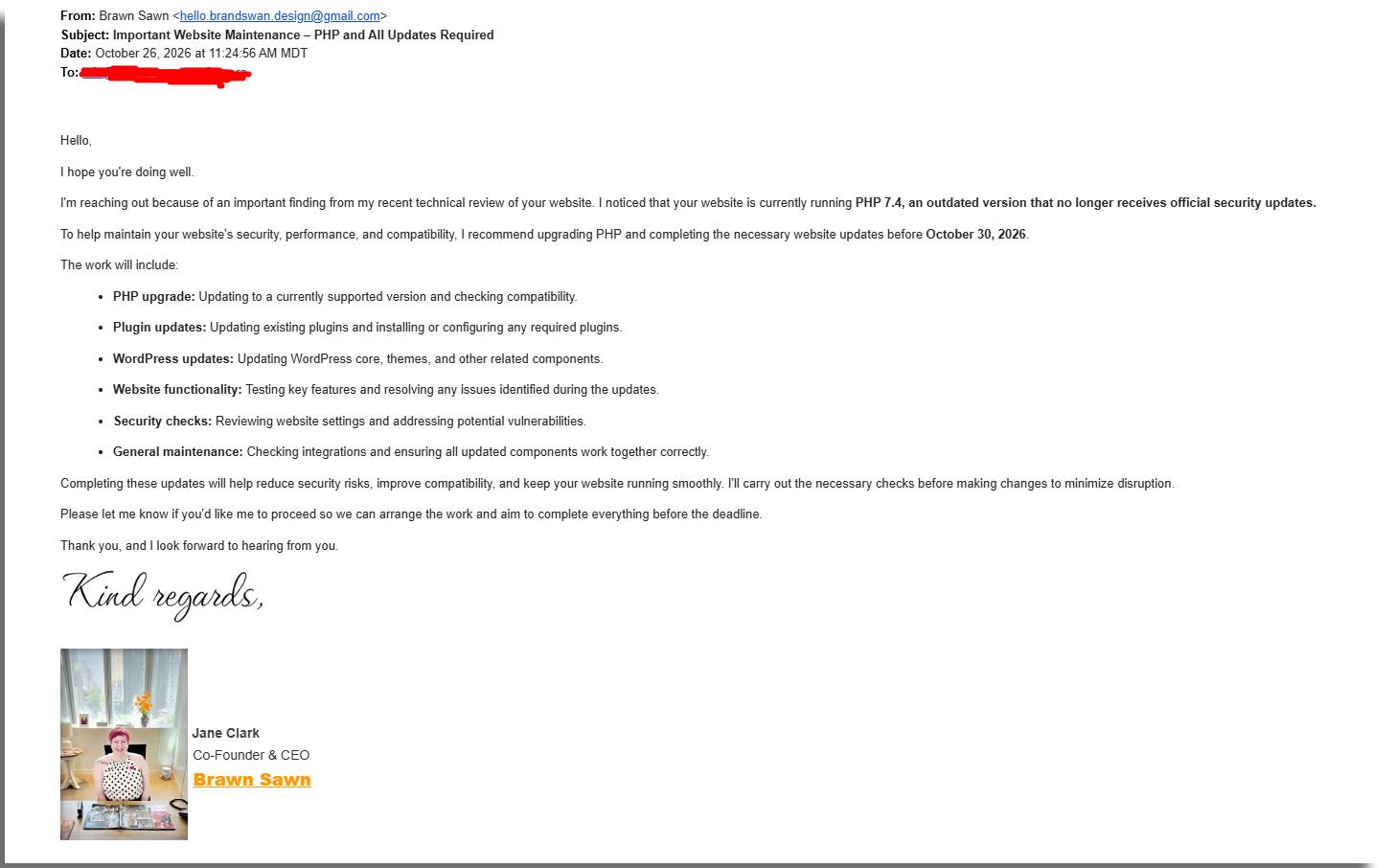
There were clues that the message wasn’t legitimate: The sender used a Gmail address rather than Clark’s business email, and the company name was misspelled as “Brawn Sawn.”
More troubling to Clark was how the scammers had identified her clients in the first place.
One recipient’s email address wasn’t publicly listed on either BrandSwan’s website or the client’s own website, she said. Clark suspects the scammers may have used AI or automated tools to collect contact information.
It’s not the first time scammers have used BrandSwan’s identity. In 2023, fraudsters impersonated the company to recruit jobseekers for nonexistent remote positions, a scheme Technical.ly reported on at the time. This time, the company’s clients were the targets.
Some of the emails sent to Epic Marketing clients directed recipients to log into their WordPress websites, apparently in an attempt to steal login credentials. Others included invoices for PHP updates and security patches.
“Not a single one was authentic,” Dibert told Technical.ly. “The scammers spoofed the real providers’ email addresses so on the surface, the emails appeared legitimate.”
The Federal Trade Commission describes the pattern: Scammers use a company’s name or an email address resembling its own to contact customers, often claiming there’s a problem that requires immediate attention. The goal is to obtain passwords, financial information or money, according to the agency’s guidance on business impersonation scams.
How to protect yourself and your clients
If you receive a request to approve unexpected work, Dibert recommends checking the sender’s address and where an email actually came from before following links, logging into accounts or providing financial information.
If anything seems suspicious, contact your web designer or IT provider through a phone number or email address you’ve used before, rather than replying to the message.



The FTC offers similar advice: Don’t use links in unexpected emails to log into accounts. Instead, visit the company’s website directly. The agency also recommends verifying unusual payment requests with the person or business involved.
Dibert knows how easy it can be to overlook a suspicious message. She said she receives about three fraudulent emails a day claiming to come from her husband, Don, who works alongside her. The messages often ask her to change his direct deposit information, log into a server or review an invoice.
“I usually just roll my eyes and hit the spam button, but there have been moments when I’m busy and not paying attention when I almost got fooled,” Dibert said. “It can happen to anyone. We all must be vigilant.”
If someone has already sent money to a scammer, the FBI recommends contacting the financial institution immediately to try to recover the funds. Victims can also report suspected internet fraud to the FBI’s Internet Crime Complaint Center.
Dibert said Epic Marketing alerted its clients and contacts to the PHP vulnerability, assured them that the agency had already installed the patches and warned them about emails impersonating its domain. “Just raising everyone’s awareness of the potential hazards went a long way toward preventing damage,” she said.
Clark said the experience made her realize she needed to talk more directly with clients about scams and explain what legitimate maintenance requests and payment instructions should look like. That could mean making sure clients know which email addresses the company uses, how it requests payments and whom to call when something seems suspicious.
The FTC recommends that businesses warn customers as soon as they discover someone is impersonating them. If that warning goes out by email, the agency advises leaving out hyperlinks so the alert itself doesn’t resemble a phishing attempt.
The agency also recommends training employees to recognize fraudulent requests and using email authentication tools that make it harder for scammers to impersonate a company’s domain.
Businesses can report impersonation attempts to the FTC and the FBI.
Clark has also been collecting the fraudulent email addresses and reporting them to the email providers in hopes of getting the accounts shut down.
She’s seen her company’s identity used to target both jobseekers and clients, and she knows the scammers could try again.
“You know, I thought it was just a one-time thing back in the day,” Clark said. “But now it’s coming around again, and now it’s even more sophisticated.”