
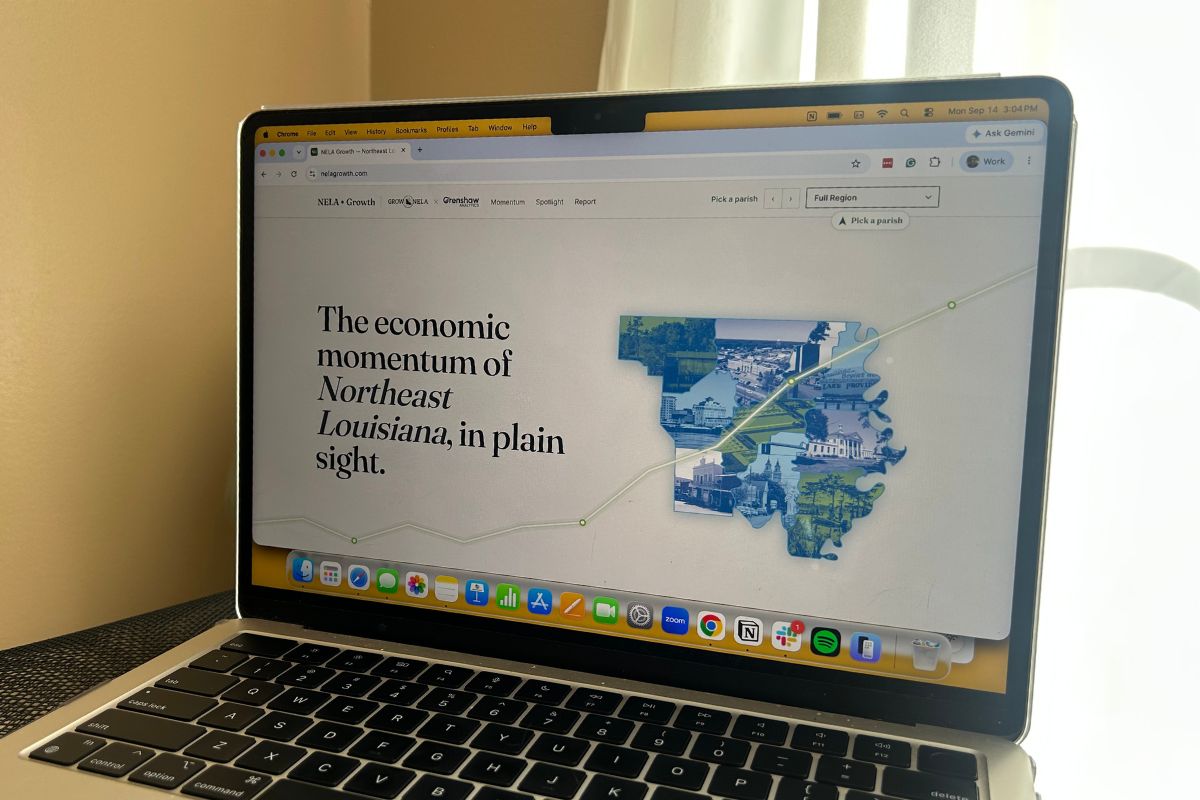
Northeast Louisiana has a new economic growth dashboard, and its key metric is hiding in plain sight: sales tax collections.
Grow NELA’s new NELA Growth tool turns those numbers into interactive, parish-by-parish data, giving the region a new way to track its economic growth quarter by quarter.
“We like that the data was all apples to apples, meaning we get sales tax data for every parish in the state.”
Rob Cleveland, Grow NELA
The nonprofit, which aims to drive economic growth in the region, created the site after tapping Michael Crenshaw of Monroe-based Crenshaw Analytics. It sought to measure the trends and settled on sales tax collections, a common way to track increases in activity over a relatively short period of time.
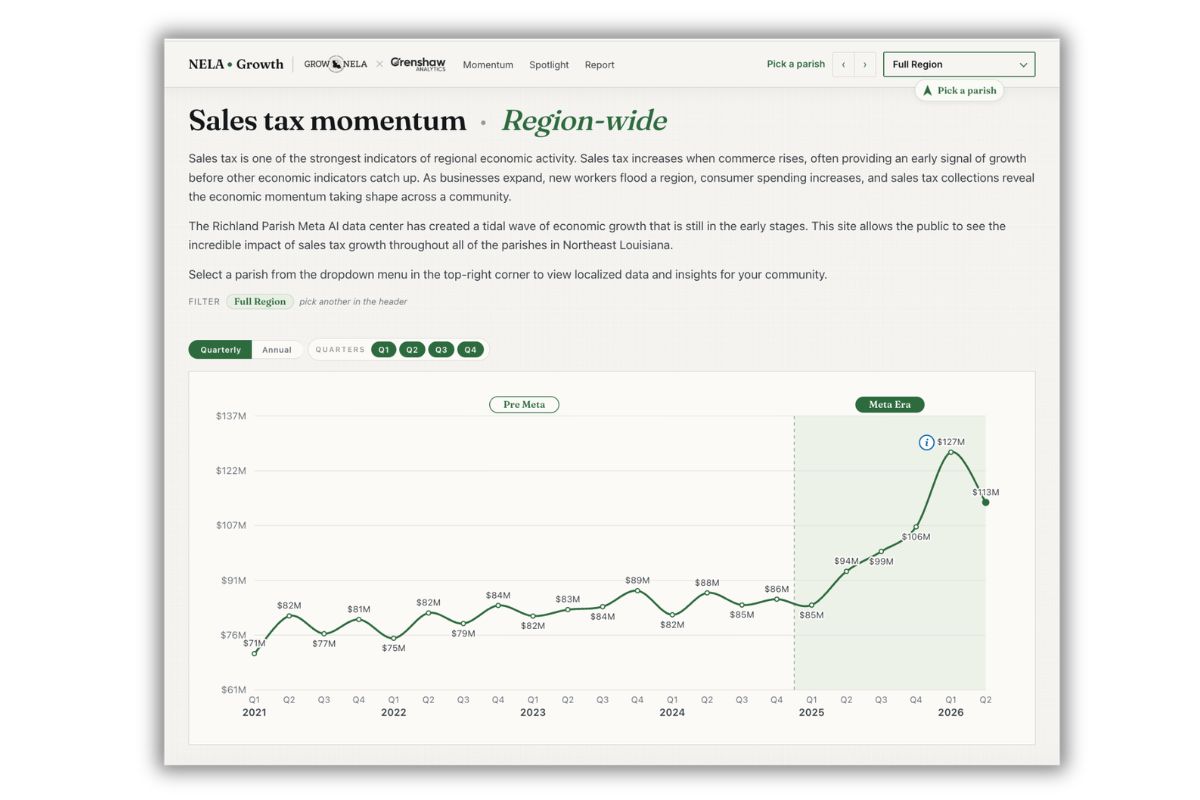
An overwhelming majority of parishes — nine out of 10 — saw an increase in sales tax revenue when comparing Q1 2026 with Q1 of the previous year, according to the data.
Richland Parish, where Meta is building its Hyperion data center, is grabbing the spotlight. Its school board collected $19.65 million in Q1 2026, up from $2.36 million during the same period last year and representing a 732.6% increase in revenue. Its parish police jury saw a nearly identical 734.4% increase when it received $13.10 million, up from $1.57 million in Q1 2025.
East Carroll and Caldwell are parishes that experienced increases as well, but to a lesser extent. East Carroll School Board No. 1 saw revenue increase by 86.9%, while Caldwell’s police jury saw collections jump 99.4% during the same time frame.
The data behind the dashboard
To gather the information, Crenshaw said he used several methods.
“I receive the data from the individual tax administrators that collect and distribute sales tax dollars in their jurisdictions,” Crenshaw said in an emailed statement. “The organization type varies by parish size, some being standalone offices, part of the largest municipality, or even the school board.”
He also explained that, at the moment, users can’t download the underlying data with one click, but they can view it through the site.
“There is no data-download functionality for the end users in the current state,” Crenshaw continued. “The individual files are shared with me in a variety of formats. The ‘Dig into the Numbers’ section is aimed at giving the users a streamlined view of the exact same data in a manner that is easy to view.”
The culminating research results in a website illustrated with quarterly and annual graphs. Visitors can quickly grab nuggets of information, including how much sales tax revenue was collected over five years.
Alternatively, one can do a deep dive by filtering the data by parish or toggling between dollars or percentages when examining categories of growth across Northeast Louisiana.
“We like that the data was all apples to apples, meaning we get sales tax data for every parish in the state,” Rob Cleveland, president and CEO of Grow NELA, said. He also emphasized that it is presented in a format “that everybody can understand.”
Hyperion fuels growth — and controversy
NELA Growth has confirmed some of the chatter about the region’s growth.
The region is undergoing “a tidal wave of economic growth that is still in the early stages,” according to the NELA dashboard. Hyperion, Meta’s largest multi-gigawatt AI cluster, was announced two years ago in Richland Parish.
At the time, Louisiana Gov. Jeff Landry lauded the data center, saying, “Meta’s investment establishes the region as an anchor in Louisiana’s rapidly expanding tech sector, revitalizes one of our state’s beautiful rural areas and creates opportunities for Louisiana workers to fill high-paying jobs of the future.”
The effects from of data center are too big to ignore, Brookley Barnes, Grow NELA’s director of economic development, said.
“These numbers, yes, they are amazing. But it’s how it’s impacting our people in Northeast Louisiana, and it shows that it is,” she said.
The amount of revenue flooding the region will ultimately improve the overall quality of life for residents, attracting higher salaries, increased public safety and upgrades to regional infrastructure, according to Barnes.
Critics aren’t ready to sign on to the project just yet.
Organizations including Earthjustice, the Sierra Club, Union of Concerned Scientists and the Alliance for Affordable Energy are citing concerns about how large-scale energy usage by Hyperion will impact residents, its overall environmental impact and a lack of transparency between municipalities that tout the project and the public.
They say those issues are reasons to halt its expansion.
“Ultimately we understand that there are people who are going to oppose the project, and we understand that,” said Cleveland. “But this has given all of us the opportunity to keep our young people here in the state.”
Morehouse sees a boost, too
Morehouse Parish, which sits adjacent to Richland, has also benefited from the Hyperion buildout, according to the dashboard. Its data shows that schools collected $2.37 million in Q1 2026. This is nearly $400,000 more than the $1.98 million they received in Q1 the year before.
Other key findings include Morehouse opening 2026 with nearly $1 million more in sales tax revenue, while every parish-wide service grew at least 19% to start 2026.
Cleveland said the gains from investments in the region provide an overall positive economic impact.
The dashboard, he said, will be updated quarterly and its immediate goal is to add more data points. Its plans include taking a look at property tax as well as other industry sectors.
“We’re going to use this as a springboard to look at more data points,” Cleveland said, “and then we can continue to push out the positive narrative of what’s happening in the Northeast.”