


This story was made possible through support from TEDCO, the Maryland Technology Development Corporation, which enhances economic empowerment growth through the fostering of an inclusive entrepreneurial innovation ecosystem. TEDCO identifies, invests in, and helps grow technology and life science-based companies in Maryland. Learn more at tedcomd.com. All stories are independently reported, with no partner review.
Startup profile: University Startups
- Founded by: Marc Steren and Jon Jabara
- Year founded: 2020
- Headquarters: Bethesda, MD
- Sector: Edtech
- Funding and valuation: $3.1 million raised at an undisclosed valuation, according to the company
- Key ecosystem partners: TEDCO, Learn Launch
A Bethesda-based startup wants to tackle one of special education’s toughest challenges: helping students prepare for life after high school.
A combination of government guidelines and the complex needs that vary by individual can make transition plans difficult to manage. University Startups developed a platform to help educators manage plans and keep them compliant — and it even adds autonomy by putting some of the decision-making back in students’ hands.
“Our team had to be revamped, but now we’re really dedicated and focused on special education.”
Marc Steren, university startups
“School districts that are out of compliance can lose federal funding. They can have years of audits,” cofounder and CEO Marc Steren told Technical.ly. “It’s a really serious issue.”
The Individuals with Disabilities Education Act (IDEA) requires public schools to develop comprehensive transition plans for students with disabilities. However, federal education data shows most states struggle to meet those standards.
After educators upload a plan, University Startups flags where it falls short of federal or state requirements and suggests fixes, such as adding timelines or including required certifications.
For students, there are hands-on chances to upskill. Students can take a short quiz that generates a “transition readiness score,” which places them in an online curriculum to address their specific needs. For example, a student who scores low in career discovery can take a course to figure out what interests them.
“We believe in self-determination and self-advocacy,” Steren said.
A crowded market pushed University Startups to a new mission
University Startups originally launched as a completely different venture — a way to get high school students interested in entrepreneurship.
During the pandemic, Steren and a fellow Georgetown University professor taught an online course on entrepreneurship as a “force for good.” A philanthropic foundation took notice and asked the group if they could bring that curriculum to under-resourced high school students.
After a few years, they realized the entrepreneurship education space was becoming oversaturated, with competitors like Naviance.
“It was super crowded,” Steren said, “kind of a race to the bottom.”
The founders turned to their school partners for inspiration. When one educator confessed that maintaining IDEA compliance kept her up at night, the team pivoted.
In 2025, they brought on special education experts, redesigned the platform and refocused the company.
“Our team had to be revamped,” Steren said. “But now we’re really dedicated and focused on special education.”
Scale to more schools and more use cases
Currently, the startup serves school districts across 18 states, with its largest contract being New York City Public Schools’ Transition and College Access Centers. The company also works with prison systems, including the Utah Department of Corrections and Delaware Youth Rehabilitative Services.
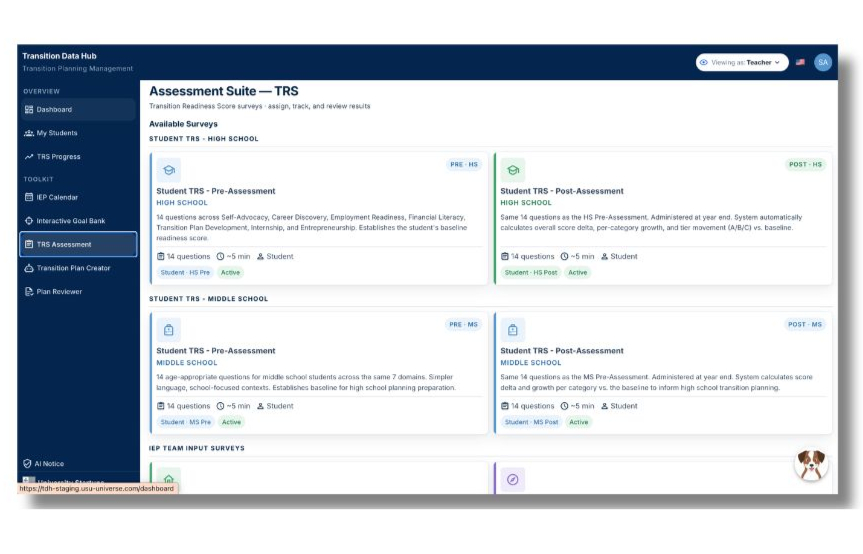
Next spring, University Startups will partner with a prison system on Maryland’s Eastern Shore. The company tailors its software to support incarcerated individuals with disabilities as they prepare to reenter civilian life.
“They use our software to transition into the community and find a better job,” Steren said, “a job that fits them and their disability.”
The company is also expanding internationally.
University Startups’ software is embedded into Classera, an education management platform widely used across the Middle East. As part of this expansion, Steren said, the startup plans to train 100 teachers in Saudi Arabia in November