
Startup profile: Geaux River
- Founded by: Robert LeBlanc (CEO) and Landry Kirk (COO)
- Year founded: 2025
- Headquarters: New Orleans, LA
- Sector: Maritime data infrastructure
- Funding and valuation: $300,00 raised at an undisclosed valuation
- Key ecosystem partners: Boot64 Ventures, VillageX (IdeaVillage), Greater New Orleans, Inc., LED, Gulf Coast Defense Catalyst
The towboat industry moves billions of dollars’ worth of cargo along US waterways, but much of its day-to-day operation still depends on handwritten records, wired equipment and software that doesn’t talk to itself.
Geaux River, a New Orleans startup founded by longtime towboater Robert LeBlanc, is building technology to address those gaps. Founded in October 2024, the company offers ways to track vessels, collect weather and waterway data and connect boats, barges and service providers.
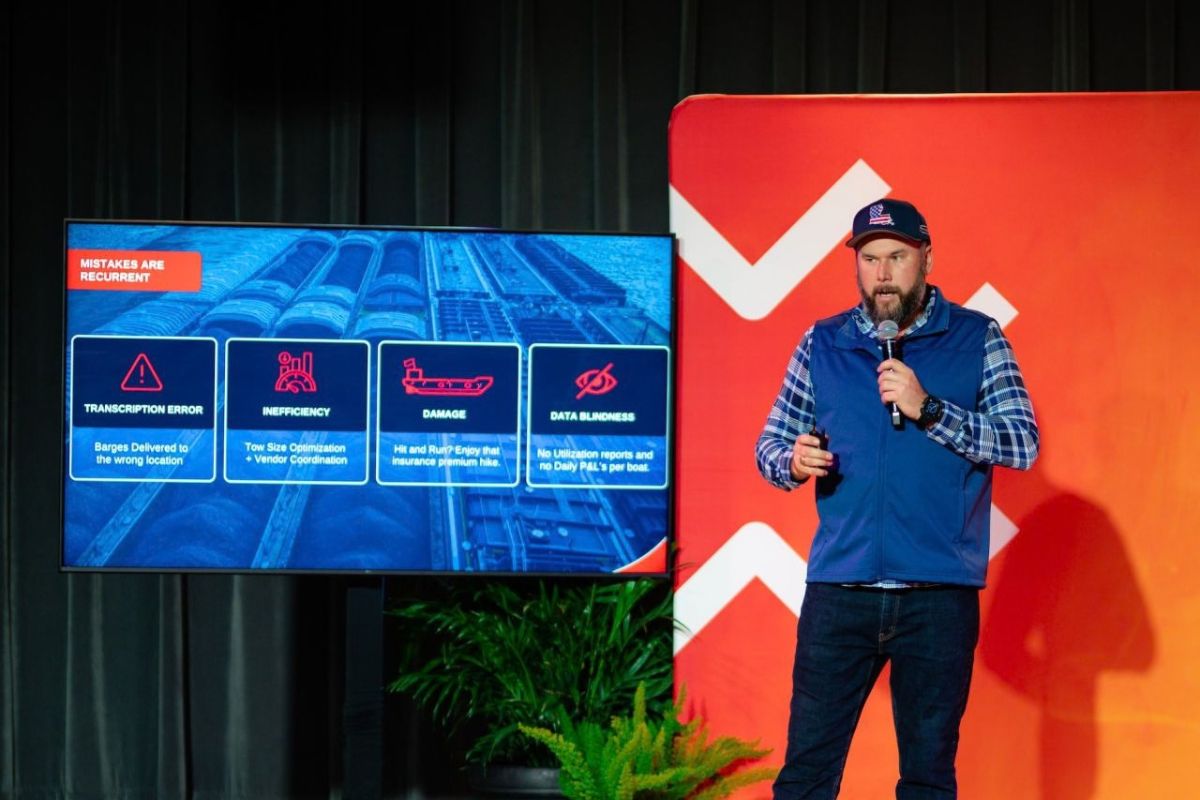
LeBlanc refers to the Geaux River team as “a bunch of towboaters building towboat technology.”
“We’re not from Silicon Valley,” LeBlanc said. “We’re built on the Bayou where a startup sounds like a diesel engine.”
LeBlanc entered the industry as a deckhand in college. Over 15 years, he worked his way through the ranks and identified some of its most costly issues — whether financial, energetic or temporal. He became frustrated that operating and tracking a towboat required multiple programs that didn’t communicate with each other. The result was a lot of redundant work.
His inner solution seeker activated.
In 2021, LeBlanc began building a system to wirelessly transmit depth data. The work resulted in its patent-pending Sounder System, which sends data without relying on cellular, satellite, Wi-Fi or Bluetooth technology.
LeBlanc left his full-time job at a marine products company in October 2026 to focus on Geaux River.
Firsthand maritime knowledge to new tools
LeBlanc refers to the Geaux River team as “a bunch of towboaters building towboat technology.”
He and cofounder Landry Kirk, CTO Carl Fravel, VP of Sales Gary Chilcutt and VP of MarineOT and Product Development Tony Geeck have drawn on their years of industry experience to develop systems such as Geaux Wireless, which sends real-time data between vessels and facilities.
“A lot of what we are building doesn’t exist, and we are creating the first devices that are actually capturing data or solving a problem,” LeBlanc said. “Can’t harness data if there ain’t any yet.”
BargeBeacon uses cellular and satellite signals to track barges and alert users when they stray from planned routes. Its forthcoming Barge Collision Detection System will use the same technology to alert teams to possible impacts and show nearby vessels.
Geaux River’s Live Vessel Tracking system uses remote, solar-powered cameras to track boats in real time. The latest version was deployed Aug. 28 at NewLab Bywater to monitor Algiers Point and the Industrial Canal.
The company also has a geofencing system that alerts users when vessels enter designated areas. For inspection companies, that can mean an alert when a vessel due for inspection is nearby rather than every time a vessel enters the area.
$300k raised, targeting about $750k in startup funding
LeBlanc initially used his own money to start Geaux River. After graduating from the VillageX accelerator in April 2026, his mentor, Corey Tisdale, invested $100,000 through Eye Want Media.
Boot64 Ventures invested another $200,000 and has the option to invest an additional $300,000.
Rather than raise a pre-seed or friends-and-family round, LeBlanc covered the initial costs himself and avoided giving up equity at an early stage.
Geaux River is seeking $750,000 through a SAFE agreement, with the company valued at $7.5 million for purposes of the agreement.
The remaining $450,000 is expected to close by the end of November, and the company plans to seek about $20 million in a Series A round in 2027.
Defense technology finds a broader network
Some of Geaux River’s technology can be used by both businesses and government agencies, known as dual-use.
One example is its Remora Defense System, which the company first publicly showcased at a Gulf Coast Defense Catalyst event and demonstrated for participating Navy commands.
“This system combines autonomous drones enabled with machine learning to detect malicious payloads attached to a ship’s hull before that ship is allowed to enter a US port,” LeBlanc said.
The same technology could also be used commercially to monitor a ship’s anti-fouling paint, which prevents marine life from attaching to the hull and slowing the vessel down.
Geaux River plans to build a network connecting tugboat industry vendors, brokers, operators and other companies. The goal is to give business owners, captains and government agencies such as the Coast Guard, Army Corps of Engineers and US Navy a way to find resources and communicate.
He described the company’s rapid development as a “force of sheer will,” adding, “I look at the industry as an airfield and each challenge as a launch pad. I’m continually building upward.”