

This story was made possible through support from TEDCO, the Maryland Technology Development Corporation, which enhances economic empowerment growth through the fostering of an inclusive entrepreneurial innovation ecosystem. TEDCO identifies, invests in, and helps grow technology and life science-based companies in Maryland. Learn more at tedcomd.com. All stories are independently reported, with no partner review.
Startup profile: BlueHealer
- Founded by: Jay Tailor, Santiago Rentería and Mitchell Lipke
- Year founded: 2024
- Headquarters: Baltimore, MD
- Sector: Biotech
- Funding and valuation: $135,000 in non-dilutive funding, according to the company
- Key ecosystem partners: TEDCO, Harbor Designs and Manufacturing, Pava Center for Entrepreneurship
Each year, federal data show roughly 150,000 Americans undergo a lower-limb amputation due to chronic illness.
Baltimore-based startup BlueHealer is developing a device that could help save some of those limbs — inspired by what cofounders witnessed while studying biomedical engineering at Johns Hopkins University.
“We even had an uphill battle going against our own faculty.”
Jay Tailor, BlueHealer
“We were in the operating rooms where these decisions were happening,” cofounder and CEO Jay Tailor told Technical.ly, “where surgeons were running out of options.”
BlueHealer is embracing an increasingly popular surgical approach known as Tibial Transverse Transport or TTT. The process involves cutting out and moving a small part of the tibia, the large inner bone of the lower leg, to improve blood flow. Chinese orthopedic surgeons helped develop the technique, which doctors now use in more than 10 countries, according to Tailor.
Diabetes and arterial disease are the main culprits behind non-traumatic amputations. Both conditions restrict blood flow to the limbs, particularly the legs. Because the symptoms build up slowly, the severity can often go unnoticed until surgeons are left with no option but to amputate.
Lower-income communities are hit far harder by amputations, with less affluent Americans with diabetes four times more likely to lose a limb. It is also one of the starkest healthcare disparities between Black and white residents, with Black patients being four times as likely to undergo an amputation.
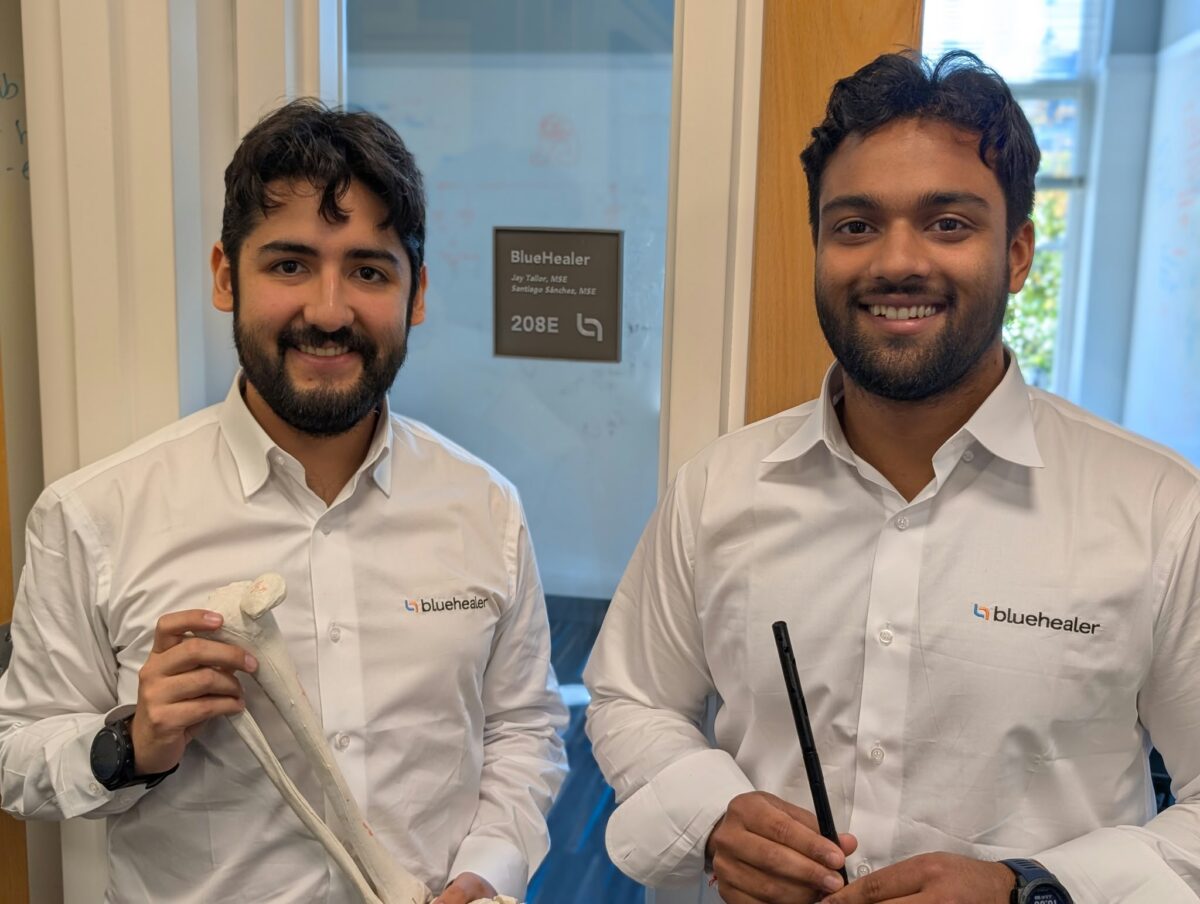
Competitors use an external frame to move the bone. BlueHealer is designing an internal device.
“Everyone is trying to prevent an amputation,” Tailor said. “This is just another tool in the toolkit to supplement what already exists.”
While this approach may not be right for every patient, particularly those with an active infection, it provides another treatment option.
External devices can also come with complications, Tailor said, including infections where the pins enter the skin and an increased risk of fractures. For some patients, internal devices may offer a safer and more practical alternative.
The next potential gold rush
In 2024, when Tailor and his cofounders pitched the TTT process to one bioengineering faculty member at Hopkins, they were met with immediate skepticism.
“His first reaction was, ‘This is batshit crazy,’” Tailor said. “We even had an uphill battle going against our own faculty.”
Over the course of their graduate studies, more products began marketing around TTT. The professor eventually came around.
In September, trade outlet Foot and Ankle News even deemed TTT technology the next potential industry gold rush. BlueHealer is ready to throw its hat in the ring, according to Tailor.
“Now with other competitors on the market,” Tailor said, “[the professor has] completely switched.”