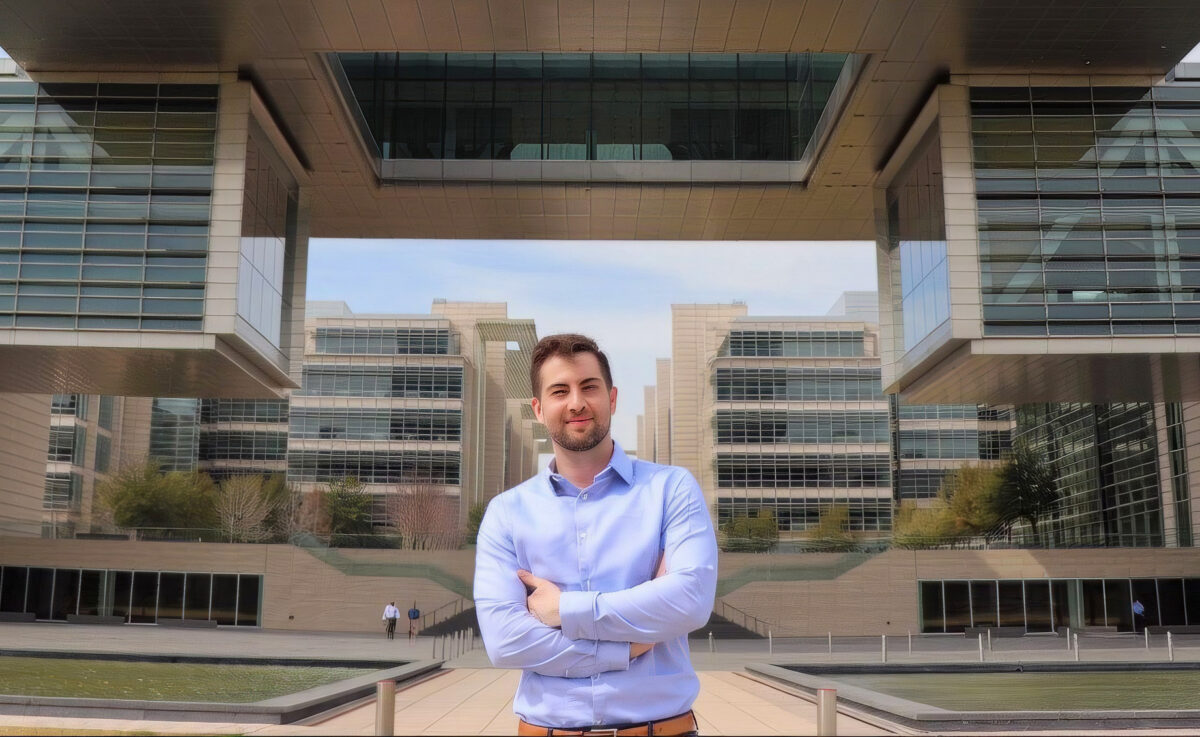
Being a builder and being a founder don’t always go hand in hand.
For some entrepreneurs, building means starting with an idea, raising money and creating a company from the ground up. For Luke Villermin, it means something different.
The Lafayette entrepreneur is searching for one “exceptional” US business to acquire through his company, Glass Bay Capital. With up to $100 million to spend, Villermin says, he isn’t looking to build a portfolio or become a passive investor. He wants to buy something, take over as its full-time operator and spend the next chapter of his career building it.
It’s a model known as entrepreneurship through acquisition, or ETA.
“I’ve wanted to own and run a business for a long time, but I don’t think my path to that is inventing the next great consumer app from zero,” Villermin explained. “I’m much more drawn to taking something that already works, learning why it works and figuring out how to make it better.”
“I’m looking for a business that provides something its customers critically need and has earned their trust over a long period of time.”
Luke Villermin
Glass Bay Capital has its targets set on businesses with annual revenue between $5 million and $50 million, prioritizing strong customer relationships, recurring revenue, good margins and industries with room to grow.
“I’m looking for a business that provides something its customers critically need and has earned their trust over a long period of time,” Villermin said.
The ETA model has gained traction nationally, with Stanford Graduate School of Business tracking 862 search funds formed in the United States and Canada from 1984 through 2025. Historically, 58% of completed searches resulted in an acquisition, although that may be changing: Between 2021 and 2024, fewer than half (48%) of funds made a targeted purchase.
One of the model’s most striking success stories is Asurion. In 1995, two Stanford graduates acquired an $8.5 million roadside-assistance company through a search fund. By building on that business and expanding into cellphone protection, they helped create a company that reached more than $10 billion in annual revenue by 2026.
Louisiana’s ETA ecosystem is harder to quantify. Axial, a merger and acquisition marketplace, listed 12 active Louisiana search funds in September 2026, but there is no comprehensive statewide count of entrepreneurs using the broader acquisition model..
It’s about strong fundamentals, not price
Villermin’s first question when evaluating a potential acquisition is straightforward: Why do customers keep coming back?
“If customers stay because the company has specialized expertise, provides a mission-critical service, has exceptional people or has spent decades earning trust, that’s interesting to me,” he told Technical.ly. “If the answer is basically ‘We’re the cheapest,’ that’s much less interesting.”
Villermin is equally mindful of what he believes would make a company a poor fit for acquisition: dependence on a single customer, key employee or owner, high customer turnover, poor cash flow or structurally declining industries.
The personal relationship with the current owner is also a critical factor, because he expects that person to help ensure a smooth transition and provide invaluable mentorship. He wants to understand what made a business successful before deciding what needs to change — ideally preserving the relationships, culture and practices that have served the company, while still finding opportunities to improve it.
“If I buy a company that’s been around for decades, my assumption isn’t that I arrived with all the answers,” he said. “I would want to understand what employees and customers believe makes the company special before changing anything.”
Glass Bay’s search is now Villermin’s full-time focus, but he’d been developing the idea for some time. He spent nearly seven years at ExxonMobil in commercial, supply chain, business development and operational roles before leaving to get an MBA at Northwestern University’s Kellogg School of Management.
“It’s been a gradual progression rather than one moment where I decided, ‘I’m going to buy a company,’” Villermin said. “Over time I became increasingly interested in owning a business myself.”
While at Kellogg, he studied entrepreneurship through acquisition and spoke with business owners, investors and other entrepreneurs. During his second year, he raised the initial capital for Glass Bay, primarily from experienced entrepreneurs and investors, many of whom are current or former CEOs. The funding covers the cost of the search itself, including his salary, travel and research, as he looks for the right business to acquire.
“I raised the money to fund the search first,” Vilermin said. “The much larger pool of acquisition capital comes together once there is an actual business to purchase. hat means the $100 million represents a target acquisition capacity, rather than necessarily being cash sitting in an account today.”
More than ‘just a financial asset’
Glass Bay’s nationwide search for an acquisition target officially began in August of this year.
Villermin is considering businesses already on the market as well as reaching out directly to owners who may not be actively looking to sell.
So far, he has screened hundreds of companies, visited a handful of owners and spoken with dozens of industry experts. Those conversations have helped him understand businesses beyond what financial records and online research can reveal.
“I’ll call somebody who has spent 30 years in an industry and explain that I’m trying to understand it,” Villermin said. “And it’s amazing how often they’ll spend an hour walking me through how the industry actually works.”
Villermin isn’t focused on closing a deal as quickly as possible. He first evaluates what a company does, why customers buy from it, how its industry is changing and whether its financials meet his criteria. If it passes that initial screen, he’ll speak with the owner or broker, sign a mutual nondisclosure agreement and investigate further before potentially making an offer..
“For an owner who has spent 20, 30 or 40 years building a company, this isn’t just a financial asset,” he said. “Their name may be on the building. Their employees may have been with them for decades. Their customers may have become friends.”
Villermin wants those owners to know he’ll take that responsibility seriously and work to build on what they’ve created: “I’m going to care about what they built, learn from them, take care of the people who helped build it and then work extremely hard to make the next chapter a good one.”
For now, the search continues. Villermin has spent years preparing to become a business owner.
“It took several years to get here, but the goal now is very simple,” Villermin said. “Find one exceptional business to partner with.”