When people think of the government, they mostly think of policy, elections and the TSA. But here in the DMV, there’s a lot more to it.
Beyond where funding decisions are set on the Hill, there’s an entire federal innovation ecosystem of entities advancing science, developing new technologies and making material inventions everyday.
Investments in national security by venture capital have increased dramatically.
From communications, physics and science at NASA Goddard that helps us understand and navigate our universe, to expanding our operational readiness, national security and homeland defense at the Johns Hopkins University Applied Physics Laboratory, to hardening cybersecurity defenses and advancing cryptologic science at the National Security Agency, just to name a few, the greater Washington metropolitan area is home to some of the world’s most advanced research and development.
It’s also become home to one of the most active defense technology startup communities in the country.
Investments in national security by venture capital have increased dramatically. Startup-friendly engagement opportunities from defense primes including Northrop Grumman and SAIC among others ignite collaboration with new entrants.
Active participation in the community from programs such as the US Army Pathway for Innovation Technology, the Department of Homeland Security non-profit partner organization HSWERX, and federal agencies including CISA, DIU and the Office of Strategic Capital, signify a commitment to accelerated startup collaboration with government.
Vehicles such as CRADAs (Cooperative Research and Development Agreements) between federal labs and non-federal entities, SBIR (Small Business Innovation Research) Phase II contracts, and STRATFI (Strategic Funding Increase) and TACFI (Tactical Funding Increase) funding that can be awarded matching private venture capital 1:1 for defense and dual-use technology companies, solidify the dollars to back that commitment collaboration.
A rising conversation on the economic impact of defense tech and newsworthy developments such as the $3.5B investment of private capital into the region by defense tech unicorn turned neo-prime Anduril represent the industry’s reach far beyond insiders and into our communities.
These convergent trends and emergent discussions make it ever more important to recognize the people doing the work behind these innovations. Within and beyond each of these organizations are scientists, engineers, strategists, physicists and technologists leading the charge. Not only are they working to invent and deploy next-generation technologies, but to devise solutions to hard national security problems that will bolster our collective well-being, and push humanity further.
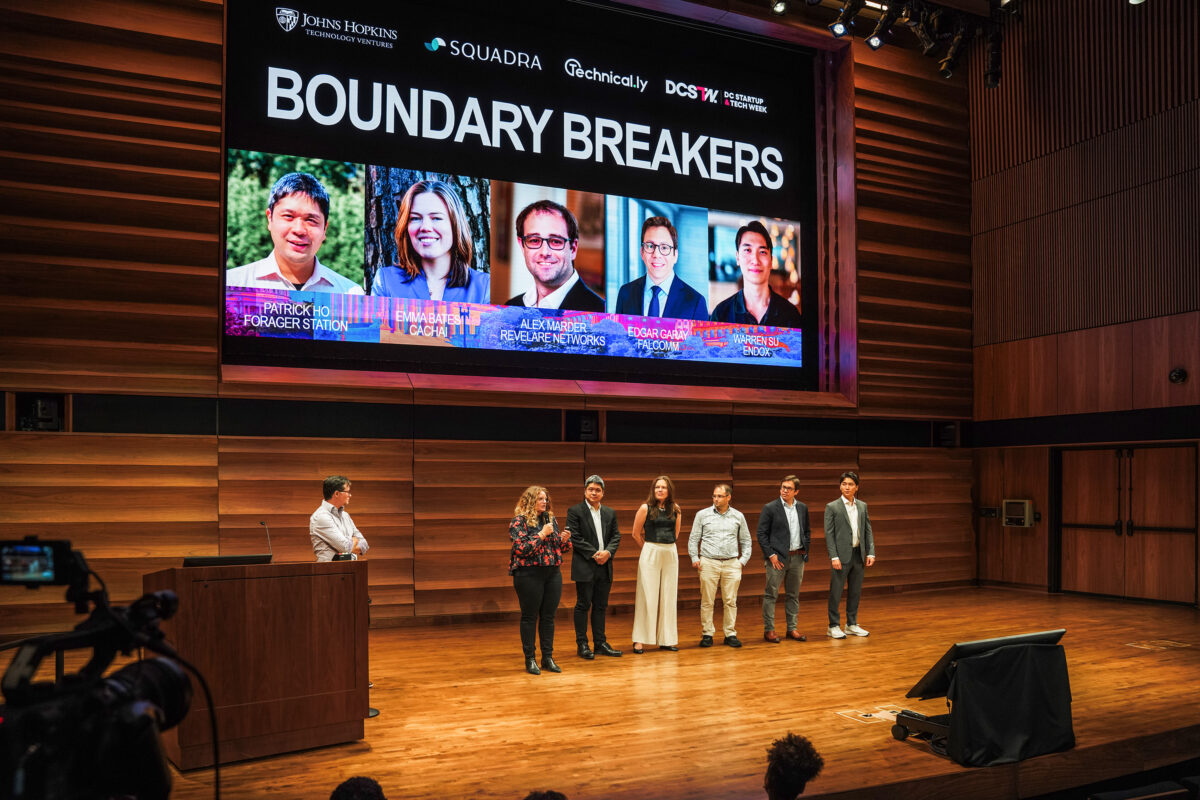
Back for the second year on Tuesday, Oct. 20, is “Boundary Breakers: A Showcase of Critical Technology Innovations in National Security,” an official event on the DC Startup & Tech Week lineup.
Entrepreneurs, technologists, investors, policymakers, government stakeholders, service members and curious community members are invited to convene at the Johns Hopkins University Bloomberg Center for an evening of lightning talks from innovators breaking the boundary between the lab and the field.
Topics range from quantum dots to drone detection to a ‘nanomaterial foundry’
This year’s speakers include:
• Priyarshini Ghosh
Ghosh is a nuclear physicist at the NASA Goddard Space Flight Center. She has served as the principal investigator of nuclear data measurements with experiments at CERN, Brookhaven National Lab, and the Facility for Rare Isotope Beams at Michigan State University, and as the co-principal investigator of an astrophysics mission set to launch to the International Space Station in 2027. With a background in chemistry and nuclear physics, Ghosh has invented a new type of radiation detection technology using quantum dots. Ghosh earned her PhD in nuclear engineering from Kansas State University.
• Katherine Hathaway
Hathaway is the founder of Lead Element, a veteran-owned venture focused on translating experience in military operations, strategy, emerging technology, and design into practical defense applications. Following 10 years in the US Army, Hathaway’s journey has taken her through Fortune 100 operations, federal disaster response with FEMA, and to national security challenges at the Johns Hopkins Applied Physics Laboratory. Hathaway is in the process of completing a dual MBA and MA in design leadership through Johns Hopkins Carey Business School and the Maryland Institute College of Art.
• Toby Magsig
Magsig is the CEO of Shift5, an operational intelligence platform for defense and transportation systems. Prior to joining Shift5, Magsig served as vice president and general manager of Enterprise Autonomous Solutions at L3Harris, and served for 26 years in the US Army. There he commanded the Joint Modernization Command at Army Futures Command, where he integrated over 110 future technologies across all five armed services, embraced agile development models, and led the Army’s largest annual experiments. He also commanded a 4,500-member airborne infantry brigade and deployed to combat twelve times across Iraq and Afghanistan. Magsig is a graduate of the United States Military Academy at West Point and holds an MA in organizational leadership from Columbia University.
• Matteo Pietrobelli
Pietrobelli is the CEO and co-founder of Gargoyle Systems, a startup building passive, distributed drone detection systems. Pietrobelli started as a structural engineer uniquely developing a cyberphysical structural health monitoring system on the Governor Cuomo Bridge. He then served as CTO of HyperloopTT where he led systems engineering for control, life support and safety-critical architectures. Pietrobelli now takes on these problems to unify awareness of airspace over critical infrastructure, campuses, stadiums and cities. Pietrobelli holds a master of science in systems engineering from the Johns Hopkins Whiting School of Engineering among other post-graduate studies at MIT, Caltech and the University of Arizona.
• Ryan Ratcliffe
Ratcliffe is a career Marine officer, having flown combat deployments in the EA-6B Prowler, worked as a strategic liaison to the Intelligence Community, served as the Marine aide-de-camp to the chief of naval operations, and now as a special operations air officer in the reserves. Ratcliffe’s career progression has taken him through the information ecosystem, seeing firsthand how leaders make decisions. As his talk will discuss, AI is reshaping the information domain; whether it will sharpen judgment or drown it is one of the defining national security questions of our time. Ratcliffe earned his master of international public policy from the Johns Hopkins School of Advanced International Studies.
• Sloane Tilley
Tilley is the CEO of Aegilys, a startup building the first domestic additive nanomaterial foundry set to pioneer advanced manufacturing for novel electrochemical products and applications. An environmental scientist by training, Tilley has worked across the biotechnology industry from global companies to deep-tech startups; she was inspired to start her own company after a severe personal accident landed her with firsthand experience of how much of human biology remains a black box. Tilley is a multi-time IRONMAN and a graduate of the Fuqua School of Business.
The evening will begin at 6 p.m. with light refreshments, followed by lightning talks, wrapping up with an hour of networking at 8:30 p.m.
All are welcome to attend; register at https://luma.com/boundarybreakers.
This event is hosted in partnership by Squadra Ventures, Johns Hopkins Technology Ventures, the Emerging Technologies Initiative at the Johns Hopkins School of Advanced International Studies and Technical.ly.