
Some voters going to the polls in the Philly metro area will be checked in on Apple iPads. In other places, poll workers will use a Microsoft Surface tablet.
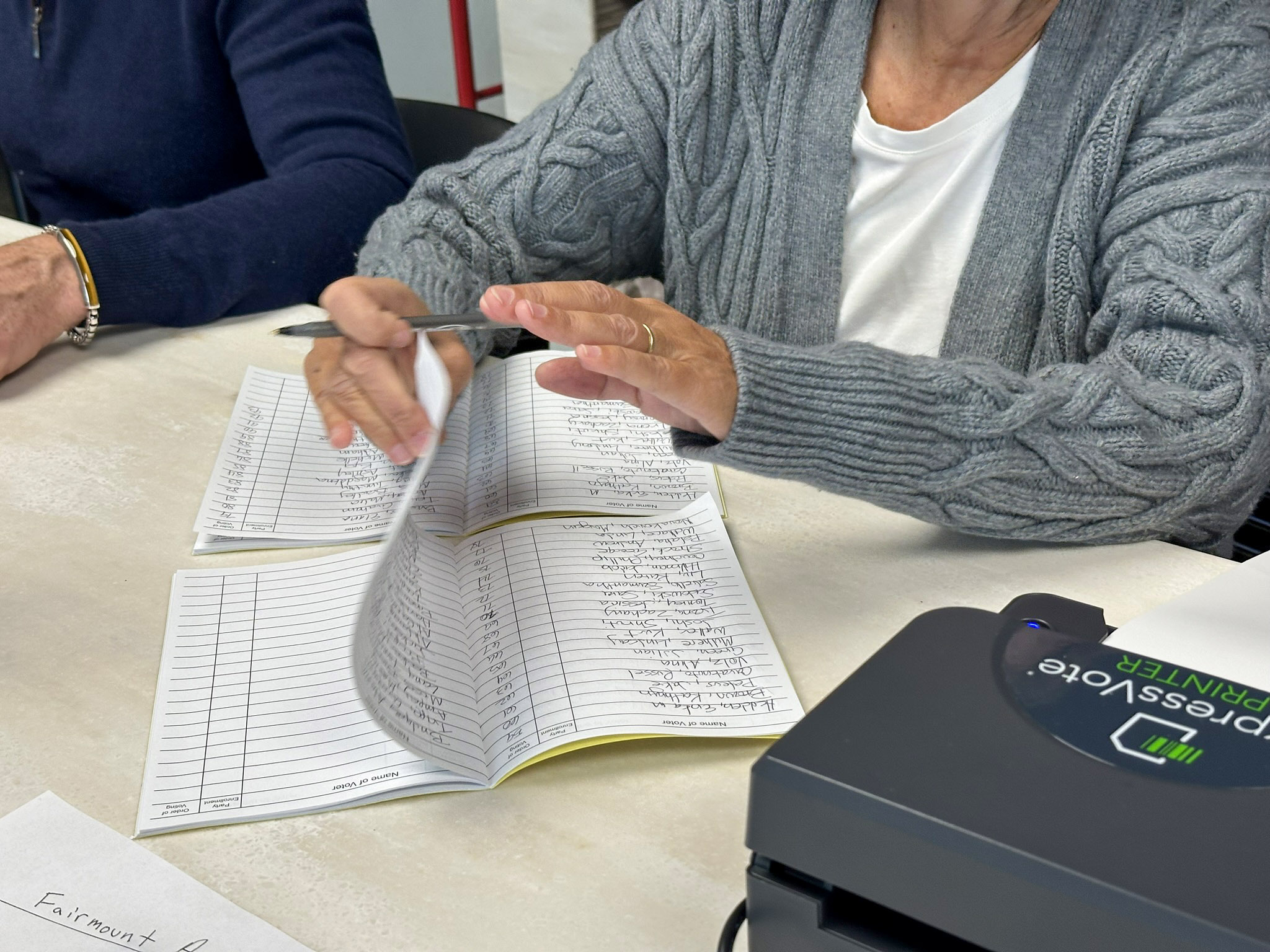
And in Chester County, they’ll still turn the pages of a paper book.
Philadelphia and its four collar counties use varying systems to confirm registration and issue the correct ballot to each voter on Nov. 3, according to official records viewed by Technical.ly.
Most use electronic pollbooks (e-pollbooks), which can simplify check-ins but need a strong backup plan, said Pamela Smith, president and CEO of Verified Voting, an organization that advocates for responsible technology use in elections.
“[E-pollbooks are] a great tool. If they don’t work, they can really slow things down,” Smith told Technical.ly. “People are really paying attention to: What’s plan B?”
“If they don’t work, they can really slow things down. People are really paying attention to: What’s plan B?”
Last spring, Technical.ly and Bucks County Beacon submitted open records requests to each county to find out more about their backup plans, and learn what training and guardrails they have to make sure the tech doesn’t disrupt voting.
E-pollbooks gained popularity because they make it easier to look up voters and confirm their identities, speeding up check-in, Smith said. They also allow poll workers to update voter information in real time and simplify the process of reconciling votes after the polls close.
But problems with pollbooks have put Pennsylvania’s voter check-in systems under scrutiny. In 2025, an e-pollbook in Fayette County wasn’t updated in time, leading to errors in tracking who had voted.
That same year, Chester County showed that the risks aren’t limited to electronic systems. The county, along with more than 30 others in Pennsylvania, still relies exclusively on paper pollbooks. An error in preparing Chester County’s printed voter lists left off voters registered as independents or with third parties. The problem disrupted check-in and led to increased use of provisional ballots.
Chester County has since explored switching to an electronic system, issuing a request for information about e-pollbook vendors last spring. Based on the records Technical.ly received, however, the county has not yet selected a vendor or signed a contract.
Delaware County did not provide documents in response to Technical.ly’s request. Records from the other counties offer a closer look at the technology used across the Philly metro region and how election officials prepare for Election Day.
State rules govern pollbook security and connectivity
Pennsylvania requires e-pollbooks to receive state approval and meet standards for security and connectivity. Its requirements also call for contingency plans to address equipment failures and preserve the voter check-in process.
Counties that choose to use e-pollbooks must select a system from the list of options approved by the Pennsylvania Department of State. The state evaluates the technology and outlines how it can be used within state standards.
One question the state has explored is whether e-pollbooks should be allowed to connect to the internet during elections. Right now, e-pollbook systems cannot be online on election day.
FAQ: E-pollbooks in Southeastern PA
What are electronic pollbooks?
Electronic pollbooks are digital devices used by poll workers to confirm voter registration and issue the correct ballot on Election Day. Across Philadelphia and its four collar counties, jurisdictions use different systems: Montgomery, Bucks, and Delaware counties use Knowink Poll Pads, Philadelphia uses ES&S ExpressPoll systems and Chester County exclusively relies on paper pollbooks.
Can e-pollbooks connect to the internet during an election?
No. Pennsylvania requires e-pollbooks to remain offline during voting. The state had planned a pilot program to test internet connectivity during the May 2026 primary, but postponed it until at least 2027. Knowink Poll Pads operate in a local peer-to-peer mode, while ES&S ExpressPoll units connect through a local wireless router without internet access.
What security protections are built into e-pollbook systems?
Both major systems meet AES-256 encryption standards to protect voter data. State certification requirements and county safeguards are designed to reduce cybersecurity risks, though overall security also depends on proper system configuration, maintenance and use.
How do election officials handle technical failures or lost connections?
Counties are required to have state-approved contingency plans. If a device encounters problems, poll workers attempt troubleshooting, follow guidance or contact city and county election hotlines for technical support. If electronic systems fail entirely, workers pivot to backups such as up-to-date paper voter lists, backup paper pollbooks or provisional ballots.
What problems have occurred with e-pollbooks in PA in the past?
In 2025, Fayette County in Southwest PA used an outdated electronic voter file for its e-pollbooks, which incorrectly indicated that some voters had already cast ballots. Poll workers had to switch to backup paper records to resolve the issue.
Are paper pollbooks immune to errors?
No. Paper pollbooks carry their own risks. For instance, during the November 2025 election, Chester County’s printed pollbooks accidentally omitted voters registered as independents or with third parties due to an error in preparing the voter lists, disrupting check-ins and increasing provisional ballot use.
What do experts advise voters to do on Election Day?
Verified Voting President and CEO Pamela Smith advises voters not to worry about underlying check-in technology. “Voters should not be concerned. Voters should just go vote,” she said, noting that election officials and workers handle potential scenarios behind the scenes.
Pennsylvania had planned to test internet connectivity during the May 2026 primary, inviting volunteer counties to evaluate the potential benefits and drawbacks. Strict limits and a small sample size were intended to minimize risk.
Shortly before the election, however, the state postponed the test until at least 2027, citing low interest and unresolved technical questions.
Connectivity is also a cybersecurity concern. E-pollbooks can introduce risks, including unauthorized access to voter information and compromised or inaccurate records. State certification requirements and county safeguards are designed to reduce those risks, but security also depends on how a system is configured, maintained and used.
Incidents involving election technology can also undermine public confidence. Research from the Georgia Institute of Technology has found that cyberattacks can hurt voters’ trust in elections.
The technology behind electronic voter check-ins
Two e-pollbook systems are used in southeastern Pennsylvania. They differ in how devices communicate offline.
Montgomery, Bucks and Delaware counties use Knowink Poll Pads. According to the Secretary of the Commonwealth’s latest evaluation, the system is prohibited from connecting to Knowink’s cloud server, ePulse, on Election Day. The tablets can still operate in “peer-to-peer mode,” allowing them to share information locally without an internet connection.
Philadelphia uses ES&S ExpressPoll e-pollbooks. The county uses a wireless router that operates without an internet connection, creating a local network where pollbooks at the same polling place can share updates to voter check-in records.
The systems also use different hardware. Poll Pads run on Apple iPads, while ExpressPoll uses Microsoft Surface Go tablets. Both meet AES-256 encryption standards to protect voter data.
Despite those differences, both systems are designed to help poll workers check in voters efficiently and securely, Smith said.
Preparing for pollbook problems on Election Day
Even systems designed to work offline can encounter problems. A device might fail to start, a poll worker might be unable to look up a voter’s registration, or a technical issue might prevent check-ins from being recorded correctly.
Having a backup is only part of the solution. Poll workers need to know when to use it and who to contact for help.
Election officials can reduce the risk of disruptions by testing pollbook systems before Election Day, verifying voter data and training workers to respond to problems, Smith said.
Philadelphia’s poll worker guidelines outline troubleshooting steps for connection errors, including how to restart the system. If the issue persists, workers are instructed to contact the city’s election hotline. If that doesn’t resolve the issue, a technician is sent to the polling site.
According to the vendor, ES&S, the system is designed to operate offline, and the city’s training guide says check-ins can continue if a connection is lost.
Philadelphia’s published guidance does not fully explain how the city reconciles voter check-ins if workers must switch to paper records.
If troubleshooting doesn’t resolve a problem, workers need another way to check in voters. Pennsylvania’s e-pollbook requirements call for contingency measures to preserve voter data and ensure poll workers can access the voter list.
In practice, that can mean keeping an up-to-date paper voter list and check-in records available, along with instructions for recording voters during an outage and reconciling those records with the electronic system afterward.
Depending on the situation, it could also mean keeping backup paper pollbooks or provisional ballots ready to go, Smith said.
“[Having] backups already in place,” she said, “and the poll workers knowing when to deploy them is a very strong mitigation.”
For Smith, the goal is to ensure that technical problems remain manageable and don’t keep eligible voters from casting their ballots.
“Voters should not be concerned. Voters should just go vote,” Smith said. “There are a whole lot of other people that worry about these things … and that look at all the possible scenarios and try to resolve them and solve for them on Election Day.”