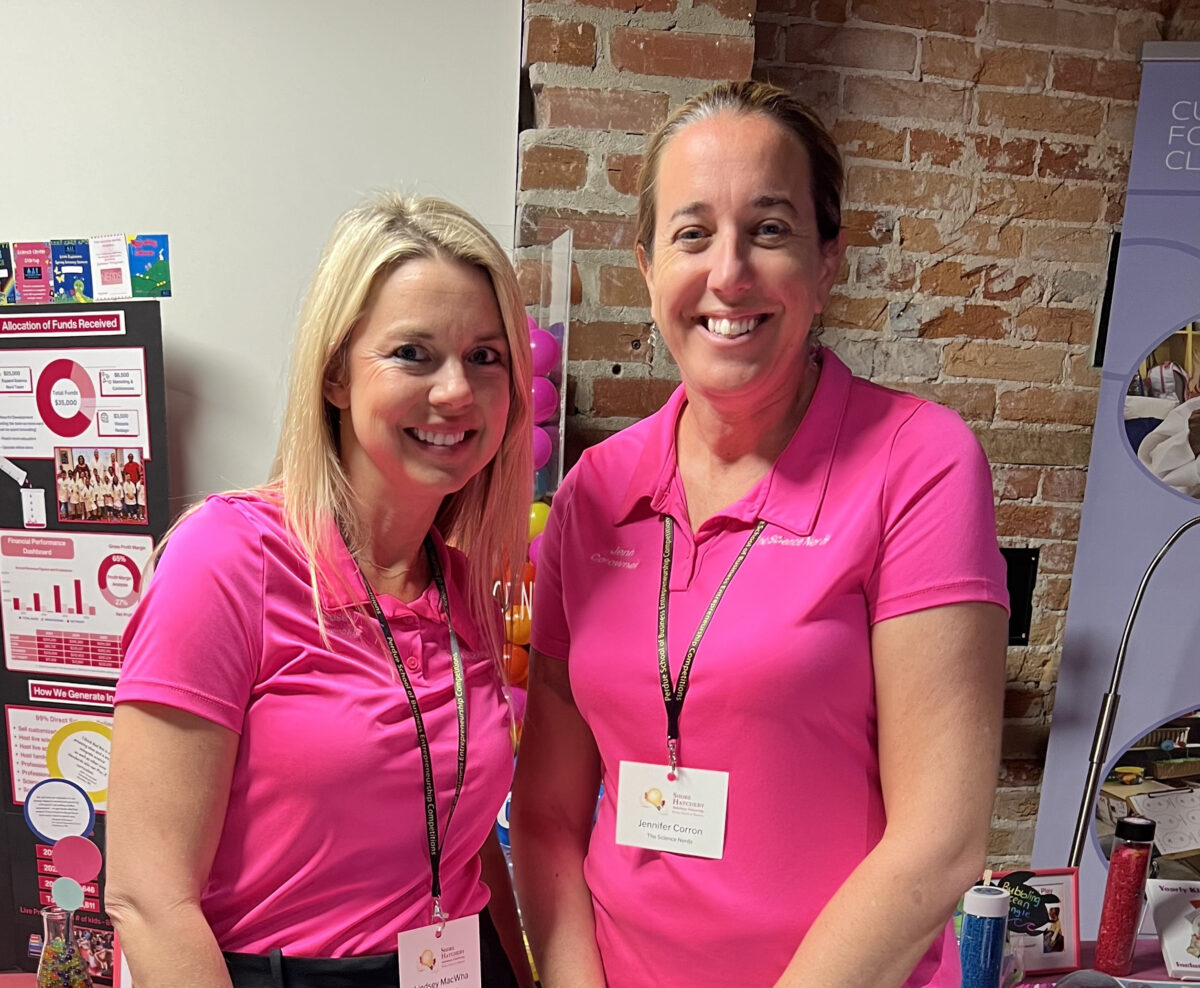
When the pandemic forced science classes online, a pair of Eastern Shore teachers bemoaned the loss of fun, hands-on experiments.
“We both had little nieces and nephews coming home and saying they weren’t doing any science,” Jennifer Corron said. “Everything was on the iPad.”
“Don’t be afraid to ask other people for help.”
Lindsey MacWha, The science nerds
Corron and her colleague Lindsey MacWha decided to create simple science kits for their family members. After posting their pandemic project on Facebook, a former student reached out to Corron asking if they could make similar kits for her preschool class.
A few months into building kits out of their kitchens, the Maryland Family Network (MFN), an early childhood nonprofit, took notice and helped the duo expand their kit business to more schools across the state.
MFN eventually offered the duo a contract to work daytime events with schools.
Three years ago, they left their teaching jobs to pursue the business. Now, they’re full-time with their venture as The Science Nerds, serving 19 of Maryland’s 23 counties.
Using their decades of teaching experience, they design detailed experiments for projects like building volcanoes and making slime, with all the ingredients included. The pair also tests every kit with local homeschool groups to ensure the activities are a good fit for the intended age group.
In this edition of How I Got Here, the Science Nerds share the ups and downs of leaving the classroom to launch their own business.
This Q&A has been edited for length and clarity.
What have been some of the challenges of starting a company?
Corron: We had to hire an accountant to help us manage our books, write invoices and process purchase orders. It was a major learning curve for us.
Marketing has also been a challenge. Neither Lindsey nor I are big on social media, so we actually had to hire younger people to help with platforms like TikTok that we just aren’t familiar with.
MacWha: Everything costs so much money, especially with advertising and social media platforms. Because of that, we haven’t really done paid advertising. Most of what we do is word of mouth.
We’ve been extremely fortunate and blessed that schools pass our name along to one another. It’s been like a domino effect to get us where we are today. Beyond marketing, we’ve definitely struggled with capacity. It’s just the two of us, so we’ve had to wear every hat in the company and learn how to do everything from scratch.
What are some perks of entrepreneurship?
MacWha: Not that we didn’t love teaching, but we’re just so thankful that we’re not teaching now.
The time that you have being an entrepreneur — the free time and working on your own schedule — is just irreplaceable. It’s just amazing every day. It’s awesome to have the flexibility.


What challenges are you facing now?
MacWha: Our main challenge is just trying to grow. We’re trying to expand outside the state of Maryland, and that’s been a big struggle to get to the next level.
We feel like we’re caught on a hamster wheel sometimes. We’re working so hard, but we just can’t quite make it to that next step.
What advice do you have for aspiring entrepreneurs?
Corron: We’ve been very blessed to have friends and family who have helped us figure out things like accounting and writing invoices. We bounce a lot of ideas off of our friends and family, and we all kind of work together.
MacWha: Don’t be afraid to ask other people for help.