
A Maryland lawsuit is putting AI surveillance companies’ promises of safer schools under scrutiny, raising questions about the accuracy of the technology they sell.
The complaint, filed Nov. 17 in Baltimore County Circuit Court, names as defendants Virginia-based Omnilert, Baltimore County Public Schools (BCPS), Baltimore County and several school and police officials. It alleges negligence and civil rights violations stemming from an incident in which Omnilert’s software mistook a bag of chips for a gun.
The lawsuit alleges that Omnilert’s system contributed to violations of four BCPS students’ civil rights when it triggered a police response that left the students in handcuffs.
“The intervening actions of the school officials and police officers don’t necessarily erase [Omnilert’s] own negligence.”
Michele Gilman, University of Baltimore
Finding Omnilert liable will require lawyers to prove a direct link between the company’s product and the alleged harms, according to University of Baltimore law professor Michele Gilman.
“Omnilert is marketing a tool with claims of accuracy that don’t seem borne out by real-world use,” Gilman said, “and the intervening actions of the school officials and police officers don’t necessarily erase [Omnilert’s] own negligence.”
In public materials, Omnilert promises school districts “reliable 24×7 monitoring” and the ability to distinguish between inert objects and weapons. The company also employs a human review team, which plaintiffs allege failed to identify the false alert before forwarding it to school officials.
Maryland’s Office of the Inspector General for Education found that more than 99% of Omnilert alerts in Baltimore County Public Schools between November 2023 and November 2025 did not warrant notification of law enforcement.
Omnilert also faces a separate lawsuit in Tennessee, alleging its software failed to detect a firearm ahead of a fatal 2025 shooting at a Nashville high school. The company is part of a growing market of AI weapons detection vendors, including Evolv Technologies, which in 2024 reached a settlement with the Federal Trade Commission over deceptive AI marketing claims.
In an email, Omnilert spokesperson Blake Mitchell said the company is reviewing the lawsuit and will respond in court. “Every student deserves to be safe at school,” he wrote, “and treated with dignity there, and we work every day toward both.”
BCPS and the Baltimore County Police Department did not respond to requests for comment.
How a false alert led to a police response
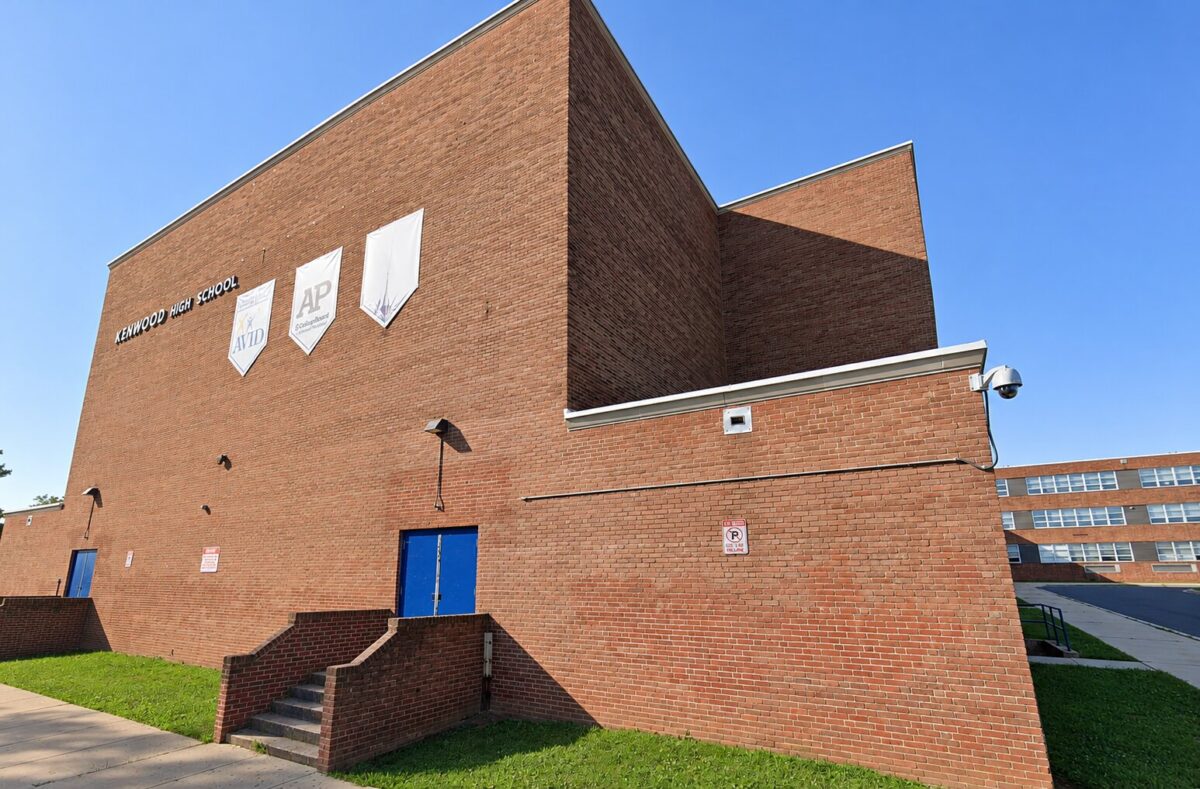
In October 2025, Omnilert’s software flagged an image of Kenwood High School student Taki Allen, mistaking his hand and the object he was holding for a firearm. The alert went to the school’s designated safety staff, who quickly recognized the error — that all he was holding was a bag of chips — and canceled it, the suit states.
According to the complaint, principal Kate Smith did not acknowledge the cancellation and forwarded a screenshot of the alert to the school resource officer, who then relayed it to police, prompting an armed response.
When police arrived, several officers had their guns drawn and did not tell the students what they were suspected of, according to the complaint. Instead, officers separated, handcuffed and searched the teens.
“The first thing I thought about was, ‘Am I about to die?’” Allen told NBC News after the incident, “because they had a gun pointed at me.”
Lawyers representing the students hope the case will prompt greater scrutiny as schools nationwide adopt AI-powered surveillance, said Len Kamdang, an attorney with the Lawyers’ Committee for Civil Rights Under Law.
“Everyone would agree that stopping gun violence in schools is a laudable goal,” Kamdang told Technical.ly. “But if the tools that you’re using are so ineffective that they could actually create an instance of gun violence for students, we believe that companies should reevaluate their products.”
The current and former BCPS student plaintiffs are seeking undisclosed damages, while also asking the court to halt the system’s use until the district improves its protocols.
The challenges of deploying AI surveillance in schools
BCPS was among the first school systems to roll out Omnilert’s technology after it was patented in 2022, according to the complaint. Between fall 2023 and spring 2024, the district integrated the software into 165 schools and at least 7,000 existing security cameras.
Human review must be paired with adequate preparation, says Vennard Wright, founder of Maryland-based Omnilert competitor PerVista AI. His company pairs its human monitoring center with training sessions to make sure clients know how to respond when an alert comes in.
“We go out on a periodic basis, and we’ll walk around with dummy guns to simulate what happens if and when a gun is detected,” Wright said, “and that’s critical so that everyone knows what their role is in an emergency.”
State investigators found no evidence of racial bias within Omnilert’s software, addressing concerns from the teens’ families that the students were unfairly targeted because they are Black.
Still, national research shows that school surveillance technology is disproportionately concentrated in low-income schools and those serving predominantly students of color.
“This suit is important not just in terms of whether the plaintiffs win or lose,” Gilman said, “but it’s important in shedding light on these issues and making the school systems and the police officers more cautious, both in terms of purchasing these systems and deploying them responsibly.”