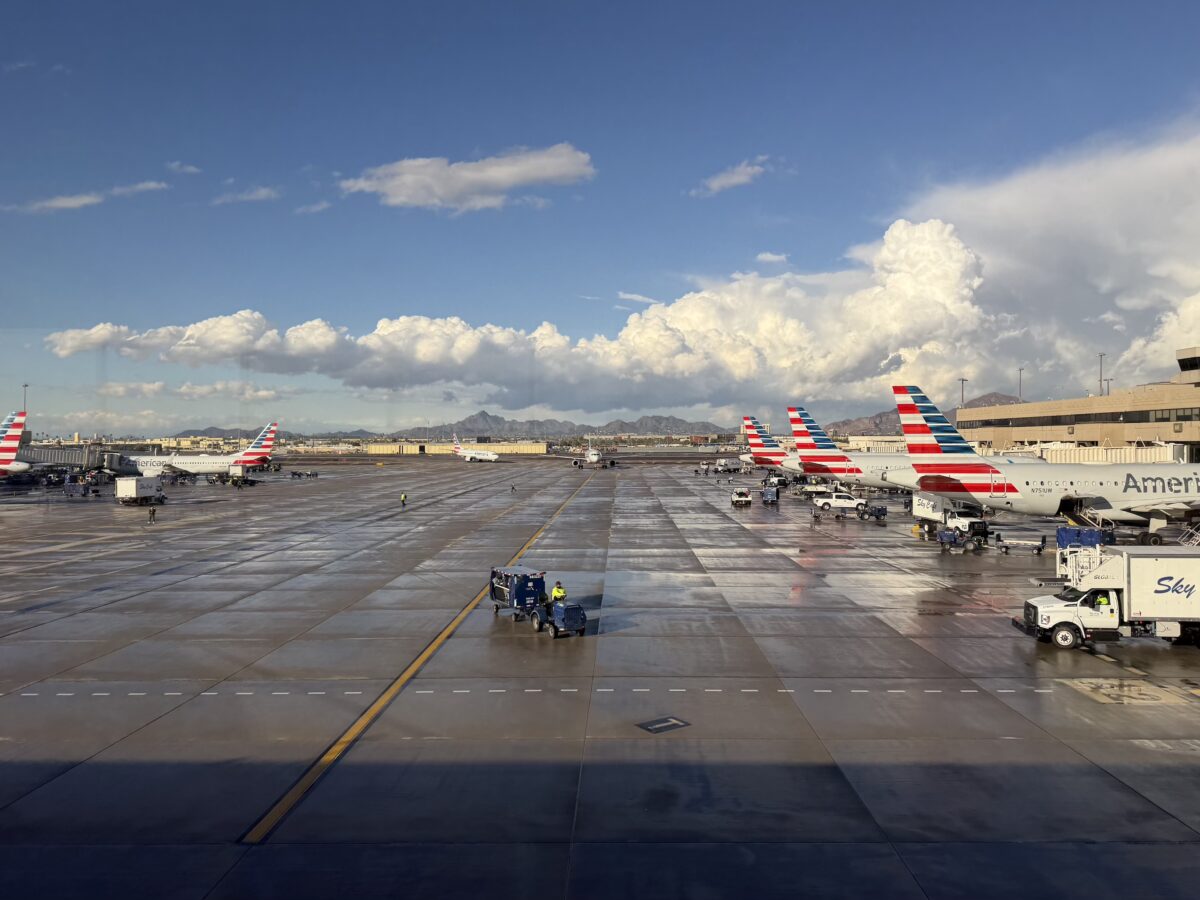
The vast majority of the country has been affected by major tech outages over the past few weeks. Microsoft 365 was down or degraded for several days; the FAA had its longest full-ground stop since Sept. 11, 2001; and other outages have occurred at Chase, Wells-Fargo, Amtrak, Apple and the NSA. This has fueled speculation if these incidents are related. The term “cyberattack” became the fourth most-searched on Google.
These incidents are absolutely related.
However, I do not believe it is because of a cyberattack (well, not beyond what our country experiences on a regular basis from adversaries such as Russia, China and North Korea). No, they’re related indirectly because of the “A.I.” hype cycle. Here are three ways:
- C-Suite executives consuming so much “A.I.” Kool-Aid that they’re making bad decisions
- Government officials have bought into the hype so much that it has weakened our security posture
- Software engineers are getting soft; the brain is a muscle, and we are not getting enough reps at the gym to stay sharp
Full transparency, that final bullet point includes the author of this article. I have not been immune from rubber stamping code I should have reviewed more thoroughly, and feel the temptation of the new shortcuts available when I am engineering software.
Microsoft’s outage
There have been many outages to Microsoft services this year, and they’re becoming more frequent. The term “five nines” uptime is popular in tech circles, speaking of an aspirational goal of having 99.999% service uptime. Outages have become so frequent at Microsoft-owned GitHub, however, that software engineers have been joking that they’re aiming for “five eights” uptime, or 88.888%.
It was just a month ago at BarCamp Philadelphia that I referenced a thought experiment from Cory Doctorow:
How much would life change if LLMs all disappeared tomorrow? Most people in the room agreed losing LLMs really wouldn’t change much. Continuing the thought experiment, imagine what would happen if Microsoft 365 went offline?
Just a few weeks later, it was no longer just a thought experiment: business ground to a halt, employees joked about a free long weekend, and it became the top international news story for days.
But how is last week’s Microsoft 365 outage related to the “A.I.” hype cycle? Microsoft CEO Satya Nadella, by his own admission, has fully bought into it, saying he’s AGI-pilled. This is directly related to the decision to eliminate 60,000 staff, about 25% of Microsoft’s total workforce, under the faulty belief that “A.I.” is ready to take their place.
Former Microsoft Outlook division employee Darren Apfel shared a story. When the layoff announcement came on Oct. 29, he reached out to a former colleague, who said, “there was nobody in Outlook left who actually knew how it worked.” The colleague predicted a major outage or security incident. Less than two weeks later, the major outage occurred.
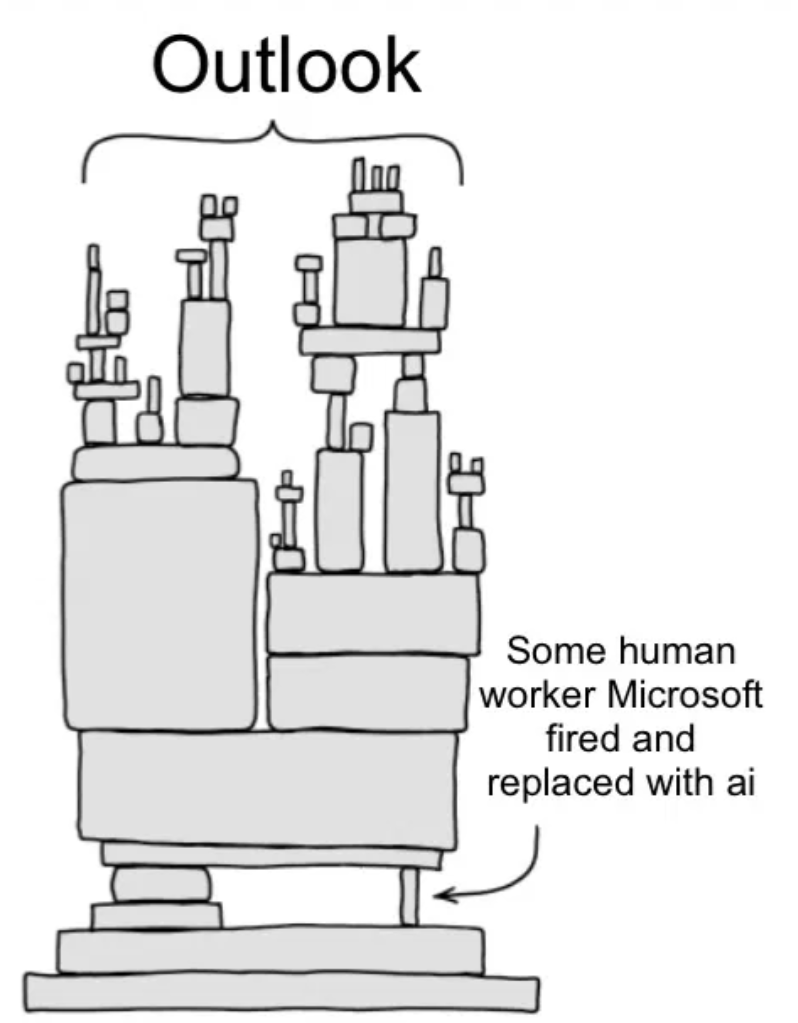
This is startling. LLMs are useful as coding assistants, but they can’t understand complex systems for several reasons, one of which is their limited context windows. Larger context windows get exponentially more expensive, unwieldy, and unreliable, so the chances of an LLM being able to help manage a system as complex as Microsoft’s 365 infrastructure any time soon is almost zero. Microsoft has eliminated a huge amount of the institutional knowledge that does understand and could manage that infrastructure, while just shifting bottlenecks in the systems.
This major outage is directly related to a lack of respect for institutional knowledge, a lack of respect for staff, and a lack of respect for best technological practices developed over decades.
The FAA outage
It is looking like the full-ground stop which caused millions of Americans to be impacted was caused by replacing production networking equipment.
First, note that someone decided to do this on a Friday afternoon. The first rule of system administration, so embedded in our DNA that any systems person can recite it, is: no major releases on Fridays. Did the ground stop last so long because it was the weekend and the agency is understaffed? Maybe, but that doesn’t mean it should be allocated another $50 billion, the staggering amount Transportation Secretary Sean Duffy asked for. He and the rest of the Trump administration were quick to lay the blame on the Biden team, despite being in command for six of the past ten years.
So while Duffy is asking for $50 billion, let’s review some recent acts of Congress and the Executive branch:
- Under the Infrastructure Investment and Jobs Act of November 2021, Congress allocated $25 billion for the FAA
- In January 2025, Trump issued an executive order pausing disbursements, stopping the flow of much of this allocated money
- Congress passed the OBBBA, championed by Trump, which allocated a further $12.5 billion, of which only about $3 billion has been spent
That is tens of billions of dollars that have been allocated, but not spent, during the same time frame as the “A.I.” hype wave. This administration has become so enamored with “A.I.” that they seem to believe it will solve these problems for them.
The aging technology of the FAA actually proves the opposite: it highlights the need for experienced technology professionals to plan and perform the upgrade work. It requires oversight, detail-oriented organization, and it can’t been done in a shoot-from-the-hip fashion. Again we can see that buying into this hype allows unserious people to discard respect for the best practices developed over decades by technologists.
Outages, service quality and bottlenecks in the ‘A.I.’ era
We have all heard anecdotes about the declining quality of services and software. Many people I speak with have a gut feeling that technology is getting worse.
We didn’t know it at the time, but upon reflection, it feels like we were in a golden era of software and services between 2009 and 2015. 2009 saw the introduction of Windows 7 and Mac OS Snow Leopard. These versions are considered by many “the best Windows” and “the best MacOS” versions. Since then, the operating systems have actively become more user-hostile to improve corporate bottom lines. Google search used to actually work, and has gotten consistently worse and more user hostile (to say nothing of what it has done to content creators).
Sci-fi author and journalist Cory Doctorow captured this mood perfectly with the the 2023 word of the year, “enshittification.” This has just been amplified in the “A.I.” era.
LLMs have increased the rate at which we can generate code, but the velocity of code generation was never the bottleneck to productivity and profit. Every system has a bottleneck, or they would be infinitely efficient. Figuring out the right spot for bottlenecks is part of engineering design. Moving the bottleneck can lead to a temporary increase in speed or productivity in one area, while ultimately leading an entire system to slow down. We’re now seeing this at scale. There’s a reason we’ve all heard the disdainful term “slop” exponentially more in the past year.

The Python programming language has ascended to become the most popular in the world over the past dozen years. One reason is the brilliant revelation the founder Guido van Rossum had: when designing Python, he realized that code is read far more often than it is written. It is much more difficult to read and understand code than it is to generate it. Using LLMs to generate mass amounts of code has created several problems:
- There is more code to review than software engineers can handle
- Software engineers are not getting “reps at the gym” writing code, due to the addicting nature of LLMs
- Pressure from the C-Suite is leading to vibe-generated, low-quality code being released to production systems
Senior-level engineers have been warning that this era of unreliability is where we’ve been heading since 2022. When you eliminate institutional knowledge, allow low-quality code into production, and keep everything in silos without concern for the big picture of systems, instability will rise. We have greatly increased the amount of technical debt in the world over the past few years, while lowering the number of people who know how to deal with it. What we are witnessing is the fallout: these outages are absolutely all related.
The United States has self-pwned
Within the first few weeks of coming into office, the Trump administration unleashed Elon Musk to slash the federal workforce. This included eliminating 1,000 employees — almost a third — from the United States Cybersecurity and Infrastructure Security Agency (CISA). This number does not include contractors, many of whom also lost their contracts during this purge. This weakens US security because the losses fell on the capabilities that matter most.
CISA’s Cybersecurity Division, which monitors federal networks for intrusions, reportedly shrank from about 1,100 people to roughly 850, and the field advisers who connect companies with federal resources fell from about 160 to less than 100. These divisions should be growing, not shrinking, given the growing hostility of the world’s technological landscape and with LLMs lowering the bar for bad actors.
The departures also included many senior and mid-level career officials. Again, we see the pattern of losing institutional knowledge from being too bullish on “A.I.” We see a pattern of disrespect for technological best practices developed by professionals over decades. This threatens the CISA’s ability to defend federal networks and support critical infrastructure operators. More than a year later, lawmakers and former officials are still asking whether the agency can recover, at a time when we are seeing more active threats than ever before.
LLMs are a helpful tool in discovering security vulnerabilities. However, the current signal-to-noise ratio in the amount of “false positives” is being used as a marketing tool for companies like Anthropic and OpenAI. The vast majority of these reports are false, which makes more work for technologists, and creates a real needle-in-a-haystack problem.
These outages, these vulnerabilities, it is all related: just not in the way you might think.
Now that the outages are happening on a daily basis, and peoples’ lives are being significantly impacted, we may see the pendulum swing back to respect for well-established technology processes. And for the people who can make the services we rely on secure and stable.