
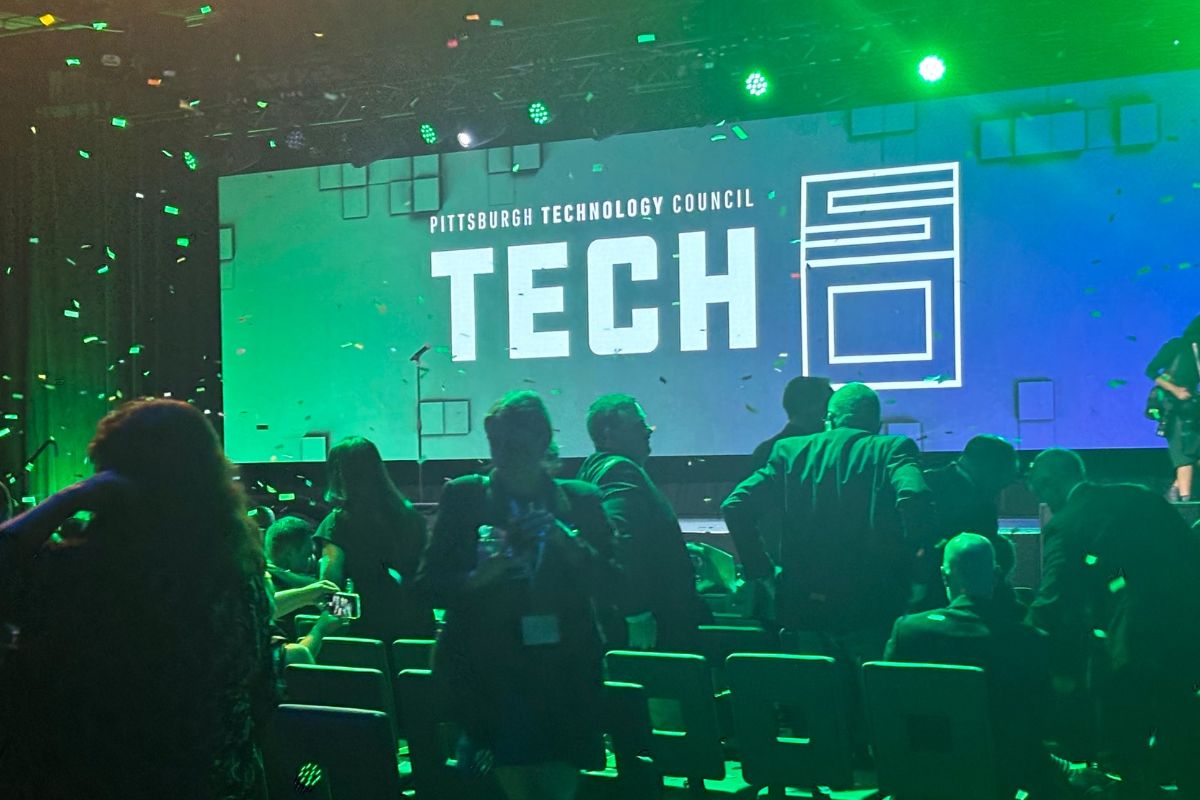
College talent and scrappiness could define Pittsburgh’s next wave of innovation, according to tech leaders at the Pittsburgh Technology Council’s annual Tech 50 Awards.
“For the next 30 years [the goal] is to continue to provide resources and support to the tech ecosystem.”
Mike Embrescia, Carnegie Robotics
Thirty years ago, when the Pittsburgh Technology Council (PTC) held its first awards, Pittsburgh’s tech ecosystem was still finding its footing. Artificial intelligence and innovation are now defining industries in Pittsburgh.
“‘Boy, [what a] difference ten years makes,’” Carnegie Robotics Chief Development Officer Mike Embrescia whispered to CEO John Bares during the event.
“This is night and day to what it was when we were getting robotics and AI, and a lot of heavy tech off the ground,” he added.
Pittsburgh has transformed from a post-industrial city trying to reinvent itself into a nationally recognized technology and innovation hub. But the next challenge is turning that research and startup activity into more companies that can scale, attract investment and build lasting roots in the region.
“We don’t say the word, quote, ‘rust’ anymore when referring to our region,” Embrescia said. “I think we’re doing a well-enough job talking about the wonderful things that are occurring in our region. I think for the next 30 years [the goal] is to continue to provide resources and support to the tech ecosystem.”
What should Pittsburgh do to stay competitive for the next 30 years? Here’s what a few Tech 50 attendees had to say.
Keeping college talent inspired
Two attendees touted Pittsburgh’s university system as key to maintaining long-term innovation.
In addition to Carnegie Mellon University (CMU) and the University of Pittsburgh, two notable innovators in artificial intelligence and technology, universities such as Carlow University, Robert Morris University, Chatham University, Point Park University and the Community College of Allegheny County bring talent to the region and help keep it there, Embrescia said.
“In some other cities across the country, they don’t have the university output,” he said. “We have a host of institutions that are, just, you’re blessed within a five, six mile radius having an incredible pipeline of young talent that is coming out of these fine institutions.”
Brian Joseph, president and CEO of Touchstone Research Laboratory, said training the next generation of thinkers is critical to keeping the region thriving.
In his work, Joseph said he aims to encourage his students to believe they can achieve the same kind of innovation as Pittsburgh’s forefathers, like George Westinghouse.
Supporting scrappy innovators
Pittsburgh entrepreneurship is another avenue for future innovation, attendees said.
“Pittsburgh is in this new era of entrepreneurs,” CodeJoy CEO and cofounder Kelsey Derringer said. “I think one of the things that Pittsburgh could do to make this, to continue to make this city a more and more vibrant place is to support small, scrappy endeavors.”
Making Pittsburgh an entry point for small-time innovators to connect with the right people and industries, find grant programs and affordable resources, and learn how to effectively run a business is critical, she added.
As CEO of CodeJoy, a small educational media company that teaches schoolchildren how to code, Derringer said PTC was influential in helping connect the company with business resources.
But companies will need financing to get there, according to PTC Vice President of Communications and Media Jonathan Kersting. He said he would like to see more investors making bets on companies and “getting a little more risky with their capital.”
“That’s always a tough thing to do,” he said. “I think every region wants to say there is not enough, but I just feel like there’s a lot of locked-up capital that I think there could be some interesting ways of trying to deploy that.”
There’s also a gap in mentorship for first-time entrepreneurs, Kersting said.
He cited Damion Shelton, who was named associate vice president and executive director of the Schwartz Center for Entrepreneurship at CMU in August 2026, as an example of the power of Pittsburgh mentorship.
Shelton, a founder of Agility Robotics, which recently went public, is mentoring the next generation of entrepreneurs through the process of scaling a company.
“I think the big thing,” Kersting said, “is trying to create a safety net, but create a culture that, if you fail, it’s gonna be OK.”