
This is a guest post by Sam Savello, the Marketing and Communications Manager at the Penn Center for Innovation, a Technical.ly partner and one of the financial supporters that helps ensure our site remains a free news resource.
Gene-editing is giving researchers new ways to treat complex diseases. By modifying DNA to afford cells new or altered functions, scientists can control whether certain genes are turned on or off and engineer cells to perform specific tasks in the body.
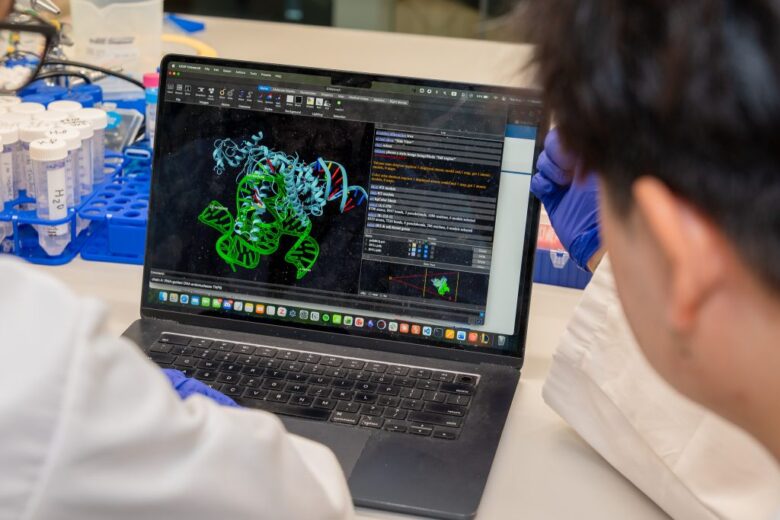
At Penn Engineering, researchers are developing technologies that uncover new methods to genetically engineer cells and leveraging algorithms to improve gene editor tools efficiently.
Using AI to improve gene editing
Gene-editing tools are designed to make precise changes to DNA, which could eventually help scientists develop new treatments for genetic diseases. But many of these tools are too large to fit inside the viral-based systems used to deliver them into cells. The gene editor Fanzor2 offers a potential solution given its small size when compared to other genome editing nucleases, however its original form was not very effective at editing DNA.
A team of researchers led by Xue Sherry Gao, PhD, Presidential Penn Compact associate professor at Penn Engineering, developed an AI-based approach called EvoMax to help improve Fanzor2’s gene editing activity. Rather than testing thousands or even millions of possible modifications individually, EvoMax leveraged a relatively small amount of experimental data to predict which changes were most likely to improve Fanzor2 performance.
After several rounds of testing and improvement, the researchers created a new version of Fanzor2, called FanzMAX, that was more than 13 times as active. In laboratory experiments, FanzMAX was able to achieve editing levels of up to 97% at a single target. Overall, the study shows how AI can help scientists improve biological technologies much faster, even when only a limited amount of experimental data is available.
Learn more here. Reach out to [email protected] to learn more about partnership opportunities.
Engineering T cells to find and fight disease
Diseases like amyotrophic lateral sclerosis (ALS), Alzheimer’s disease and inclusion body myositis (IBM) are characterized by an accumulation of misfolded protein aggregates. These proteins leave behind distinctive fragments that act like molecular “flags,” giving researchers a way to identify diseased cells.
A team of Penn Engineering researchers led by Ning Jenny Jiang, PhD, the J. Peter and Geri Skirkanich Associate Professor of Innovation at Penn Engineering, discovered a way to turn these disease-indicating flags into targets for the immune system.
The researchers identified T-cell receptors (TCRs) capable of recognizing the diseased cells, and then engineered cytotoxic T cells, the immune cells responsible for attacking threats, to express these receptors. Together, this duo was able to locate and destroy the unhealthy cells, offering a potential new way to selectively target cells associated with neurodegenerative and muscular diseases.
This technology may be able to facilitate early detection and treatment of neurodegenerative and muscular disorders, which are often difficult to diagnose and treat effectively.
➡️Learn more about opportunities for development and partnership.
Translating genetic innovation into patient care
Together, these inventions show how Penn continues to expand what is possible through genetic engineering. From developing an AI tool to improve the function of a gene editor to offering a new way to identify and attack cells associated with disease, these technologies demonstrate how genetic engineering innovations are transforming and improving available treatment options.
Inventors at Penn continue to explore the applications of their technologies, and with the support of the Penn Center for Innovation (PCI), their ideas are being translated from the laboratory into solutions that help patients and providers.
➡️Learn more about PCI’s portfolio of revolutionary technologies and the latest innovations at Penn.