
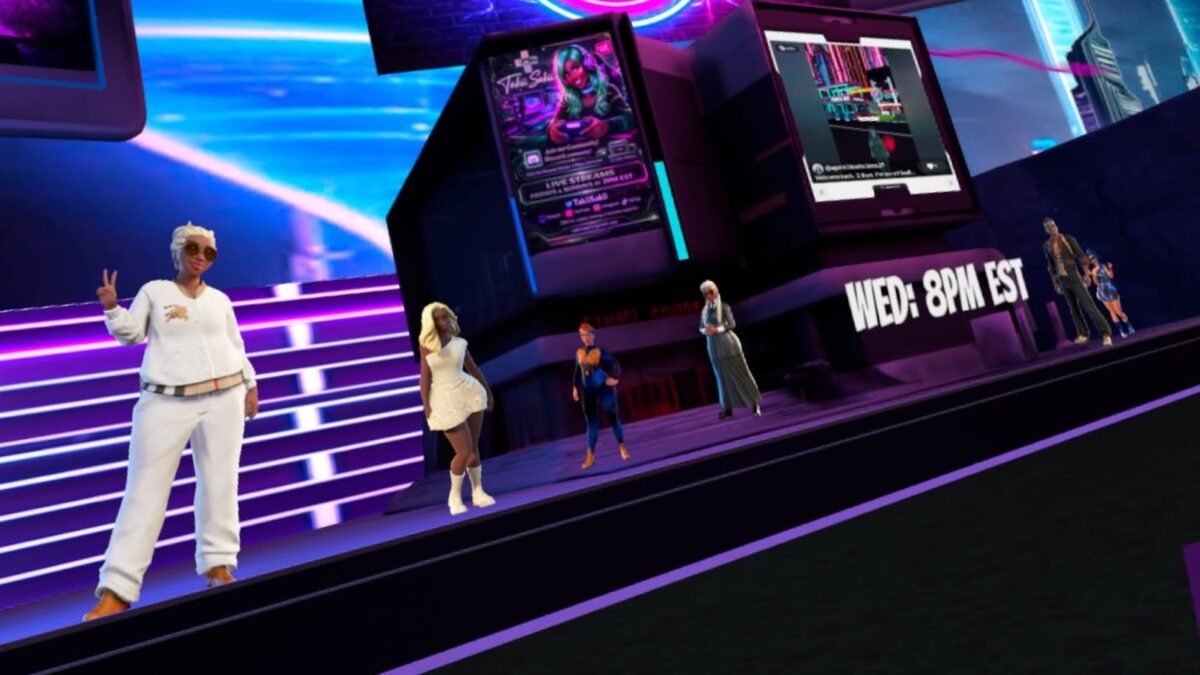
The party bus rolled through a neon-lit city under a star-filled sky. It was 2 in the afternoon, but here, it was perpetual night.
From my office, wearing a Quest 3 headset, I was riding the Indie Tours VR bus with several creators, all of us in avatar form. Most of the creators were part of a close-knit Black virtual community where many had spent years building social spaces, businesses and events.
We were in Horizon Worlds, Meta’s sidelined mega-project that was supposed to change the world. For most people, it didn’t. For these creators, it did. And they weren’t ready to let it go.
“There’s so many cultures and so many different communities and subcommunities,” said Indie Tours host Sue2daq, as we made our way through the virtual city.
“Life for me is here. They really become family.”
Linda Watson aka Dalboogie, HOrizon worlds creator
We passed towering billboards and digital marquees promoting fashion events, podcasts, games and live performances. None were Meta ads. None were even corporate ads. The tour was a way for users to advertise to one another while socializing.
“We spotlight creators, the innovators, artists, the community,” Sue2daq said. “It’s a networking hub.”
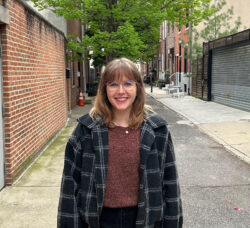
Linda Watson, an entrepreneur I know in the outside world, had invited me to spend time with some Horizon Worlds creators, as I’d done in the past, to see for myself what remained after Meta began pulling away from VR earlier this year.
I watched as about a half-dozen avatars talked about commissioned worlds, businesses, music and even a serialized movie filmed inside Worlds itself.
In here, at least, it didn’t feel like the remains of some abandoned project.
Worlds has battled a negative reputation since its public launch in late 2021, from its famously legless early avatars to spaces crowded with kids. But users who dug deeper built a community from the ground up. Some eventually made a living through Meta’s creator programs.
In March, Meta announced that Horizon Worlds would leave its Quest VR headsets behind as the company shifted the platform toward mobile. VR users, including some of the people I was riding with, were not happy. Meta ultimately reversed part of that decision, saying existing VR worlds would remain accessible “for the foreseeable future.”
The reversal did not restore the old Horizon. Meta had spent years encouraging creators to build businesses and audiences in VR, but its attention and financial incentives were increasingly shifting toward mobile games and experiences.
Some creators stayed, even as other users left. Others followed their audiences into VRChat, another virtual world platform, or began trying to build across platforms.
Meta Connect, the company’s annual developer and technology conference, begins Sept. 23 and could offer more clues about what comes next. Several longtime Horizon creators I contacted said they wanted to wait until after the event to talk about the platform’s next phase.
A place to move, grieve and build
Watson, known in Horizon as DaLBoogie, came to the platform in 2024 after another entrepreneur urged her to try it. She expected to just look around. Instead, she spent hours touring worlds and never really left.
Outside, Watson uses a wheelchair and has limited mobility. In Horizon, she runs, jumps and navigates parkour courses. She eventually built parkour worlds of her own.
“I’m always jumping. I’m always running,” Watson told me. “I find myself doing the things that in real life I currently can’t do.”
While Worlds gives her a kind of physical freedom, it also helped her through her grief after her mother died in 2024. She pulled away from socializing offline, but in Worlds her social circle grew, including friendships with people who were carrying difficult experiences of their own.
They talked about grief, disability and mental health. Watson co-hosted conversations about loss.
“Life for me is here,” Watson said. “They really become family.”
In Horizon, Watson, a designer by profession, began building worlds, designing virtual clothing, creating art galleries and organizing the Honey Hive, a community intended to help entrepreneurs promote virtual businesses.
It’s real work with institutional backing. With support from the Delaware Department of Labor, Watson is developing a business called Creative Ave, which helps traditional businesses enter immersive platforms and helps metaverse-native entrepreneurs turn what they built in virtual worlds into businesses that can operate outside them. Watson said the department also helped with business development, marketing and equipment.
When Meta changed the deal
Meta is still paying some Horizon creators, but not the way it used to.
Up on a rooftop in Kharmanee’s Cliff House world, with the sun setting over a virtual sea, I met Thickaz24, an event promoter who had built a busy nightlife business in Worlds.
On a single day on the platform, Thickaz said, she might host brunch, open a spades room in the afternoon and run a club or live-performance event at night. She’s a promoter offline, too, which might mean doing business from Queens to Brooklyn to Harlem in the same day.
“In the real world, you actually have to travel to those places,” Thickaz said. “You actually have to get in your car and drive.”
In Worlds, she could move between venues without leaving home. And Horizon paid.
Thickaz said Meta’s previous creator compensation system rewarded activity in her worlds, allowing busy events and popular spaces to generate meaningful income. One newer world, she said, drew about 100,000 visits in its first month.
Then the payment structure changed.
Now, Thickaz said, she and other qualifying creators receive a smaller stipend. She said creators were told to use the transition period to learn the kinds of game-building skills Meta increasingly wanted.
“The stipend is not even half of what I was making,” she said. “I’m grateful,” she added. “Could be zero.”
Meta did not respond to Technical.ly’s questions about creator compensation and its mobile-first strategy before publication.
On the rooftop, the focus shifted from how creators were paid to what they were creating, as Kharmanee took the stage. The singer-songwriter, whom I’d first met on the party bus, came into Horizon intending to promote her music, network and make money. She said immersive VR ended up giving her career “a second wind.”
Worlds such as Soapstone Comedy Club had long hosted stand-up. Meta also staged splashy immersive concerts using prerecorded video from major artists. Kharmanee does something more intimate and immediate: She is actually there. She uses professional audio equipment and works with a sound engineer, and at her events she requires performers to sing or play in real time rather than run a prerecorded track.
Kharmanee did a quick sound check and launched into a song. For real.
For a few minutes, we just watched and listened. Horizon avatars can be janky, but it didn’t matter. We were all there in the same place, listening to Kharmanee from wherever in the physical world we happened to be.
Like many of the people I met, Kharmanee is now carrying that culture into VRChat, where she’s rebuilt Cliff House — same name, new platform — around live performances and the kind of adult social environment she cultivated in Horizon.
But moving an event is easier than moving everything a place has come to mean.
Thickaz had largely shifted her events elsewhere when a member of the Horizon community died. She came back to hold a memorial. Horizon was still the place that made sense to gather.
Then there are the worlds that never really emptied out.
Hardy World Spades 2K26 is the latest version of one of Horizon’s best-known Black-built social spaces. Its creator, Khaleem Solomon, known as Hardy West, taught himself to build after he wasn’t initially accepted into the Meta Horizon Creators Program. By 2024, when I last interviewed him, his worlds had become his full-time business and Hardy World Spades was drawing about 1,000 visits in an average week.
Solomon told me then that when he started, there weren’t really any adult spaces, and “there definitely weren’t any spaces of color.” He said his worlds and social media helped draw more Black users into Horizon, followed by more Black-built clubs, galleries and games.
On a recent visit to Hardy World Spades 2K26, I still found avatars around the tables playing cards. “His space is really popping,” Watson said. “People still come over there.”
Finding the gate out
Back on the bus, the conversation kept turning into introductions. A builder’s name led to a scripter, which led to another world, another event, another person someone thought I should meet. When somebody mentioned a useful tool, someone else usually knew who had made it.
When I asked Sue2daq why Indie Tours had become necessary, she came back to discovery, and to what she described as a small circle of creators with access to Meta’s attention.
“If you didn’t know somebody that was in that circle, then the likelihood of your world actually being on the menu was really, really low,” she said. “You didn’t get in there because of talent. You didn’t get in there because of what you do for your community.”
RELATED NEWS

As Meta added money and formal creator programs, Sue2daq said, getting seen became increasingly valuable. When official systems didn’t provide what creators needed, they built their own. EvilSmirk, another creator in the group, had gathered scripts and other community-created building resources into a virtual tablet and made it available to users for free.
Sue2daq described Worlds as a “walled garden.” Inside it, creators had learned to work around what they lacked.
I’d seen that pattern before. In 2022, I found creators teaching one another building skills, and when Meta dropped Horizon’s events feature the following year, users built their own calendar and moderation tools.
Now creators are taking what they learned outside the garden.
DaUndaBoss started creating in Horizon in 2022 after seeing worlds by builders including Hardy West and thinking he could do it, too. He already had a technical background, then learned Horizon’s scripting system and began building for other users.
These days, he said, “I’m mostly VRChat.”
VRChat worlds are generally built on a computer using outside development tools such as Unity. For DaUndaBoss, that opens up possibilities. He prefers the greater flexibility and has continued building there with a team.
Watson had almost the opposite reaction. In Horizon, she could build while inside VR. With controllers in her hands, she could pull out an object, position it around herself and experience the scale of the world while she created it.
“It’s a whole different sort of experience,” she said. She is learning VRChat anyway, including taking classes to create a new avatar. She wants options if Horizon changes again.
“It’s not the same,” Watson said. “This really is our home.”