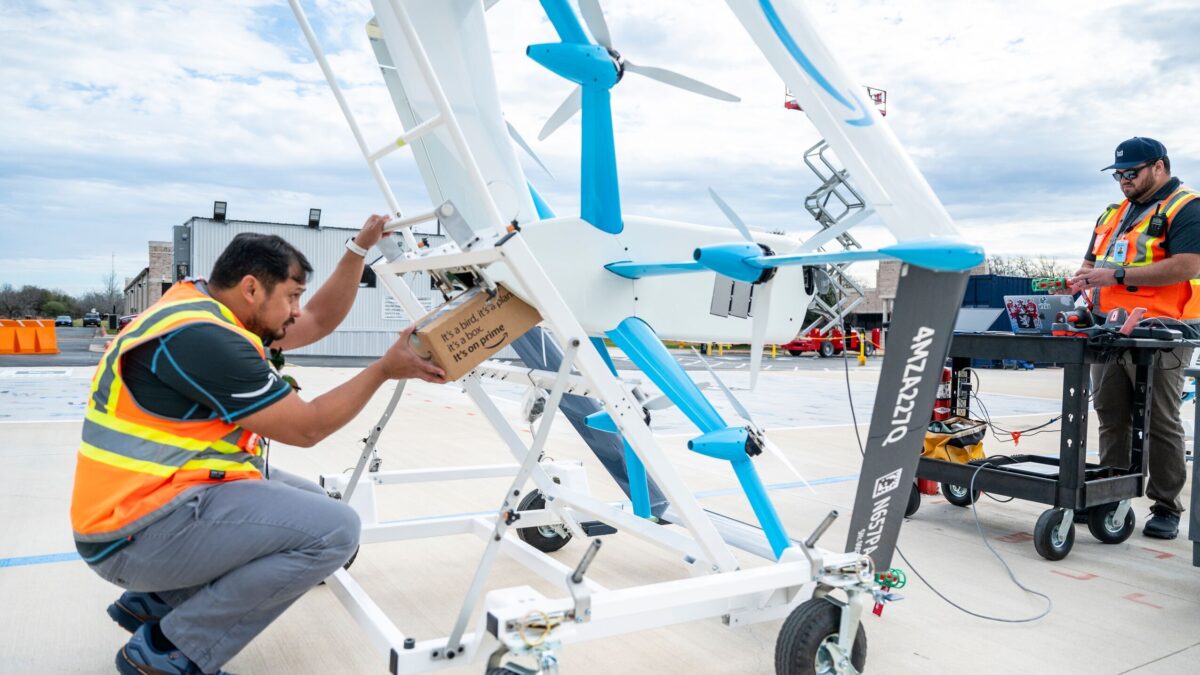
Delivery drones buzz overhead to drop off a life-sustaining prescription medication in minutes. They can also bring you deodorant when you realize, while getting ready for work, that you have none.
Whether it’s something vital or just much-needed, today’s autonomous flying delivery bots get things where they need to go in as little as 20 minutes — and they do it without a road, a driver or, in some cases, much of the infrastructure we’ve come to expect. That matters a lot in rural and underserved communities, where transportation can be a bigger barrier than distance itself.
But in early US test markets, the disruption may be more noticeable than the convenience.
Right now there are four major players to pay attention to: Amazon Air, Flytrex, Wing and Zipline. When you see a retailer announce new drone delivery services — like Walmart and Lowes — it’s usually with one of those brands as a partner. That’s shifting, as places like DoorDash move from outsourced to in-house tech, but even it started as a Wing partner.
Amazon Air, by far the service with the largest footprint, currently operates in multiple US cities, including Dallas-Fort Worth, Houston, Phoenix, Detroit and Tampa, plus the surrounding 175-square-mile region.
The company says its delivery sites are mostly suburban, where there’s more open space, fewer pedestrians and fewer buildings for a drone to dodge.
And, at least for the company, it appears to be going well. Amazon Air plans to expand to nearly 500 cities and towns by the end of 2026, part of a larger trend. The US Government Accountability Office expects the number of drone deliveries to “increase substantially” over the coming months and years.
Many researchers note this as a positive.
In healthcare specifically, they’ve largely come to the conclusion that drones are most useful for delivering small, urgent supplies when roads are too slow, unreliable or unpredictable, according to a 2026 review of current studies. A professor and PhD student at Carnegie Mellon University concluded in 2022 that drone deliveries save energy and reduce emissions, compared to alternative delivery methods.
As testing continues, however, more details about the disruption are coming out. Not just complicated privacy concerns and crowded airspace, but also quality of life.
“It sounds like a beehive coming right across, right above our houses, but it just — it’s just a nuisance,” a Richardson, Texas, resident who lives near an Amazon Air location told CBS News.
Those concerns can become harder to dismiss when the main selling point of this tech is convenience.
Some communities are hitting pause. In July, Parker, Colorado, imposed a nine-month moratorium on commercial drone-delivery hub applications. One day later, the nearby community of Castle Rock followed with a six-month freeze.
Cobb County, Georgia, shut down a Walmart-Wing proposal that would’ve brought delivery drones to town. Forty minutes away, Atlanta, Georgia, is on Amazon Air’s shortlist for new launches.
Because drones operate in shared airspace, the Federal Aviation Administration (FAA) — not state or municipal governments — holds the final say.
That power recently increased. FAA signed nationwide guidance stating that delivery drones have no significant impact on the surrounding environment. It is framed as a practical measure, as the agency says it has already viewed about 20 individual reports and got the information it needed to proceed more broadly.
In practice, that means many new drone delivery launchpads may no longer require a separate FAA environmental review and public comment process.
As far as what we can do about it, I think Haye Kesteloo, the pro-drone founder of DroneXL.co, puts it best:
“The fight over the sky was lost before Amazon arrived, because the airspace was never a town’s to control,” Kesteloo wrote last week. “What’s left is the ground and the record, and residents should use both. Show up before the pad is approved, and make Amazon answer on the record.”