
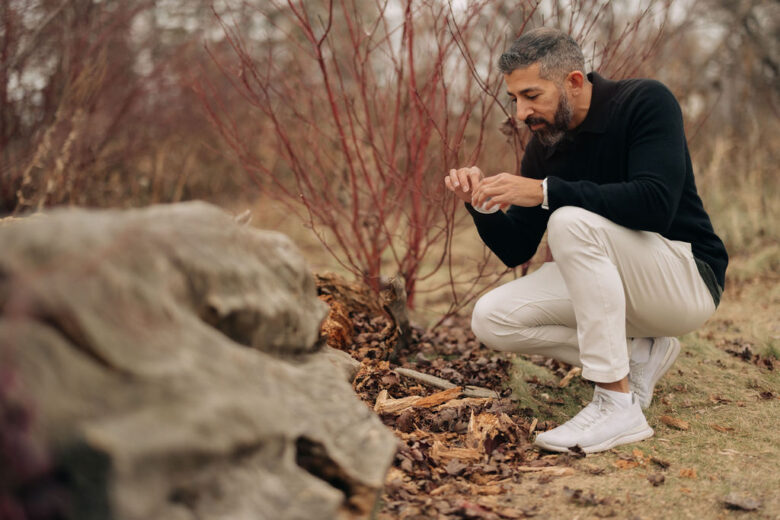
Mustafa Fakhri spent his career as a scientist developing solutions to problems after they happened, including vaccines and cancer treatments. Now, he’s focused on stopping problems at their roots.
Fakhri founded Dirt Dive in 2025 to create protozoa-based plant supplements. When mixed into soil and water, these microscopic organisms — which you might remember from high school biology, and which he describes as “little bean-shaped swimming creatures with tiny hairs that they use as oars” — help houseplants thrive.
While chemical fertilizers and plant growth regulators feed minerals directly to plants for a short-term boost, they can create dependency and degrade the soil. Dirt Dive takes a biological approach. Its protozoa build a healthier long-term environment, Fakhri said.
“They swim around, eat bad bacteria and pee out nitrogen, [and] more nitrogen means a healthier plant.”
Mustafa Fakhri, Dirt Dive
“They swim around, eat bad bacteria and pee out nitrogen,” Fakhri told Technical.ly. “The plant’s roots soak up the nitrogen, and you end up with this really positive cycle: more nitrogen means a healthier plant.”
Aimed at houseplant owners, Dirt Dive sells packets containing more than 100,000 dormant protozoa — what Fakhri calls “a really potent dose that would have a noticeable impact.” The product is stocked at Shey West in West Fargo, with plans to expand into more retail shops soon.
Long-term, Fakhri sees anywhere with dirt as a market, eyeing expansion into commercial farming and even space agriculture. He’s working toward this goal with help from the local ecosystem, as a fall 2025 alumnus of gener8tor’s North Dakota Accelerator, which twice a year offers five teams a $100,000 investment in return for 7.5% equity.
Behind the company’s mission and playful branding is a lifelong fascination with biology that Fakhri hopes to share with everyday plant parents.
“I’ve always loved zooming into the micro-world,” Fakhri said. “Even as a 12-year-old, I would come back from school and spend hours looking at pond water under my microscope instead of watching TV. In a very real way, I’m diving into the dirt. We wanted to capture the essence that there’s this awesome, beautiful, dramatic world happening down there.”
This Q&A has been edited for length and clarity.
What brought you to North Dakota originally?
I grew up near Chicago, went to grad school in Florida and Arkansas and worked in Pennsylvania. What brought me to Fargo was Aldevron being at the absolute forefront of DNA and RNA technology. I didn’t know anything about Fargo before I arrived, but once I got here, I fell in love. My heart is in Fargo. The people are amazing, daily life is frictionless and I’ve been here for five years now.
What is your background?
After getting my first microscope at 12, I went on to study protozoa in soil and insects through undergrad and grad school. For my master’s in biology, I spent four years studying an amoeba that lives in the guts of cockroaches.
“I spent four years studying an amoeba that lives in the guts of cockroaches.”
After that, I worked in biopharmaceuticals for five years, including at Johnson & Johnson and later at Aldevron. We were developing cures for autoimmune diseases, cancer, Parkinson’s and Alzheimer’s. I loved the science, but I eventually realized that while treating acute diseases is important, we can also amplify our impact by preventing them in the first place — through healthier food and less exposure to harmful synthetic chemicals.
Combining that realization with my lifelong obsession with protozoa, I left biopharma to build Dirt Dive. We’re using these incredibly underappreciated creatures as a fundamental way to improve the world. This is my dream life.
Where are operations based?
We have a very small lab based right out of my home in downtown Fargo. Everything we do is completely non-toxic and safe; developing a safe process was actually a big part of our initial R&D. We grow these creatures by the millions and put them to sleep.
A really fun detail is that I actually handpicked the specific protozoa we use. I looked at lots of different dirt under a microscope, searching for a species that was universal and highly impactful on plants. Using a tiny glass pipette I made myself, I handpicked about two dozen of them, figured out what nutrients they needed, and grew them to the millions. We run everything with just me and a part-time research and executive assistant, Marley Lund-Peterson.
What kind of traction have you seen so far?
Early on, we had a handful of people who wanted it immediately, which led to some great word-of-mouth sales. Now, people can buy directly from our website at dirtdiving.com, and we just got our product into our first retail store, Shey West. We’re hoping to expand into more retail plant shops around Fargo over the coming weeks.
It’s a dual effort right now: getting the product into people’s hands, but also just educating them about these weird little creatures. If you go to a store looking for microbial inoculants, you’ll see bacteria and mycorrhizal fungi, but you won’t see protozoa. We’re literally bringing in the third, missing pillar of the soil microbiome to help restore it completely.
What are your ultimate goals for the company?
The dream is that everywhere there’s dirt, Dirt Dive will be there. Right now, we’re improving houseplants so people have healthier plants with fewer synthetic chemicals. Next, we want to expand into outdoor gardening.
After that, agriculture is a massive goal. We want to allow farmers to use fewer chemicals while still achieving high yields. We are currently working on how to bridge the gap from houseplant-scale to running large, thousand-plant greenhouse trials.
Beyond that, my ultimate, out-there vision is space agriculture. If you think about a low-ventilation, low-nutrient environment on a spaceship or a planetary biodome, you’re going to have strict weight limits on soil. Having the absolute best soil microbiome will be essential to getting maximum productivity out of that limited dirt.