
Startup profile: HydroBIND
- Founded by: Steve Kemp
- Year founded: 2025
- Headquarters: Williston, ND
- Sector: Biotech mineral extraction
- Funding and valuation: $220,000 raised to date; targeting $500,000 pre-seed
- Key ecosystem partners: University of North Dakota, gener8tor, the North Dakota Agricultural Products Utilization Commission
A North Dakota startup is using AI to create proteins that can pull valuable minerals out of fracking wastewater.
“I design proteins that are designed to bind and … pump, if you will, these critical minerals that we’re chasing.”
Steve Kemp, HydroBIND
HydroBIND is based in Williston, the heart of the Bakken formation. The region’s oil boom relies on pressurized water to crack open deep underground rock, generating massive amounts of toxic runoff filled with valuable, hard-to-recover resources. That wastewater — also called produced water — is a noxious liability for western North Dakota’s agricultural industry. Founder Steve Kemp wants to turn it into an asset instead.
“While produced water has been the bane of many farmers’ existence because it’s very salty and it damages the land if spilled,” founder Steve Kemp said, “boy, wouldn’t it be nice if we could develop something positive for the landowners and the farmers and the ranchers.”
Kemp’s solution to that problem is a novel one: Using AI-powered software to precision engineer proteins that bind themselves to desirable minerals — and only those minerals.
Critical mineral recovery, from lithium to proteins
Critical mineral extraction is driving startup innovation nationwide. These raw materials — used for everything from electric vehicle batteries to consumer electronics — are considered a national security priority. Other players in the space include Maryland-based Forager Station, microbial intelligence startup Endolith and the Bill Gates- and Jeff Bezos-backed KoBold Metals.
It’s a hot market and Kemp has spent the last decade in this space. Before he founded HydroBIND in November 2025, he founded Wellspring Hydro in 2016 to extract lithium from oilfield wastewater.
He has since secured $220,000 in early capital, which consists of a $160,000 grant from the Agricultural Products Utilization Commission (APUC) and a $60,000 friends-and-family investment round.
“With that, I’ve been incredibly capital efficient and literally I’m in my office in my house,” Kemp said. “In the back of my house I have a 40-by-70 shop. In the back corner of that shop I’ve got my lab set up. I basically put up some glass walls and partitioned it off so that we could have a safe, clean environment in that shop. That’s where my nephew [Joe Kemp] runs all of our protein expression.”
HydroBIND is currently participating in gener8tor‘s free gBETA fall 2026 cohort — advised by Sarah Louise, director of gener8tor’s 1889 Fund and director of platform in Fargo — with plans to apply for the organization’s North Dakota Investment Accelerator next. The company hopes to raise an additional $500,000 in an upcoming pre-seed round to deliver a minimally viable product (MVP).
In addition, Kemp has been taking advantage of several other entrepreneur resources. HydroBIND is a member of NVIDIA Inception Program (an AI-focused startup accelerator), AWS Activate (Amazon’s cloud credit program), the Google for Startups Cloud Program (Google’s cloud infrastructure initiative) and Microsoft for Startups (Microsoft’s startup support network), securing in-kind cloud credits for its simulation work.
How HydroBIND works: Precision-engineered proteins
The most common method of critical mineral extraction uses small man-made polymer resins — or ion-exchange resins — that attach themselves to desirable minerals.
However, that approach isn’t perfect. Synthetic resins are built on a macromolecular scale and cannot be engineered at the atomic level; they don’t offer what’s called a “lock and key” fit. As a result, they may also bind to nondesirable substances in wastewater — such as calcium, magnesium and heavy salts.
In contrast, HydroBIND uses highly precise protein structures that bind only to specific minerals so they can be separated from wastewater. So far, HydroBIND’s target minerals include ammonium (a key nitrogen source in agricultural fertilizer), potassium (an essential crop nutrient and critical mineral), boron (a micronutrient vital for plant growth), and lithium (a critical mineral used to power rechargeable batteries).
To make that extraction a reality, HydroBIND — the name combining “hydro” and the acronym for Biological Ion Nano Delivery — utilizes deep-learning AI software developed by David Baker’s lab at the University of Washington Institute for Protein Design. According to Kemp, Baker’s 2024 Nobel Prize-winning research has led to exponential growth in scientific understanding of protein structures, from 150,000 known structures to over 210 million in a little more than half a decade.
That research, he said, has made it possible for HydroBIND to use AI-powered software technology to design micromolecular proteins tailored for highly specific mineral extraction, offering precision that traditional man-made resins cannot match.
“Understanding what those known structures are allows us to take [them] and reconfigure them in a way that makes my work, work,” Kemp said. “I design proteins that are designed to bind and … pump, if you will, these critical minerals that we’re chasing.”
HydroBIND isn’t the only startup extracting critical minerals from oilfield produced water, but according to Kemp, they have only a few competitors. None of those other companies are in North Dakota.
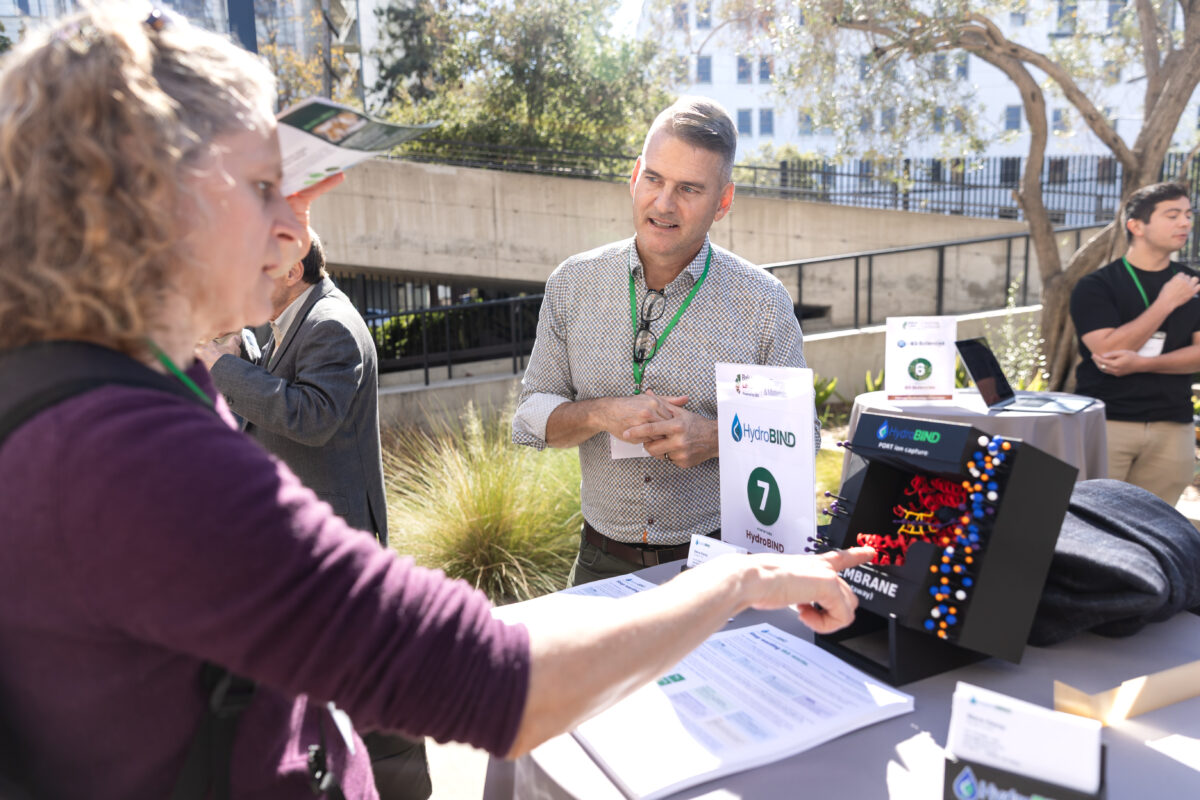
However, he doesn’t see other companies in the space as competitors in a traditional sense. Kemp recently showcased HydroBIND’s technology at the Berkeley Symposium on Critical Minerals, joining a collaborative nationwide push to re-shore domestic mineral extraction. The event was hosted by UC Berkeley’s Bakar Labs.
“It felt more like, ‘Hey, we’re all just doing our best to get this technology developed because we need to re-home our critical mineral mining and manufacturing and develop our technologies here to do that extraction,’” Kemp said. “They’re called critical minerals for a reason.”
Looking beyond produced water and the Bakken
Kemp sees potential for HydroBIND to drive an impact beyond the Bakken and beyond just produced water. His long-term goal: expand protein-based critical mineral extraction to other industries and wastewater varieties.
Kemp is also leaning on a long-running relationship with the University of North Dakota to expand HydroBIND’s reach into rare earth elements. He is working closely with Nolan Peaker, senior research manager for critical minerals at UND’s College of Engineering and Mines Research Institute, using shared university research data to explore new recovery methods.
“This is the hardest water, the toughest water to work with in the world,” Kemp said. “Everything from here should be easier. Any industrial wastewater, sewage water or other wastewaters that exist around the world could be a target potential customer.”