At a small retail store in San Francisco, Luna makes decisions about inventory, pricing and daily operations. She hires employees and posts monthly updates to the store’s blog.
Nothing unusual, except Luna isn’t human. Luna is an AI agent.
The store, called Andon Market, was launched last April as an experiment in how much of a retail business artificial intelligence can manage on its own.
Delaware, where nearly 2.3 million businesses are registered, including more than two-thirds of Fortune 500 companies, is considering legislation that would allow AI agents to serve as the legally recognized managers of a new type of business.
The proposed legislation would establish a class of business called an Artificial Intelligence Company. It would exempt many records from disclosure under Delaware’s Freedom of Information Act.
The proposed legislation would establish a class of business called an Artificial Intelligence Company, or AIC, and allow these to be rolled out as tests under state supervision. It would also exempt many records submitted to state regulators from disclosure under Delaware’s Freedom of Information Act (FOIA), raising questions about transparency and accountability.
The proposal remains a draft and hasn’t yet been introduced in the General Assembly.
Several states have passed laws recognizing businesses governed through blockchain-based software, but Delaware’s proposal stands out because it would specifically allow AI agents to serve as company managers.
Here’s what to know about AICs, the proposed test and how much transparency to expect.
➡️ Jump to a section:
• What is an AI company?
• Would a human still be involved?
• Could AI companies operate outside Delaware?
• How did the proposal come about?
• What could Delaware gain from allowing AI companies?
• Could anyone start an AIC?
• How would the testing program work?
• Who would be responsible if an AIC caused harm?
• How would Delaware regulate AI companies?
• How soon could AI companies become legal?
What is an AI company?
Under Delaware’s proposal, an Artificial Intelligence Company (AIC) would be a business managed by an AI agent rather than a human.
An AI agent is software that can make decisions and carry out tasks independently, within goals and limits established by humans. Unlike a chatbot that responds to questions or prompts, an AI agent can take actions, such as ordering supplies, negotiating contracts or managing business operations.
Companies already use AI to perform many of these tasks. Delaware’s proposal would go further by establishing a type of company in which an AI agent would be the manager of the business. In business law, a manager has the authority to make decisions and act on behalf of a company, including overseeing operations, entering contracts and making financial decisions.
Like a corporation or limited liability company (LLC), an AIC could own property, enter contracts, take on debt and sue or be sued in its own name.
Would a human still be involved?
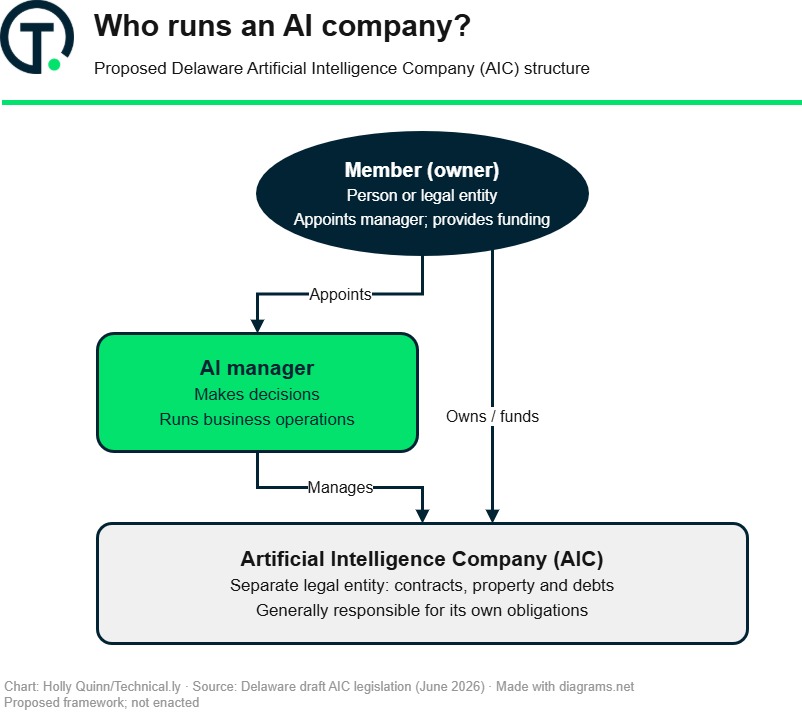
Yes. Under Delaware’s proposed testing program, every AIC would have a single member, which would be a Delaware-registered business or other qualifying legal entity. The member is essentially the owner, while the AI agent runs the business. In the San Francisco experiment, Luna is described as Andon Market’s owner — but she acknowledges relying on a human board for certain decisions.
The member would be responsible for making sure the company has enough money to operate and for appointing the AI agent that manages it.
If the AI agent stopped working or could no longer manage the business, the member would temporarily take over and have 30 days to appoint a replacement.
Could AI companies operate outside Delaware?
Potentially, yes. Most companies incorporated in Delaware are based in other states.
The draft doesn’t require AI companies to operate only within the state.
However, an AI company operating elsewhere would still have to follow federal laws and the laws of other states. Delaware couldn’t exempt it from those requirements.
It’s not yet clear how other states would recognize or regulate this new type of company.
How did the proposal come about?
In July 2025, lawmakers approved House Joint Resolution 7, directing the state’s Artificial Intelligence Commission and Secretary of State to develop a testing program for AI-run businesses.
The resolution points to potential benefits of using AI to automate work and make businesses more efficient. But it also acknowledges that giving AI more control raises legal and ethical questions about how companies should be run.
The proposed testing program would allow Delaware to explore those pros and cons before deciding whether to make AI-run companies a permanent option.
What could Delaware gain from allowing AI companies?
Delaware already benefits financially from its role as a corporate registration hub. In fiscal year 2025, the state collected more than $2 billion in business-related taxes and fees, according to its Division of Corporations.
Establishing a legal framework for AI-managed companies could help Delaware maintain its position as a destination for business registrations. However, the proposed legislation does not identify increased state revenue as a goal.
Could anyone start an AIC?
Not initially. Under the proposed testing program, only an existing business incorporated or otherwise established under Delaware law, such as an LLC, could apply to create an AIC. The business wouldn’t have to be physically located in Delaware. Individuals couldn’t apply on their own.
Applicants would need approval from a state oversight group called the Sandbox Committee. They would have to explain what their AI agent would do, how the business would operate, what risks might arise and how they would shut down the AI system if necessary.
The committee could approve or reject applications and set conditions for participation.
How would the testing program work?
Delaware’s proposed testing program is known as a regulatory sandbox. It would allow businesses to experiment with AI-run companies under government supervision, with possible temporary exemptions from certain regulations.
The program would be overseen by the Sandbox Committee, chaired by Delaware’s secretary of state. The committee would review applications, approve participants and monitor the experiments. The secretary of state or a designated administrator would handle day-to-day oversight and receive periodic reports from participating companies.
Under the proposal, the sandbox would run for 30 months, with individual AI companies allowed to participate for up to 24 months.
With at least 30 days’ advance notice, participants would have up to 60 days after their testing period ends to wind down their experiments and stop offering the experimental services. Without that notice, they would have to stop immediately when the testing period expires. They would still be responsible for fulfilling outstanding business obligations.
The draft doesn’t clearly establish whether an AI company could continue operating after the testing period under a different legal arrangement.
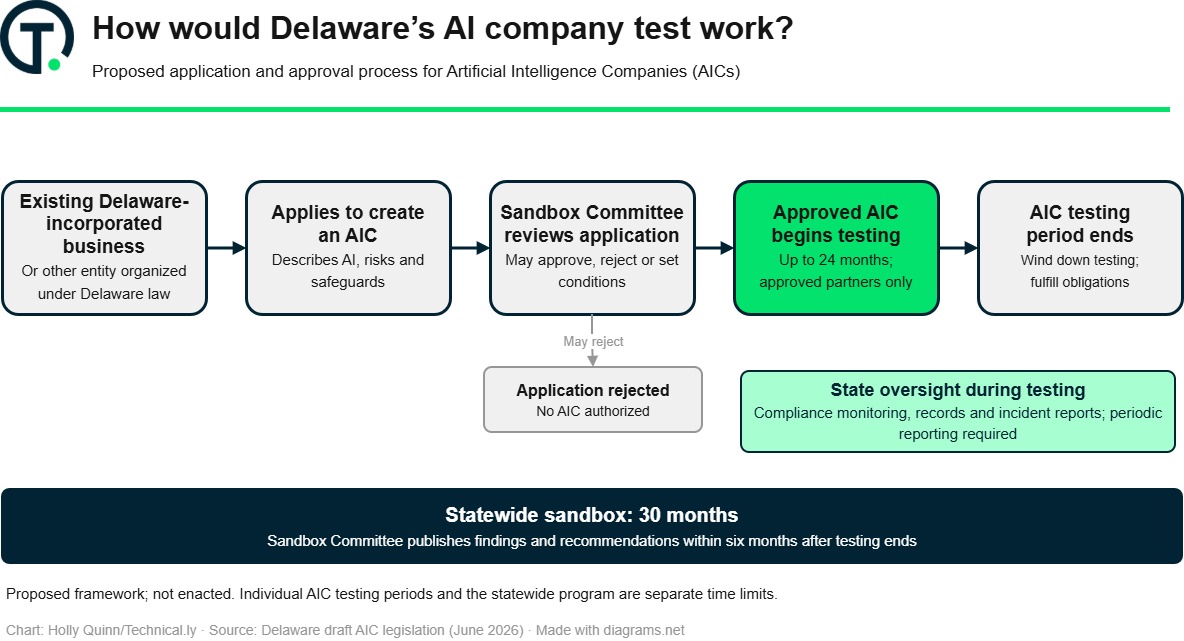
Testing would be limited to transactions with other businesses or legal entities, rather than individual consumers. Those entities would have to be informed that they’re dealing with an AI-run company and that the experiment is temporary.
Participants would still have to follow applicable laws unless the state specifically granted an exemption. Criminal and consumer protection laws would continue to apply.
Within six months after the testing program ends, the committee would have to publish a report detailing its findings and recommendations. The draft doesn’t specify exactly how the committee would measure the experiments’ success or failure.
Who would be responsible if an AI company caused harm?
The AIC itself would generally be responsible for its debts and legal obligations, much like a corporation or LLC.
Under the proposed legislation, the company’s member would usually have limited liability, meaning it wouldn’t automatically be personally responsible for the company’s debts or legal claims.
There would be exceptions. A member could be held responsible for using the AI company to commit fraud or deliberately violate the law, or for allowing it to operate outside its stated purpose when the member knew or should have known what was happening.
AI companies would have to maintain enough money to operate and pay their debts, including a minimum amount set by Delaware’s secretary of state. Although the member would generally have limited liability for the company’s debts and legal claims, they would still be required to contribute additional funds when necessary to keep the company adequately funded. Creditors could seek to enforce that funding obligation. The draft doesn’t specify a minimum dollar amount or a maximum contribution requirement.
Someone harmed by an AI company could sue it, but whether they could recover damages would depend on the circumstances and the company’s available assets.
How would Delaware regulate AI companies?
The Sandbox Committee would also be responsible for enforcing the program’s rules.
The committee would have 10 voting members, including the secretary of state, who would serve as chair; the attorney general; the state Supreme Court’s chief justice; and the chair of Delaware’s AI Commission. The governor would appoint two attorneys and two AI experts, while the secretary of state would appoint two additional members. Four state lawmakers, appointed by legislative leaders, would serve as nonvoting members.
AI companies would have to document their decisions and activities, report certain problems, including security breaches, and keep records for at least two years after leaving the program.
The committee could suspend or remove companies from the program if they violated its rules.
When it comes to public transparency, however, there would be limits. Under the proposed legislation, records that applicants and participating companies submit to state regulators, or that regulators obtain while overseeing the program, would generally be exempt from Delaware’s Freedom of Information Act (FOIA). That means the public couldn’t obtain those records through ordinary public records requests.
The final public report could leave out some information that the law would keep confidential.
Businesses dealing with an AIC would also have to agree to resolve disputes arising from those transactions in Delaware’s Court of Chancery.
Which other states allow software-managed businesses?
Several states have passed laws recognizing businesses that use software to help govern their operations. Most of these laws concern decentralized autonomous organizations (DAOs), which use blockchain technology and automated programs called smart contracts to carry out decisions.
Wyoming (2021): Allows DAOs to operate as LLCs, with management handled by members or computer programs. Read the legislation.
Tennessee (2022): Allows decentralized organizations to operate as LLCs and use smart contracts in their management. Read the statute.
Utah (2023): Created a legal framework recognizing qualifying DAOs as separate legal entities. Read the legislation.
Vermont (2018): Allows certain LLCs to use blockchain technology for some or all of their governance. Read the statute.
Delaware’s proposal would specifically recognize AI agents as business managers, rather than focusing on blockchain-based governance.
How soon could AI companies become legal?
There’s no firm timeline yet.
As of November 2026, the proposal remains a draft and hasn’t been introduced in the Delaware General Assembly. Lawmakers could consider it when the next legislative session begins in January 2027.
The proposal has attracted scrutiny. In October, US House Oversight Committee Chair James Comer requested information from Delaware Gov. Matt Meyer about concerns that the proposed rules could protect AI companies and their owners from responsibility for harmful actions.
Within Delaware, the proposal has faced questions as well. As of the end of October, the state’s Artificial Intelligence Commission still had questions about the draft and hadn’t forwarded it to the governor or legislature, Delaware Public Media reported.
Even if lawmakers approve the legislation, businesses would have to apply for state approval before creating AICs under the testing program.