This is a guest post by Sam Savello, the Marketing and Communications Manager at the Penn Center for Innovation, a Technical.ly partner and one of the financial supporters that helps ensure our site remains a free news resource.
Artificial intelligence has quickly become a part of our everyday lives. In medicine, it’s transforming care by accelerating the diagnosis process, giving clinicians more time with patients and enabling new treatments.
At Penn, researchers are developing breakthrough AI technologies that have the potential to optimize and enhance doctors’ workflows and improve patient outcomes.
Two Penn-invented technologies in the medical imaging sector are showing how AI can make an impact in the clinical setting.
AI that accurately aligns medical images through self-learning techniques
In the world of radiology, “medical image registration” is key. It’s the process of aligning multiple medical images so the same anatomical structures — such as specific organs or tissues — appear in the exact same position across each scan. This allows doctors and researchers to accurately compare images over time, across different imaging types or between patients.
Machine learning is already being incorporated into conventional medical imaging, but there are inconsistencies. In response, Yong Fan, PhD, Professor of Radiology at Penn Medicine, developed an image registration algorithm using deep learning methods that do not rely on pre-existing data. Instead, the technology performs “self-supervised learning,” optimizing and identifying how to line up medical images accurately as it goes. This algorithm is able to bypass the data limitations of previous models, and can adapt more reliably to each new image it processes.
It’s also fast: 0.2 seconds per image compared to the several seconds or even minutes per image that traditional medical image registration may take. The new method offers improved image alignment over existing techniques, allowing doctors to provide more accurate diagnoses and monitor changes in a patient’s condition more easily over time.
This AI tool can be potentially used for a variety of medical processes, like comparing MRI scans to monitor tumor growth, aligning CT scans during emergency care, guiding image-based surgeries or conducting large-scale clinical research studies.
This technology is currently available for licensing and partnership opportunities for those interested in developing it further, which you can learn about here.
Cloud-based machine learning delivers AI-based insights to radiologists
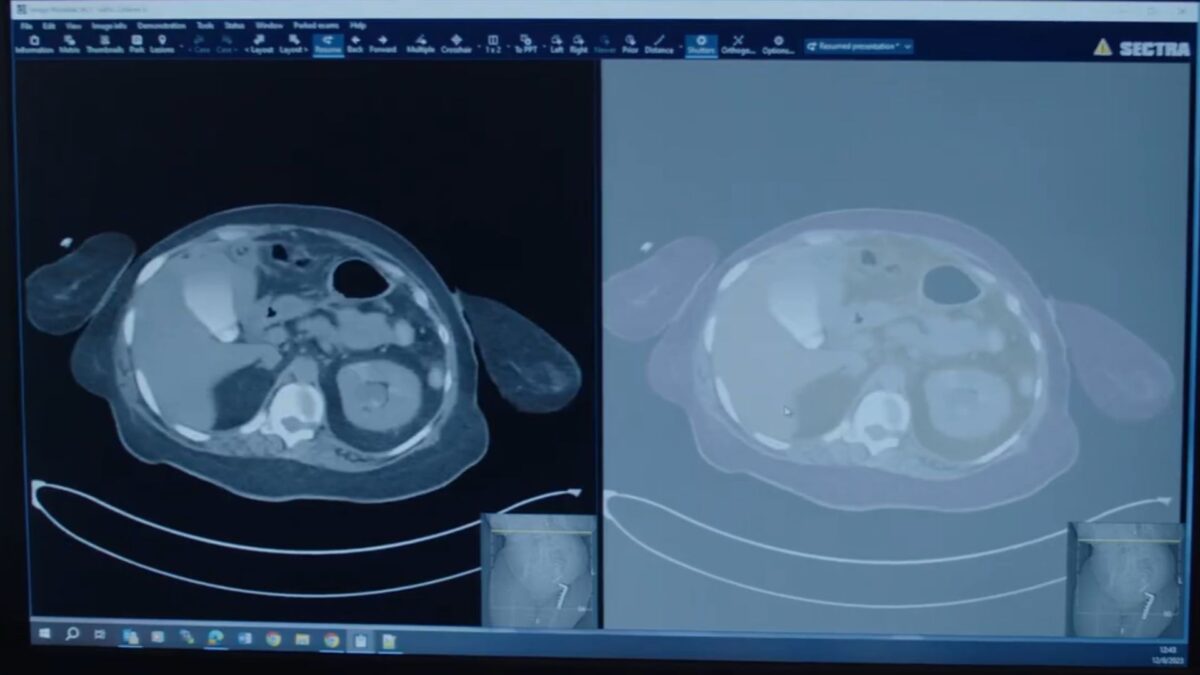
Also within the radiology field, another group of Penn Medicine researchers led by Walter Witschey, PhD, Associate Professor of Radiology, Ari Borthakur, PhD, MBA, Adjunct Professor of Radiology, and colleagues in the Department of Radiology and Penn Medicine’s Information Services team, developed a cloud-based machine learning platform that offers clinical image analysis in real-time.
The technology, called AInsights, delivers a medical image processing pipeline on a cloud server, which allows clinical picture archiving and communication systems (PACS) to access machine learning models. These models analyze newly acquired medical images in real time, identify clinically relevant patterns, and generate diagnostic predictions that radiologists can incorporate into patient reports. Not only is AInsights anticipated to improve diagnostic accuracy and save radiologists time, but it will also integrate seamlessly into existing workflows.
The technology currently has several projects under way to test its effectiveness in clinical settings and was recognized with the CIO Award in 2024 and the Healthcare Innovation Award 2025 for its breakthrough approach in using AI to improve patient care.
Learn more about this technology and opportunities for licensing and partnership here.
What’s next for AI in medical imaging
Together, these innovations show how Penn is paving the way for easier and more accurate medical imaging processes.
From providing fast and accurate medical image registration to delivering predictive diagnostic information to radiologists, they highlight the potential for AI to equip doctors with the tools needed to enhance their work process and provide treatment more accurately and efficiently. The researchers behind these innovations continue to make discoveries about what AI can do in clinical settings, and with the support of the Penn Center for Innovation (PCI), their ideas are being translated from the laboratory into solutions that help real patients.
Learn more about PCI’s portfolio of groundbreaking technologies and the latest innovations at Penn here.