
Personality tests can help you learn about yourself, but they rarely explain why you keep having the same family argument. To go further, a DC local launched a tool that describes how people act in relationships — and gives advice on how to make healthier choices
Through the consumer tech platform SeenWithin, you can get insights on how you handle stress and connect with others in real life based on dozens of questions analyzed by AI-powered proprietary software. You can also invite family and friends to fill out the questionnaire and compare behaviors.
That latter feature differentiates it from a traditional personality quiz, said founder Taneka Caffee.
“We often might have a lot of different arguments, but oftentimes it’s actually really the same loop that’s repeating.”
Taneka Caffee, SeenWithin
“I’ve taken quite a few tests just to learn a little bit more about myself,” Caffee told Technical.ly. “Those other tests gave her good information in terms of self-reflection and self-awareness, she said, but weren’t “necessarily helping me understand how I show up and how somebody else shows up and how our patterns are showing up together.”
The first step on SeenWithin is a free snapshot briefly outlining someone’s common behaviors, based on about 12 questions. You’ll then be assigned one of 10 labels describing your personality and how you interact with people.
For $39, users answer 47 questions to get a deeper breakdown, including common threads in resolving conflict. From there, you can compare results with others and get suggestions for improving your relationship — including during arguments.
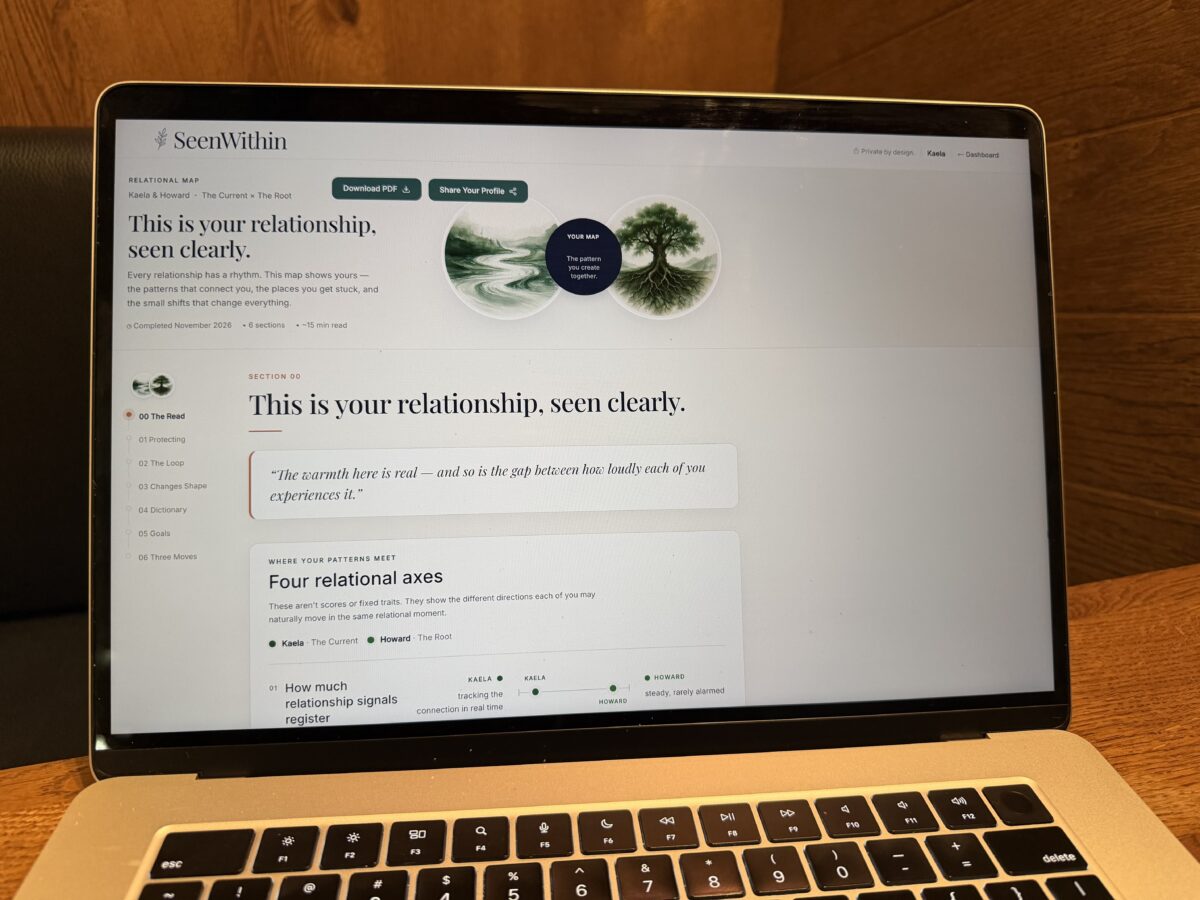
It took me about eight minutes to fill out the questions, and a couple of minutes later, the results landed in my inbox: I’m classified as the “Current.” I also recruited my dad to take part, and he’s labeled as the “Root.”
After I sent an invite to his email to create a Pair Map (which is included in the $39) of how we interact, our joint results arrived in another eight minutes.
We already knew we’re pretty different people, and this tool really showed some divides in how we operate. I often read too much into situations, while my dad is generally more steady (hence, the Root). Overall, we agreed with the assessment.
The gap between ‘self-awareness’ and ‘relationship awareness’
After launching earlier this fall following beta testing, Caffee hopes people will use SeenWithin during the holidays, especially when navigating tense conversations with loved ones.
“We often might have a lot of different arguments, but oftentimes it’s actually really the same loop that’s repeating,” she said. “If there’s a little bit of light that’s shed on that, I think that would … help people put language to something that they might not be realizing.”
A tech communications professional working at OneMain Financial, Caffee is using a mixture of manual and vibe coding to build SeenWithin. The platform is developed using research on relational dimensions and attachment styles, she said, and is not a clinical tool or for diagnosis.
SeenWithin generated very detailed reports, but my dad and I thought a few additions could improve the results: There wasn’t a way to specify whether the other person is a family member or a friend. Including our ages would also be helpful, since that can factor into relationship dynamics.
It takes about 15 minutes to read through the report, which outlines how phrases like “I’m fine” — which SeenWithin apparently believes I say often — can have a deeper meaning alongside example questions that aim to address misunderstandings.
When I go to visit my family in December, I feel like I’ll be going in with some more introspection. That’s Caffee’s goal.
“I really wanted to dive a little bit deeper into the gap between self-awareness and relationship awareness,” Caffee said. “I really wanted to bring light to that.”