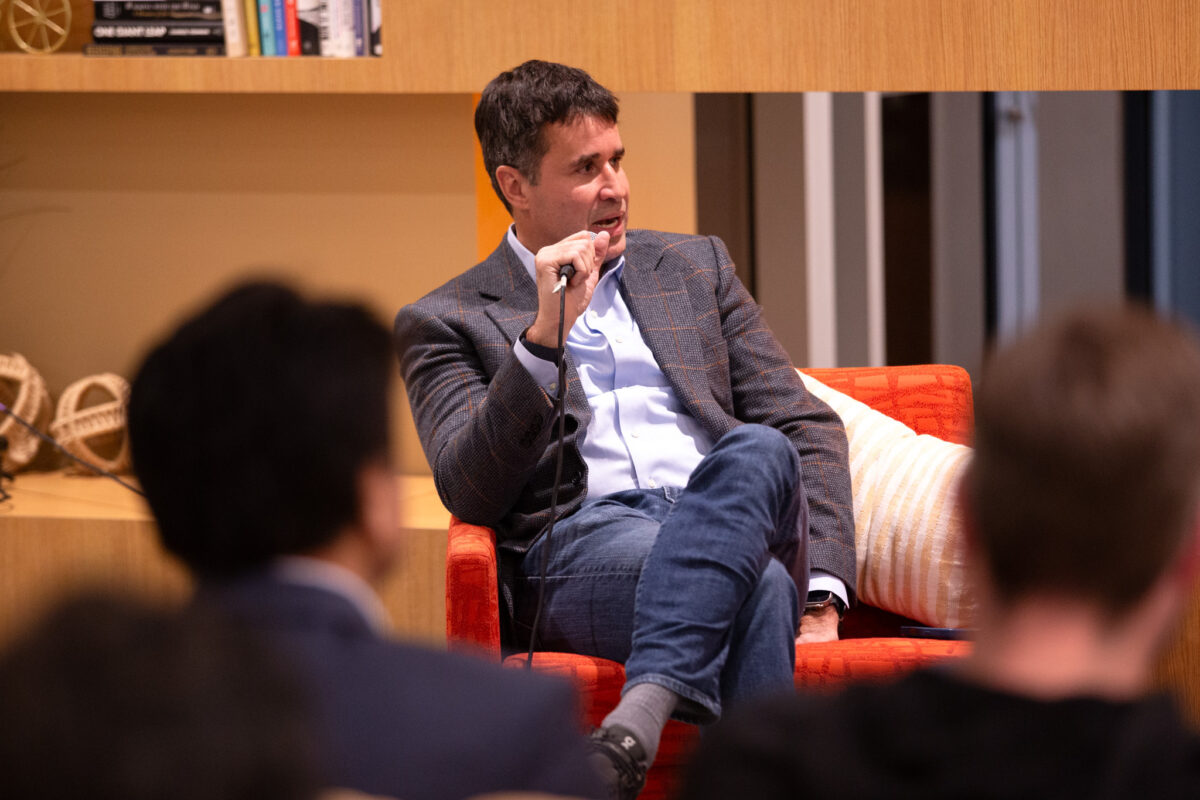
After years of building his own business, Chris Brandt is turning his attention to the next generation of entrepreneurs.
In 2022, Brandt sold his IT services company, Audacious Inquiry, in a deal valued at $400 million.
Now, he’s taking over as CEO of UpSurge at a pivotal moment for the group’s strategy — and with a fresh $1.6 million to fund the next two years.
Nearly two years after merging with the Greater Baltimore Committee (GBC), the ecosystem builder is still settling in at a more traditional economic development organization. Brandt served as an interim CEO for several months before his official appointment, succeeding Kory Bailey, who stepped down last November.
Brandt said he knows how much entrepreneurship comes down to luck. But in Baltimore, he hopes connecting major institutions to the strongest startups proves to be a winning formula.
“Let’s try to build some relationships,” Brandt said, “that could help move a handful of our top-performing companies forward.”
In this edition of How I Got Here, Brandt looks back on his early tech career and lays out his vision for UpSurge’s role in the region’s innovation economy.
This Q&A has been edited for length and clarity.
What was the beginning of your tech journey?
I wanted to be an architect. That was my childhood idea, anyway. But I took a computer science class in my first semester as an undergrad at Duke, and it was a really great class. I enjoyed the problems, the problem-solving nature of academic computer science. It felt like doing puzzles.
I think that was the pivotal moment. I ended up pursuing a degree in computer science, and the timing was very good. It was the ’90s.
What was your first job in tech?
While I was in college, I did a number of internships.
After my freshman year, I worked on the internet at T. Rowe Price. Then, after my sophomore year and into my junior year, I did a nine-month co-op doing software development for a big systems integrator and technology firm out of Northern Virginia called American Management Systems.
After that, I took a summer semester at Stanford to make up the two classes I had missed, so between my junior and senior years, I was out in Silicon Valley during the height of the dot-com boom.
It was very formative. After I graduated, I had a number of great options, and I chose to do a leadership development program with Prudential. I got my Series 7 and learned that side of the business, and then I rotated around. I worked as a network engineer for a year, and then I did project management for their financial planning platform.
What excites you about the work at UpSurge?
My opinion on where we should go, and on UpSurge’s strategy, is very much colored by my experience as an entrepreneur. The premise is this: if we’re going to grow venture and growth investment in the region, it’s going to come in the form of pretty chunky deals — $20 million, $30 million, $50 million — bigger investments. That’s what creates jobs and scales things up.
So, that’s where the GBC’s acquisition of UpSurge really makes sense. The companies that are ready to move to that next stage are also ready to do commercial deals with our major employers. What GBC brings to the table are those relationships with anchor institutions. Getting those leaders out and talking about their opportunities and challenges is really great for entrepreneurs.
Venture and growth-stage companies need customers, mentors and funders, but there has to be a real value-add and real context. So what we’re trying to do is convene the anchor institutions, the policymakers and the innovators in a choreographed, sensible way.
What are some short-term projects you’re working on?
The big drumbeat is engagement. We did our healthcare summit, and we had our advanced manufacturing event with Stanley Black & Decker. We’re also working on an energy supercycle event that I’ll be able to talk about soon, which is pretty cool. And we have a couple of lighter-weight events, like the one with the Orioles and T. Rowe Price coming up on November 17.
Beyond events, we have our monthly newsletter cadence to make sure folks are aware of the news happening in the region and to tie it together with broader national themes.
As for other projects, there’s policy work I’m cautiously optimistic about related to healthcare innovation. We’re looking at legislative changes that could help position Maryland to be among the leaders in redefining healthcare in the age of AI. That’s a big push that I’m pretty excited about.

What advice do you have for aspiring entrepreneurs?
There’s a survivorship bias, right? You’re asking someone who had a lot of good fortune, “What was the secret to your success?” With Audacious Inquiry, a lot of it was the tailwinds of interoperability, and having great people — both within the team and outside of it — who helped us succeed as a business.
Within your sphere of control, though, grit and perseverance are such a big part of success for almost every entrepreneur I’ve ever met.
High-performing “A students” especially aren’t used to failing. There’s just so much outside of your control, and you’re trying things that are exceptionally difficult. You’re going to get punched in the face. Being able to absorb that, get back up, and fight another round is the quality I’d most encourage aspiring entrepreneurs to test in themselves and think about.