Three years ago, TECFusions sent state officials a proposed vision for data centers in Pennsylvania.
In June, the concept went live when the developer turned on the first building at its Westmoreland County site. It marked a major milestone for the firm as TECFusions works to keep scaling this campus, known as Keystone Connect.
To win a $2 million state grant in support of the project, the Florida-based company promised thousands of jobs and sustainable economic growth at the former Alcoa R&D campus.
To win a $2 million state grant in support of the project, the Florida-based company promised thousands of jobs and sustainable economic growth at the former Alcoa R&D campus.
It took one expensive pitch to Pennsylvania’s Department of Community and Economic Development (DCED) to get everything started.
The Florida-based company spent $250,000 on the proposal sent in November 2023 to DCED, Technical.ly has learned. The price tag for the presentation includes direct executive time, specialized consulting, financial modeling and technical analysis.
Now, TECFusions is fighting to keep that slide deck under wraps.
Documents obtained by Technical.ly earlier this year in a Right-to-Know (RTK) request included redacted details related to these discussions — including the content of the presentation itself. After our appeal to unredact was granted by the PA Office of Open Records, TECFusions petitioned the state’s Commonwealth Court to keep the files sealed, arguing they contain trade secrets and/or confidential proprietary information. The case is currently pending in the appeals court.
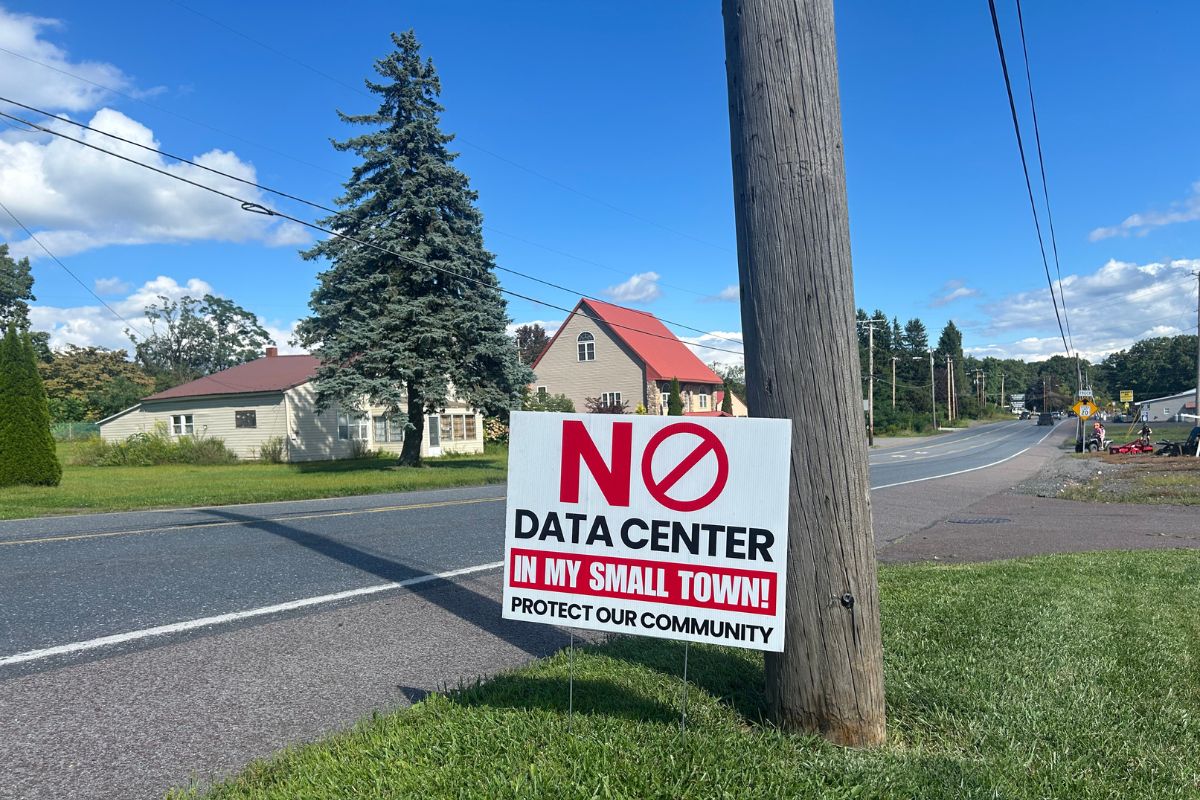
When the pitch was made, PA was still in the early days of a data center boom that government officials are now trying to rein in. TECFusion’s proposal, once widely lauded for potential economic gains, soon became the target of lawsuits and partially inspired a local moratorium as groups try to slow the builds.
Gov. Josh Shapiro’s administration has changed its attitude. Where the governor once touted ease-of-business opportunities, like fast-tracked permitting, his recent executive order aims to contain the unwieldy growth spurt. It introduces “GRID” standards for new data center developments, requiring certain environmental and energy standards, and introduces a plan for regular audits.
“The costs of data centers are not limited to energy; they also include water, land, and other resources,” Yury Dvorkin, a member of the Ralph O’Connor Sustainable Energy Institute (ROSEI) at Johns Hopkins University, told Technical.ly. “The benefits are also not limited to the tokens generated and sold; they include tax revenue, jobs and broader boosts to the local economy.”
Energy providers back up state’s efforts to court data centers
Unredacted parts of the RTK documents reveal discussions about a joint proposal between Pennsylvania, Virginia, New Jersey and Maryland around making energy grid operator PJM Interconnection more attractive to data center developers.
PJM is the nation’s largest regional transmission organization, with oversight over the power grid across 13 states.
With support from industry group the Data Center Coalition and utility companies Exelon and PPL, the quartet of Mid-Atlantic states proposed a system that “trades bring-your-own-generation [BYOG] in exchange for faster access,” according to an October 2025 email from David Wade, chief of staff for PA’s Office of Transformation and Opportunity (OTO), to PA DCED Secretary Rick Siger and Chief Transformation and Opportunity Officer Ben Kirshner.
It can take years for large data centers to get plugged into the grid as utilities make sure there’s enough capacity to serve them. Under the BYOG idea, developers who committed to sourcing their own power would get to skip some of the backlog.
“BYOG is intended to limit the cost impact on other grid-connected consumers,” said Dvorkin, of Johns Hopkins, but the intended result is not a given. “Its success hinges on two things: whether developers can procure sufficient capacity and whether that capacity can be co-located with the data center so that it minimizes use of the transmission network.”



The conversations unveiled in PA officials’ emails from last fall foreshadow where PJM eventually landed.
In August, PJM officially asked federal regulators to approve a rule that would force new large-load electricity users to take on more responsibility for meeting power needs. If approved, data centers that haven’t helped secure additional power capacity could face restrictions when demand is high. During periods of extreme heat or cold, those facilities could be asked to switch to backup generators or cut their electricity use to ease pressure on the grid.
Given PJM’s massive footprint, that’s a lot of room for influence.
“Data center costs are like a balloon — squeeze one side and costs hop across state borders,” Abe Silverman, assistant research scholar with the Ralph O’Connor Sustainable Energy Institute, told Technical.ly. “That’s why you’re seeing costs rise in places like Delaware, which has virtually no data center load growth, as well as in places like Pennsylvania or Virginia, which are hotbeds of data center development.”