
This story was made possible through support from TEDCO, the Maryland Technology Development Corporation, which enhances economic empowerment growth through the fostering of an inclusive entrepreneurial innovation ecosystem. TEDCO identifies, invests in, and helps grow technology and life science-based companies in Maryland. Learn more at tedcomd.com. All stories are independently reported, with no partner review.
Many Maryland counties and startups headquartered in the state reap similar benefits: federal proximity, a highly educated workforce and top-tier universities.
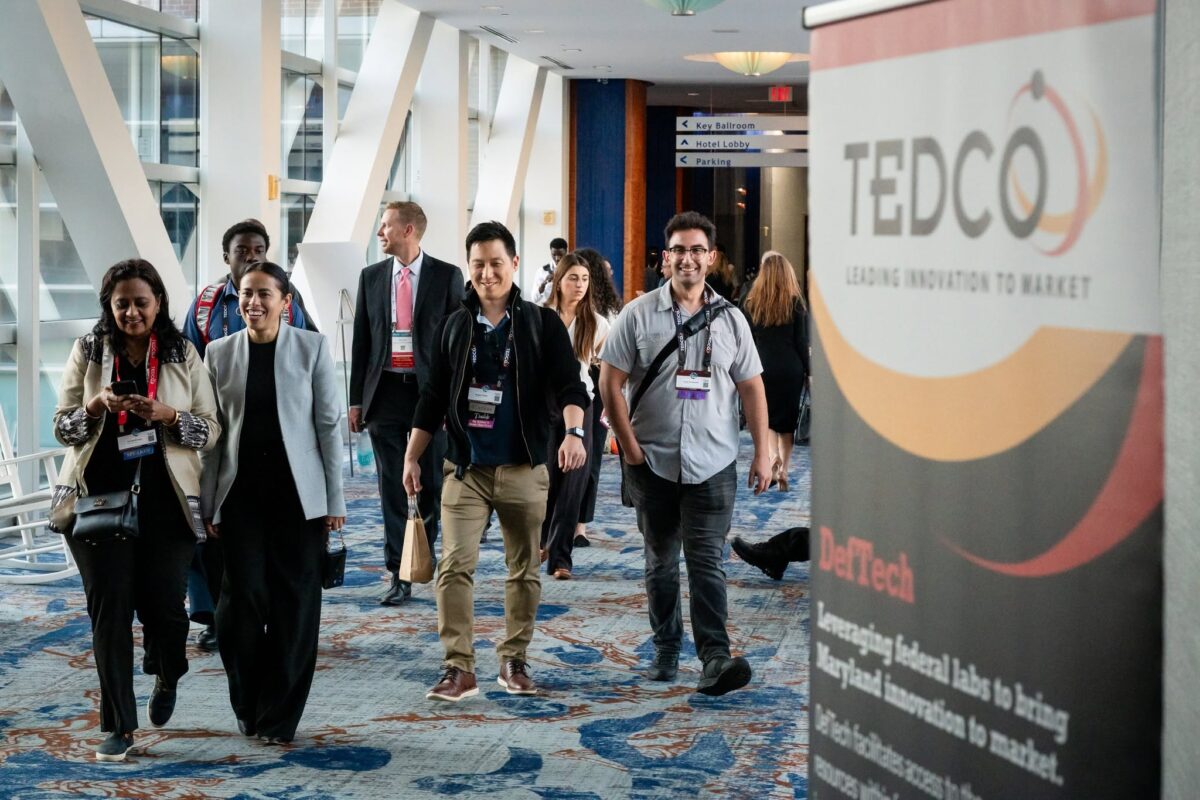
Wandering the halls of the TEDCO Entrepreneur Expo, where 1,300 people checked out everything from lacrosse grip tape to waitress robots, it was clear every corner of the state also brings something unique to the table.
Aerospace, cybersecurity, life sciences, advanced manufacturing and quantum resources span the counties — but some have a distinct edge over others. Whether that’s the presence of a large job creator or an academic partnership, there are reasons to narrow in on a specialty.
“We have the epicenter of quantum technology within our state, federal laboratories with advanced technology,” TEDCO CEO Troy LeMaile-Stovall, who stepped down shortly after the expo, wrote in an email, “and researchers who are willing to work with small businesses to support the state’s growth, and much more.”
That’s why some counties like Montgomery couldn’t pick just one, according to Montgomery County Economic Development CEO Jared Smith.
But specialization can be a good thing. A concentration of companies and skilled workers can create opportunities for collaboration, deepen a region’s talent pool and help businesses build on one another’s expertise.
Five Maryland county-level leaders explain why they hold the edge for their specific industry and what it takes to narrow in on a niche.
Anne Arundel County: Cybersecurity
Anne Arundel County identified several growth industries in its five-year strategic plan, including aerospace, life sciences and logistics.
Yet cybersecurity stands out as the county’s largest economic opportunity, according to Anne Arundel Economic Development Corporation CEO Amy Gowan. That focus is anchored by Fort Meade — the state’s largest employer — which houses the National Security Agency, US Cyber Command and the Defense Information Systems Agency.
“You have this unique concentration of federal mission,” Gowan said, “that then supports our cybersecurity and defense contracting industries that surround the fort.”
The county ranks among Maryland’s top hubs for federal cybersecurity contracts over the past decade, according to a recent Technical.ly analysis. Federal cybersecurity spending per capita trails only Montgomery and St. Mary’s counties and ranks closely with Howard and Prince George’s.
Looking ahead, the county hopes to find more ways to unite the public and private sectors in cybersecurity and other emerging technologies, Gowan said.
“We’re looking to take some of those dispersed efforts and bring them together in a centralized kind of hub, like an innovation space,” Gowan said, “where we can really provide intense, targeted resources to help our technology companies.”
St. Mary’s County: Aerospace
For St. Mary’s County, growth is all about looking to the skies — and its local infrastructure backs it up, according to economic development specialist Emily Lacey.
The Navy might be better known for operations at sea, but its footprint here centers on Naval Air Station Patuxent River, a testing ground for aviation technologies.
The county also boasts a strong regional airport surrounded by the Aeropark Innovation District, where aerospace companies operate alongside University of Maryland aerial testing facilities.
“There’s just a lot of opportunity for innovation and startups,” Lacey said, “in that aerospace, defense contracting space.”
Frederick County: Life sciences and related manufacturing
Reflecting Frederick County’s geographic diversity, where sprawling farmland meets an expanding urban corridor, economic development leaders avoided pinning the area to just one niche.
Instead, two stood out: life sciences and advanced manufacturing, according to senior business development manager for technology, Solash Aviles.
On the life sciences side, the county already hosts pharmaceutical heavyweights such as AstraZeneca and Thermo Fisher Scientific. Plus, it’s home to the Frederick Innovative Technology Center, a business incubator for primarily biotech startups.
“We sit on the northern end of the 270 corridor,” Aviles said, “having access to those big pharmaceutical companies anchors our life sciences industry and workforce development.”
But advanced manufacturing also works alongside life sciences. The term refers to using modern technology to refine production processes, which is often essential in vaccine and medical device development.
“It’s the synergy of technology and manufacturing,” Aviles said.
Carroll County: Advanced manufacturing
Frederick’s eastern neighbor also embraces the potential of advanced manufacturing.
Earlier this year, Carroll County welcomed a SpaceX production facility to Westminster. That addition builds on an already robust manufacturing base, which includes Strouse Corporation, Knorr Brake and Northrop Grumman.
Carroll County’s agricultural roots carry over well into the sector, according to deputy director of business development Paige Sunderland.
“We have a very strong work ethic from our workforce because we are a rural community, a farming community,” Sunderland said. “Those skills and that work ethic seem to have translated well to advanced manufacturing.”
Prince George’s County: Quantum and AI
Prince George’s County is all in on quantum and AI.
Home to the University of Maryland, College Park — the epicenter of the state’s Capital of Quantum initiative — that choice is hardly surprising.
The campus supports industry heavyweights like IonQ, a new Microsoft research facility and key federal testing partners.
While still in its nascent stages, the sector could be an economic boon for fields such as cybersecurity and finance, according to technology business development manager Sam Braden IV.
“We have the higher education institutions, proximity to DC and federal agencies,” Braden said. “There’s a lot of opportunity.”