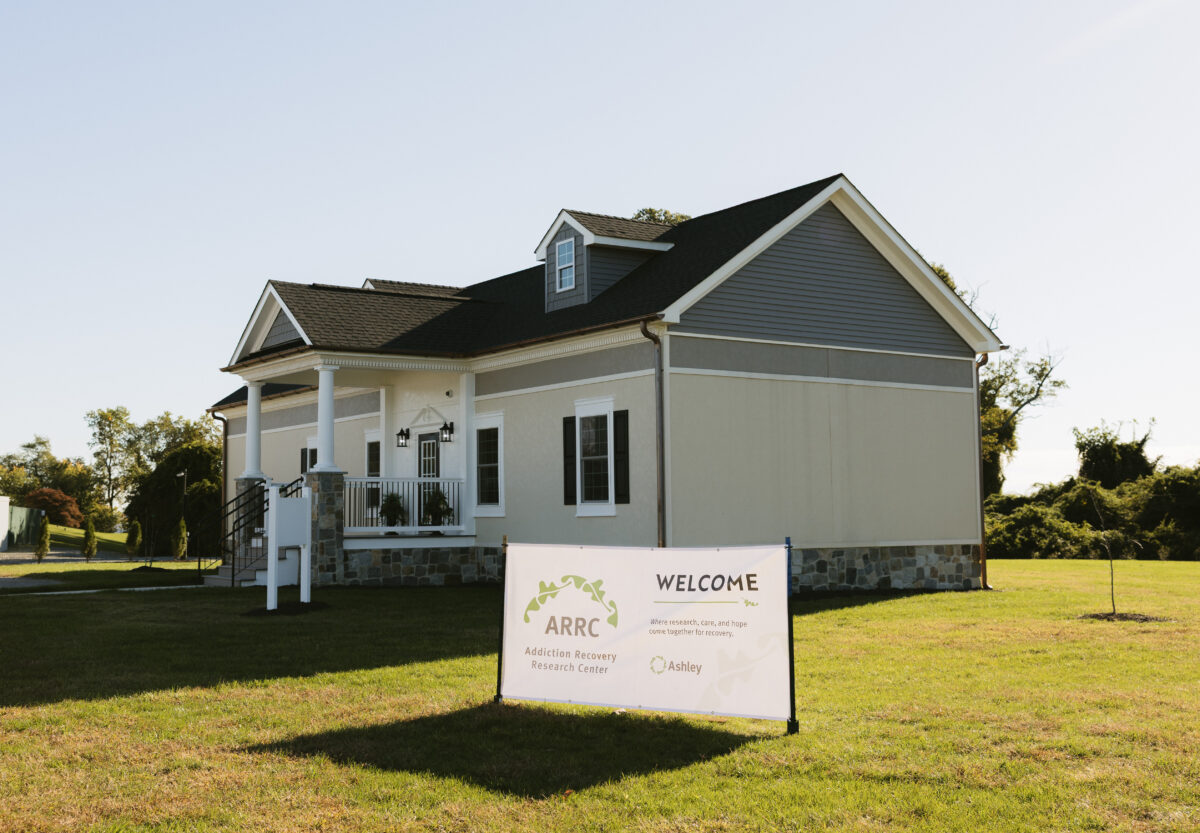
A Maryland addiction treatment center has opened a research facility, advancing an uncommon model that brings scientific studies directly into care.
Ashley Addiction Treatment revealed the new building on Tuesday, which will provide a dedicated space for its studies. The effort expands on the nonprofit’s research partnership with Johns Hopkins University School of Medicine and, for everyone involved, the facility is long overdue.
“We were literally operating out of the basement,” Jami Barney, Ashley’s director of clinical research, said. “We couldn’t have patients down there. We called it the research dungeon.”
“[Addiction] wasn’t seen as a medical illness. It was seen as a moral failure. Hospitals didn’t want anything to do with it.”
Jami Barney, Ashley Addiction Treatment
Typically, studies and clinical trials take place within academic institutions, and their findings only slowly trickle down to providers.
That dynamic distinguishes addiction medicine from fields like oncology, where patients can receive care at academic hospitals that double as study or trial sites.
“[Addiction] wasn’t seen as a medical illness. It was seen as a moral failure,” Barney said. “Hospitals didn’t want anything to do with it.”
While Barney doesn’t consider hospitals ideal places for long-term recovery, stigma has historically kept addiction isolated from mainstream medical research, she said.
Barney, who previously worked at Hopkins, first arrived at Ashley’s main campus in Havre de Grace as part of a university study. For more than seven years, the organization has collaborated with Hopkins researchers to inform and improve its treatment offerings.
This includes research on cognitive decline in older adults with substance use disorders, the link between gut health and recovery and treatments for co-occurring insomnia and alcohol use disorder.
Research drives treatment, but access remains a challenge
In 2018, Ashley’s inaugural research study with Hopkins targeted fentanyl, the powerful synthetic opioid that began dominating the street drug market around the mid-2010s. Collaborating with Hopkins researchers, Ashley’s team set out to measure how long it takes for fentanyl to leave the body.
“It was such a new chemical compound,” Barney said, “even a question as simple as that hadn’t been answered yet.”
The resulting data gave Ashley’s staff a better understanding of fentanyl withdrawal. Since then, the center has conducted dozens of studies aimed at refining its treatment models.

Beyond specific studies, the Ashley team also monitors patient physical and mental health metrics.
“Every piece of data that we collect actively shapes patient care,” Barney said.
Its research, however, is limited to its client base. Ashley serves a predominantly white and older demographic, according to its 2025 impact report.
While the nonprofit accepts most major commercial insurance plans, that still excludes a significant portion of individuals with substance use disorders — nearly 26% of whom are uninsured, according to a 2022 study published in Drug and Alcohol Dependence Reports. The organization relies on donor funding and philanthropy to provide treatment scholarships.
That struggle is not unique to Ashley. Drug treatment is notoriously expensive, with the average total cost of residential rehabilitation in Maryland close to $57,000 per person.
Early findings on GLP-1s and addiction treatment
Looking ahead, the Ashley research team is gearing up for its first clinical trial in three years: a study investigating GLP-1 medications and addiction.
Early research suggests the popular weight-loss drug may help treat substance use disorders by targeting the same brain pathways that regulate dopamine response. The upcoming trial will evaluate the efficacy of combining a GLP-1 with naltrexone, an established medication-assisted treatment for alcohol use disorder.
While the joint trial with Hopkins will provide rigorous clinical data, Ashley’s internal research team has already begun tracking the phenomenon. Staffers analyzed a cohort of 25 patients who arrived at the center while taking the drug.
Rather than improved treatment outcomes, researchers found higher rates of depressive symptoms.
“It gave us the basis of information that this does need to be further evaluated,” Barney said, “because people are coming out right now and making strong claims.”