
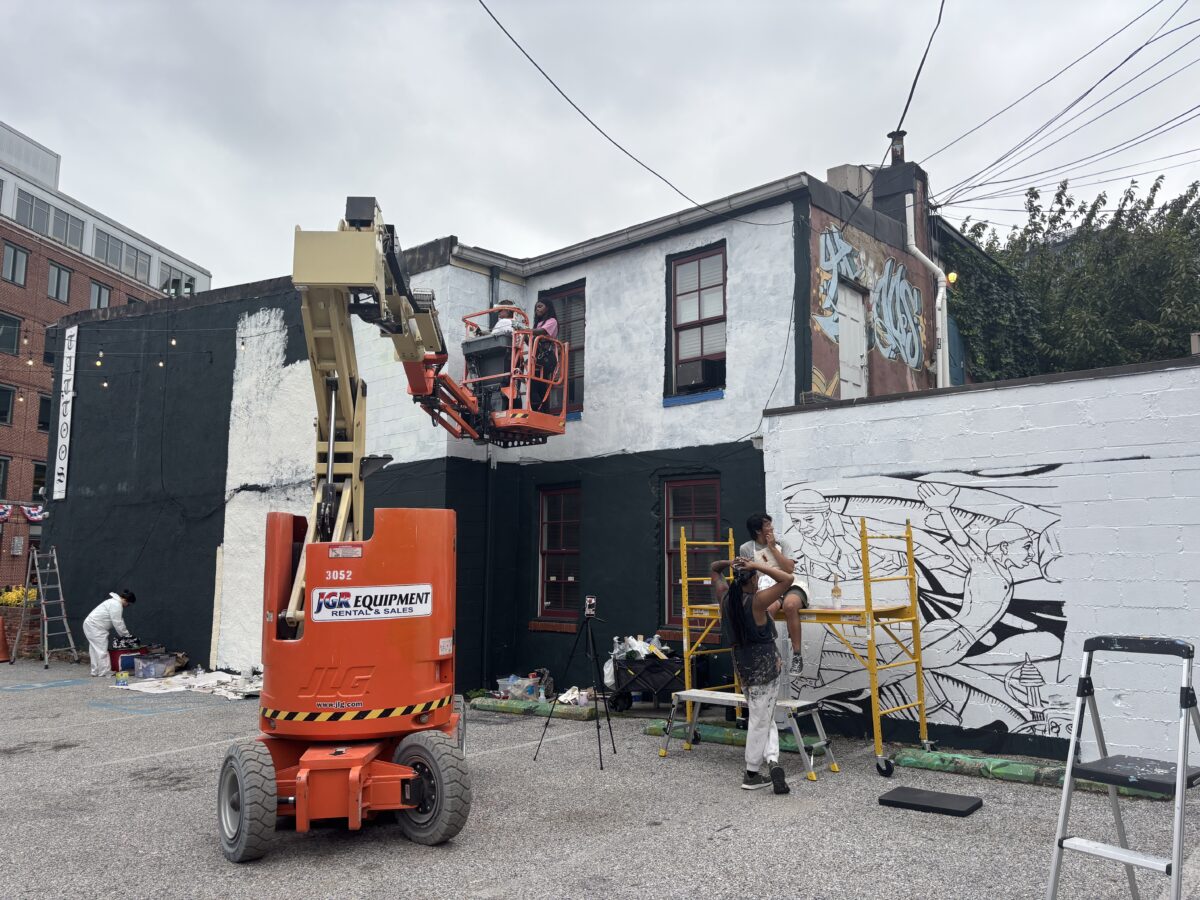
A muralist’s toolkit has long included paint, brushes and ladders, but in Baltimore, artists are reaching for something decidedly more futuristic: a VR headset.
The tech helps painters with the arduous task of scaling designs for large surfaces. Rather than relying on projectors and other methods, VR systems create virtual sketches that artists use as guides for tracing.
“Who wants to drop $2,000, compared to a $300 headset?”
Caroline Lampinen, muralist
“It has made my job go so much faster,” local muralist Caroline Lampinen told Technical.ly, “so much faster.”
Lampinen uses a Meta Quest headset and an app called Contour. She positions her design and locks it into place using hand controllers, likening the setup to following a “floating picture in space.”
VR assists Lampinen about 75% of the time, she said. She often mixes and matches techniques, including traditional grids or pounce patterns, a method that uses perforated paper to transfer designs.
Fellow Baltimore muralist Camila Leão has also jumped on the VR bandwagon. Both Lampinen and Leão used the method in September during Baltimore’s Brush Mural Festival, an event dedicated to supporting local artists.
Leão first noticed the technique on Instagram, where it has gained popularity among muralists. She tried it for the first time last year and now primarily relies on the headset to transfer her designs.
Ditching the night shift
Many mural artists rely on standard art projectors, which force them to work at night when ambient light won’t impact the image. While powerful projectors exist for daytime work, they often retail for thousands of dollars and require an external power source.
“Who wants to drop $2,000,” Lampinen said, “compared to a $300 headset?”
And Leão certainly does not miss those long nights up on the wall.
“There are some glitches,” Leão said, “but it’s all worth it for the flexibility.”
It might not be the solution for everyone.
Being in the headset for long periods of time can cause nausea or vertigo. That is especially true for women, who are more likely to experience motion sickness in VR environments, according to research from engineering firm Lockheed Martin. Critics of the technology point to a gender bias in headset design, which often lacks features that could reduce simulator sickness.
Plus, the image can appear slightly distorted, making it better suited for large shapes than precise work such as lettering or intricate patterns.
“It’s just like anything else,” Lampinen said. “You can get the hang of it and manipulate it.”