Looking over a cross-section of members of the region’s tech community, real estate developer David Cordish, Gov. Larry Hogan and Baltimore Mayor Stephanie Rawlings-Blake stood on a stage and spoke of the importance of startups and entrepreneurs for job creation.
Rawlings-Blake talked about how the new coworking space they were gathered to open, called Spark Baltimore, was a sign that “smart, young people from around the country are trying to move here.” After they flipped the switch on the ceremonial lightbulbs, Cordish, whose firm developed the space, raised both arms in celebration, as if celebrating a championship.
It was plainspoken and a little brash: hallmarks of a good entrepreneur. But to Mike Subelsky, the cofounder of adtech startup Staq and a veteran of the local scene, the event had him reflecting more on what the city had provided him, rather than what he added to the city.
“Baltimore made me an entrepreneur,” Subelsky said. “I feel like I owe everything to the city. I always think, ‘I could’ve lived anywhere.’”
The current plans point to a promising time of growth. But big new investment also means higher stakes.
Then, he brought up a quote attributed to Bill Gates: “We always overestimate the change that will occur in the next two years and underestimate the change that will occur in the next ten.”
Subelsky was referencing the ten years that passed on his own startup journey. During that time, he helped form the Beehive Baltimore coworking space and the Ignite Baltimore talk series. He had watched as Betamore emerged, joining the Emerging Technology Centers in the pool of local resources for startups and aspiring tech workers. There were acquisitions and closings and hiring churn. Tech was on the map.
That Gates quote covered the last decade, but it also seemed to apply to the next. The Baltimore tech community of today is full of fast-moving plans that seem set to change the landscape. And since this is the fifth anniversary of Baltimore Innovation Week, let’s pick five years for a prescient look into the future.
The signs are already there.

Located above Power Plant Live!, Spark Baltimore’s opening represented a center for startups in the city’s business center.
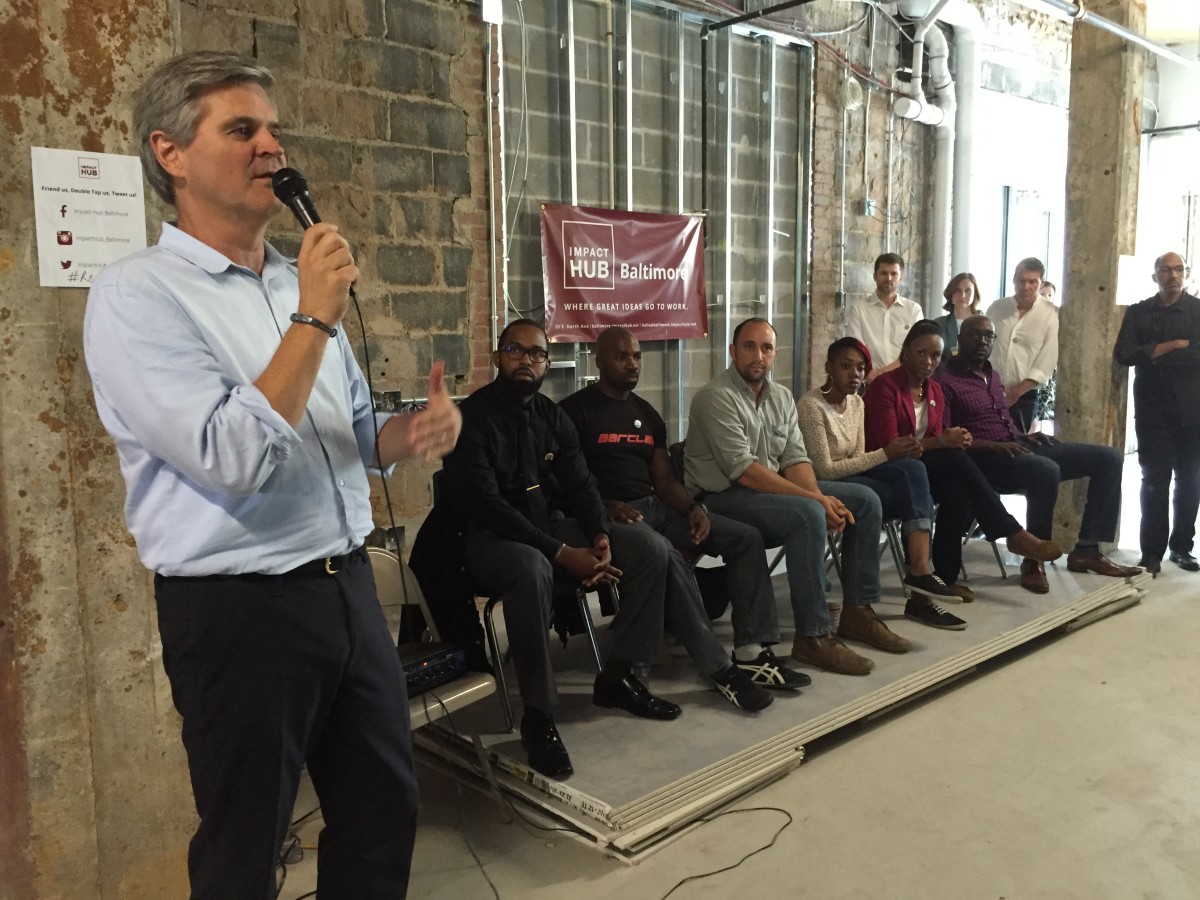
Then, about a week after the event mentioned above, seemingly all of Baltimore’s political leaders gathered on a frigid morning outside the newly-reopened Penn North CVS that was torched by rioters eight months earlier. They talked about how the innovation economy could bring jobs to the area, and laid out a 6.8-square-mile map of West Baltimore that is dubbed Innovation Village. The following week, City Councilman Carl Stokes called a $17.5 million economic development deal that would clear the way for a new building housing a startup incubator at the University of Maryland BioPark the “best TIF ever” — referencing a wonky governmental financing program. In Station North, entrepreneurs turned out to hear from the city’s mayoral candidates at Impact Hub Baltimore. And the next day, Under Armour representatives presented plans for a sprawling new campus in Port Covington to a city architecture panel.
In the months that followed, two ambitious makerspaces opened in the form of Open Works on Greenmount Avenue in Station North and The Foundery, which reopened with ten times the space at City Garage in Port Covington. A Pigtown industrial building was getting new life as a manufacturing hub for startups. Construction chugged along on a new building that would house Johns Hopkins’ FastForward incubator.
A maze of intricacies and interests surround each of these projects. The details continue to unwind, but there are a couple of common threads that run through each.
Tech and entrepreneurship are at the heart of each. None of the projects are in the areas that the startup scene congregated in before the last couple of years.
But where entrepreneurs took pride in developing their own spaces to align with what they wanted, these new projects require working with, and in some cases getting permission from, the city’s decision makers.
Taken together, the current plans point to a promising time of growth that reflects on a city with serious companies and the ability to create jobs, but big new investment also means higher stakes. Really, the future of the city is at stake.

Talent. Ideas. Funding. Space. Events.
The pieces of a tech community are now recognizable, and can be mapped. But it wasn’t always that way. Part of a national campaign, Startup Maryland cofounder Mike Binko also began his efforts to spotlight the state’s entrepreneurial efforts in March 2012. On a bus equipped with a studio to record pitches, Binko criss-crossed the state looking to find entrepreneurs he could shine a light on. The idea of ecosystem building wasn’t fully formed yet.
“We didn’t know what we’d find, but we were blown away when we did it,” he said.
This year, the Startup Maryland tour is organized around identifiable industry clusters, and Binko maintains that Baltimore is the “crown jewel” for the region.
Betamore Board Chairman Greg Cangialosi and CEO Jen Meyer, an entrepreneur and an economic development executive who have championed local tech efforts, see what was once a grassroots effort woven into the fabric of the city.
“Innovation and ‘being an entrepreneur’ have definitely become commonplace in Baltimore,” they said in joint remarks emailed to Technical.ly. “No longer is it abnormal to meet people who are building, investing in or working for a startup company.”
It’s also a realization of the idea that creating a few new spaces and relatively small investments can help startups flourish — especially in an area that already features a high concentration of STEM and creative workers, big institutions with lots of resources and a cityscape of affordable amenities.
That’s a lot of pieces, and they look good on paper, but getting everyone to agree can take just as much work as drawing the plans up. It’s easy to point to the money behind Johns Hopkins’ big investment in startups as a catalyst for the current moment, but Johns Hopkins Technology Ventures Senior Director of Strategic Initiatives Elizabeth Smyth said the collaboration that’s happening is just as important. Folks like Cangialosi, Meyer and Subelsky found working together helped early, and now these larger groups are realizing that, too.
“We are creating an environment where companies now have the space, funding and services they need to get started, and hopefully, grow,” Smyth said. “Additionally, I think that all of the groups that support economic growth through innovation are working hand in hand to envision a new future for Baltimore.”

Based on the responses for this article, these new projects won’t ultimately succeed if leaders don’t keep working together. But there’s also an opportunity to build something new, and this is where Gates’ quote about underestimating the next ten years comes in.
Margaret Roth believes the companies that establish themselves over the next five years will be the foundation for the city for years to come. The cofounder of data interoperability startup Yet Analytics is one of the Johns Hopkins grads that the city’s leadership wants to keep around. But she stayed for an opportunity to build a business, rather than a specific decision to stay in Baltimore. Now she’s committed, and says she couldn’t leave if she tried. But plenty of other smart Hopkins grads ended up leaving, and that’s whom she thinks about when it comes to the future.
“You can’t rebuild a city’s population on a small subset of risk takers,” she said.
That population could come from people moving in, but it could also be right here. Sagamore Ventures’ Demian Costa, who works with startups through investment and at City Garage, said it was equally important to do a “better job of telling our growth and opportunity story to the rest of the country, and attracting more companies to locate here,” as well as “expand tech-enabled training programs in the public school system to ensure we are preparing the workforce in our community to be able to take these jobs that are being created.”
Along with collaboration, the idea of building infrastructure also keeps coming up. In tech, it’s about the anchor companies or bolstering the organizations that help them. But for a Baltimore resident thinking about living or staying here, issues like transportation, housing, public education and WiFi also come up. Embracing the entire city may mean dealing with its challenges, but that might be where the ideas we need to succeed originate.
One area that bridges the tech scene and the city’s wider issues is social entrepreneurship. To Michelle Geiss, who founded Impact Hub Baltimore with Pres Adams and Rodney Foxworth, the conversation and support for social entrepreneurship is already there.
“The discourse around equity and opportunity in the city is strong, and is increasingly finding its way into the strategies, board rooms and budgets of resource-holders and policy-makers,” she said.
But Roth, of Yet Analytics, says there’s a message there for entrepreneurs, too.
“We have to be willing to try things that may challenge our belief systems, that may be out of our comfort zones, that test us,” she said.