In the world of healthtech startups, some founders are content to start out with an idea, an identified need in their respective ecosystem, and a lot of faith. Others, however, need a little more support to take their companies from a university lab to an office in the Strip District or East Liberty.
That’s where accelerators can come in handy. But which one is the right one for your company?
As a part of XchangeInnovation Week, the HealthTech Startups Showcase gave LifeX, Innovation Works and Nucleate Pittsburgh the chance to explain what they offer startups while allowing a few of the companies they’ve backed to highlight their products and achievements.
If you could only be in Oakland in spirit during the festivities, no worries: Technical.ly’s here to share what each of these programs could do for a startup in need.
LifeX

If you’re a life sciences company in need of assistance in the way of commercialization, funding and resources to support your startup’s growth, LifeX might be a good option for you. LifeX offers a three-month accelerator where startups can receive hands on support from experts in the field, gain access to content designed for early-stage healthcare and science spinouts, and
benefit from the incubator’s network of companies and the experience their founders bring with them. A life sciences startup inside or outside of Pittsburgh can apply for the program.
“A critical component of our accelerator program is being intentionally designed to help to create access to our companies to a very diverse and broad network of experts, again, that span ranges of backgrounds, expertise, geographies [and] institutions,” LifeX Director of Ecosystem Development Kelly Collier said.
LifeX alumni include Resilient Lifescience — one of Technical.ly’s 2023 RealLIST Startups — and Precision Neuro, which you might recognize as the 2022 UpPrize Social Innovation Challenge first place winner.
Innovation Works’ AlphaLab Health and Gear

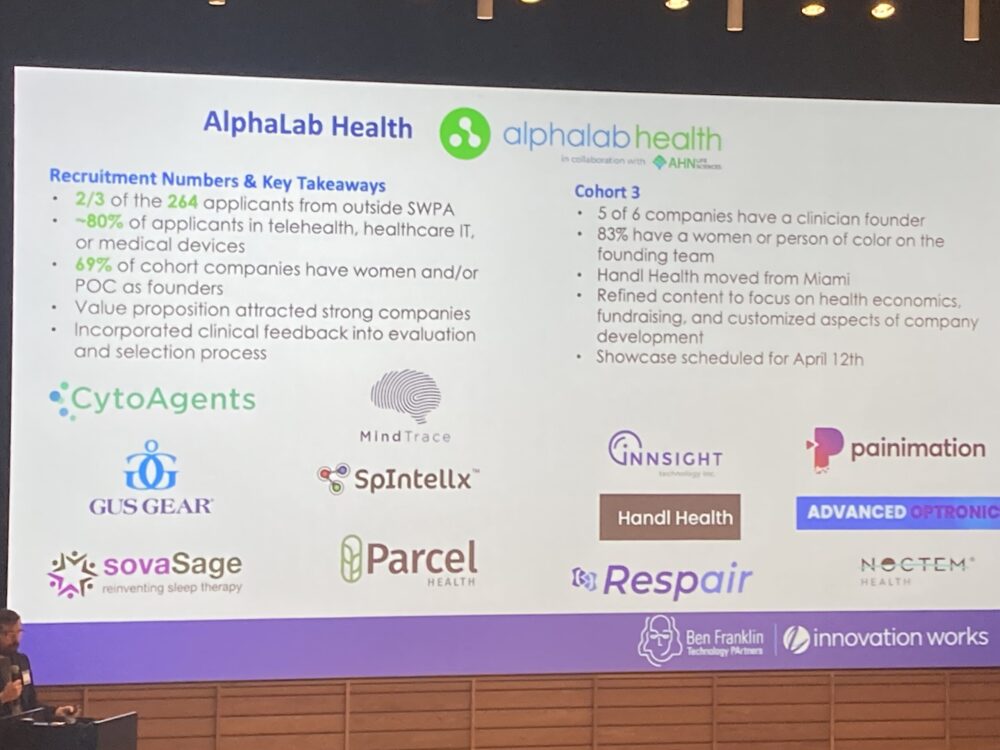
Started in 2020 by early-stage funder Innovation Works and Allegheny Health Network, AlphaLab Health wants to lend a hand to companies navigating the healthcare system. The program’s support comes in the form of up to $100,000, mentorship from seasoned industry professionals, and the use of wet and dry lab space. Innovation Works also runs the AlphaLab Gear program, which focuses on hardware-based startups and provides them with hands-on help building their products, as well as up to $100,000 in investment, too.
Since its inception, the AlphaLab programs have supported companies such as AlgenAir, a natural air purifier development company, and Morgantown, West Virginia-based Endolumik, a surgical device company calibration system to enable surgeons to see better during their surgeries.
Thanks to AlphaLab Health’s support and the use of the AlphaLab Gear facility, Endolumik CEO Mara McFadden says the company has been able to build a network of support while having a place to work within the city.
“We’ve done all of our benchtop mechanical testing in the [AlphaLab] Gear offices,” McFadden said. “And that’s been a great residence for us.”
Nucleate Pittsburgh

Last but not least, Nucleate Pittsburgh provides a student-led haven for biotech companies.
As a local chapter of a global network, Michael Gee and Chris Aldrich, two Carnegie Mellon University students and the Pittsburgh chapter’s co-managing directors, said Nucleate Pittsburgh’s mission is to link up with biotech companies and VCs with a desire to support biotech-based entrepreneurship. Having both spent time in cities such as San Francisco and Boston, Aldrich and Gee said they saw no reason why Pittsburgh didn’t have a student-centered biotech community.
By starting Nucleate Pittsburgh, Aldrich said, they hope to create a network of biotech startups and researchers, and a place to educate the next generation on what career opportunities lie in biotech.
“We have a number of programs suited to whatever your needs,” Aldrich said. “We do believe that diversity is the future of biotech. Over 50% of our team identify as women, nonbinary [and] 25% are underrepresented minorities.”
_
As Pittsburgh continues on its quest to become a life sciences hub, more resources will be needed to support the region’s young companies. Check out these additional startup resources to help make it happen, and if you have any other recommendations as far as accelerator programs for healthtech startups that should be highlighted, let us know at [email protected].