
Deep inside the halls of Mount Pleasant High lies an unexpected surprise.
Behind two double-doors is an 8,000-square-foot space, split up into three large rooms, where students can build and test robots, cut wood with a CNC mill or laser cutter, create prototypes with 3D printers, and even construct big projects like, say, smart farms.
What’s a smart farm? It’s one of the tech department’s student projects that involves building a greenhouse from plywood that uses devices like Arduino micro-controllers to do things like sense humidity in soil, water plants and provide lighting.
There are also plans for infrared cameras to record growth progress.

A student-programmed Arduino microcontroller for sensing soil humidity.(Photo by Lindsay Podraza)
On Wednesday night, Mount Pleasant’s tech and engineering students held an open house to share their projects, called “idea2impact,” as part of the first-ever Delaware Innovation Week.
The largest group of students there, clad in matching black T-shirts, is working on a WikiHouse project. WikiHouse, based in London, is an open-source architecture forum that aims to help people around the world design and build sustainable and low-energy homes, particularly for those who need temporary disaster relief.
The designs call for the pieces of wood to fit together so they can be easily put up and taken down without many tools. “It’s kind of like a puzzle you can live in,” said senior Jillian Quale.

Some of the students working on the school’s WikiHouse project. (Photo by Lindsay Podraza)
About 20 teens at Mount Pleasant lead WikiHouse First State, which is Delaware’s only (and the world’s first student-led) chapter. Their goal is to build a 40-by-16-foot house by the end of May that they can send to help Syrian refugees. They’re also working on creating items like modular desks, beds and chairs that they can send to people in need. “We’re promoting the idea of completely community-built architecture,” Quale said.
The students, however, are going to soon need help from the community in sponsoring the project if they want to finish it by May, said tech-ed teacher Brooks Twilley. He said he’s proud of the work they’ve done so far, and is happy about the enthusiasm for learning about technology and engineering at Mount Pleasant.
“I’ve got the best job in the world because I get them excited about what I’m excited about,” he said, “and that’s solving problems.”
Other cool projects from the Mount Pleasant tech lab include:
Sophomores Darren Brumberg and Nick Suiter showed off their particle accelerator that launches nuts (the metal kind) more than 100 feet. “We went through a ton of rubber bands,” Brumberg confessed.

Darren Brumberg (left) and Nick Suiter are building a particle accelerator. (Photo by Lindsay Podraza)
Three quarters of an all-girls team — sophomores Jakayla Allen, Olivia Smith-Donovan and Sierra Milhoan — talked about how they’re preparing to represent Mount Pleasant in a February Technology Student Association competition that involves multiple-choice questions, a hands-on test and an essay. The trickiest subject to study for? Six Sigma.

Left to right: Jakayla Allen, Sierra Milhoan and Olivia Smith-Donovan study for an upcoming STEM competition. (Photo by Lindsay Podraza)
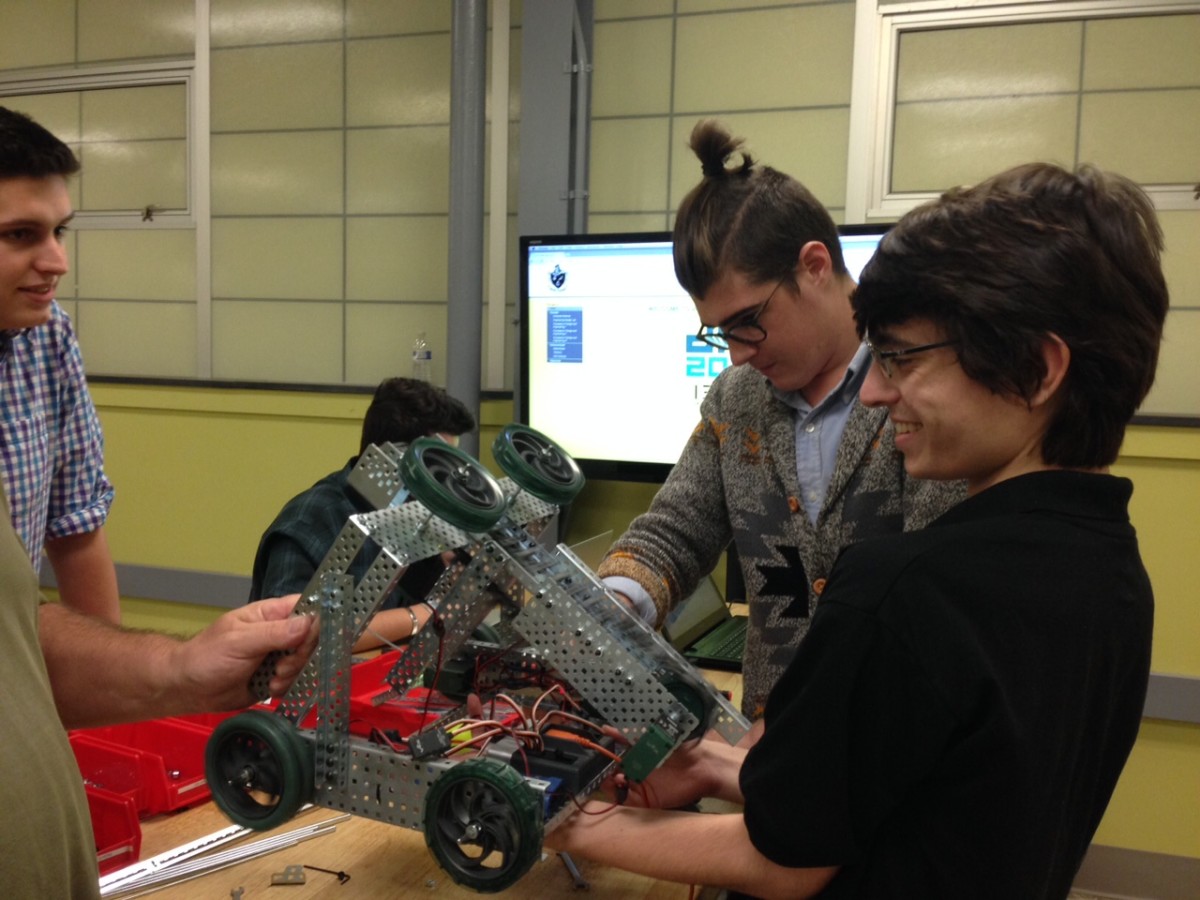
A bunch of other students worked on their robots for an upcoming Vex tournament, where they’ll scrimmage against other schools with robots that (hopefully) throw foam balls into designated nets. Junior Alex Beyer said he hopes the two Mount Pleasant teams make it to the worlds level of the tournament. “We’ve got a really great team, and I think we can go far with this,” he said.

Students test a robot for competition, launching a foam ball in the process. (Photo by Lindsay Podraza)
Before you go...
To keep our site paywall-free, we’re launching a campaign to raise $25,000 by the end of the year. We believe information about entrepreneurs and tech should be accessible to everyone and your support helps make that happen, because journalism costs money.
Can we count on you? Your contribution to the Technical.ly Journalism Fund is tax-deductible.

Join our growing Slack community
Join 5,000 tech professionals and entrepreneurs in our community Slack today!

The person charged in the UnitedHealthcare CEO shooting had a ton of tech connections

The looming TikTok ban doesn’t strike financial fear into the hearts of creators — it’s community they’re worried about

Where are the country’s most vibrant tech and startup communities?
