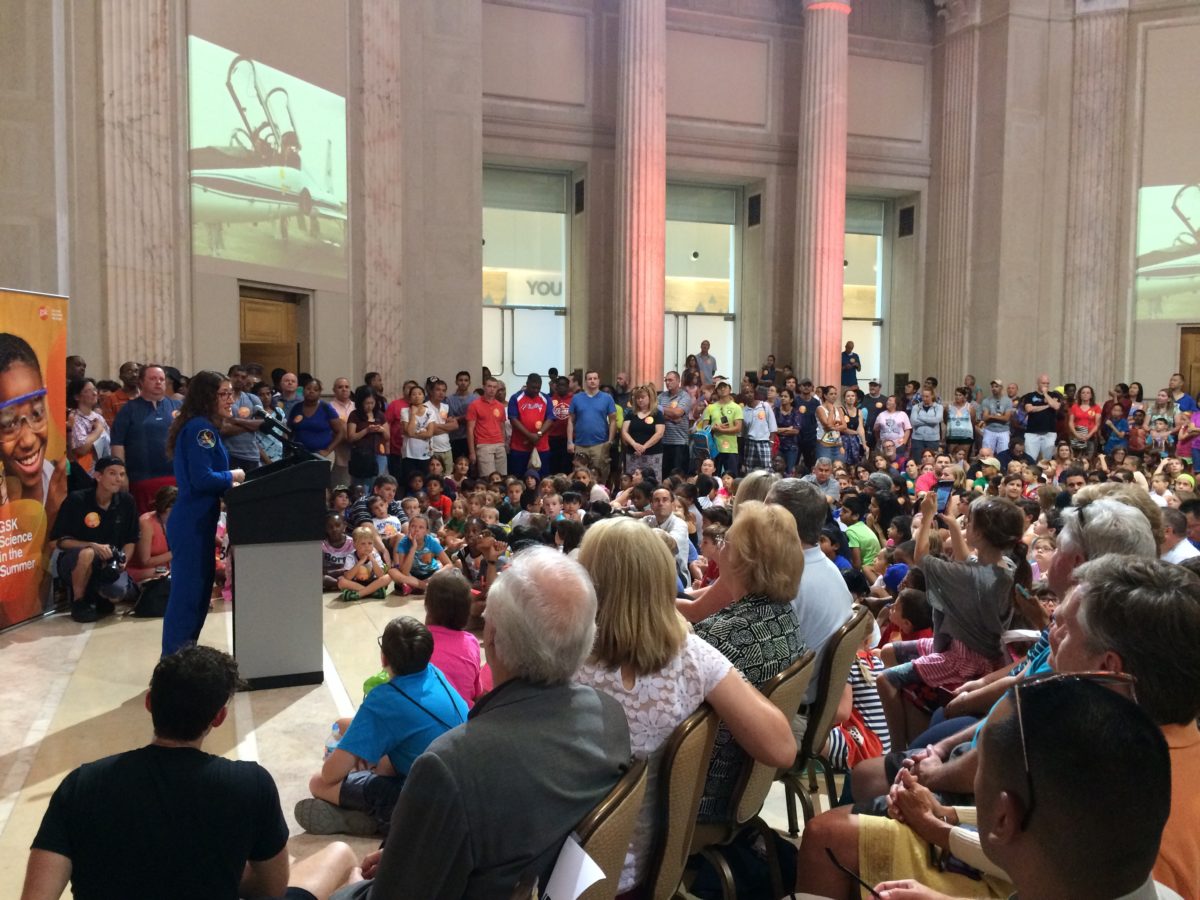
The heatwave has made Philly feel a bit like Venus, but that didn’t stop NASA from dropping into town last weekend to celebrate the 30th anniversary of GlaxoSmithKline Science in the Summer, a free STEM (science, technology, engineering and math) enrichment summer program for kids. Founded by former GSK scientist Dr. Virginia Cunningham of Montgomery County, the program has locations all across the country.
To mark the occasion, the Franklin Institute hosted more than 1,500 Philadelphia-area elementary school students and their families for a day of live science demonstrations and free admission to the museum.
NASA’s traveling International Space Station (ISS) exhibit also rolled up outside, offering visitors the chance to touch a moon rock brought back to Earth by Apollo 17 astronauts.

But the event’s biggest attraction was NASA astronaut Christina H. Koch, a member of the space agency’s newest class of astronauts who recently completed training and is now eligible for future space travel assignments.
Koch, who grew up in Jacksonville, N.C., and is based in Houston at the Johnson Space Center, spoke with enthusiasm to kids gathered around the museum’s Benjamin Franklin statue, detailing her beginnings as “a space gadget engineer” and her transformation into “a girl training to do a spacewalk.” Young faces stared at her in awe when she mentioned that for every day the kids have been alive, there have been humans living continuously in space aboard the ISS.

Earlier in the day, we sat down with Koch to chat about civic tech, STEM and what Philly has in common with astronauts.
###
The Philly tech scene is always grappling with how to relate tech skills and knowledge into civic tech. What, in your experience working with NASA, are the benefits of lending technological skills and knowledge to a civic organization that’s for public good and public interest?
I think that’s huge. I sort of see two ways that there’s a carryover. One would be in the actual technology itself. For example, the idea of using technology to increase collaboration, to increase knowledge sharing and to increase access to information. Using tech to make sure that folks who need to know something have access to that information when they need to know it. Often, in city or any sort of government organizations, there are so many different people trying to do good, but if they don’t know about other resources even within the organization, they can be less effective than they may need to be.
When I was going through school, I never heard the term 'STEM.' I just knew that I had never seen a female engineer or scientist growing up.
And then, the other thing that I would say connects NASA with the idea of civic tech is just that we’re all here to benefit humanity. At NASA, the whole reason we do what we do is to bring the research, development opportunities and results back to Earth to benefit people here. Some of the reasons that civic organizations exist, to bring up populations of underserved people and things like that, are the same goals that NASA shares.
You started in engineering, right?
Engineering and science, yes, but mainly engineering, electrical engineering and physics.
When we talk about STEM, people are quick to associate just the science part with space, whether it’s the science of astronomy or astrophysics. But technology and computer science elements are what allows a lot of the scientific research to happen.
Absolutely. A lot of that is actually applied in the human spaceflight program, which is what I’m a part of now. In my past work with NASA, I was more on the science side. I used engineering skills to design science instruments for planetary probes or Earth-orbiting satellites. But now, being on the human exploration side, yes, we’re doing science on the space station, but in order to enable that science, to get it to happen, an amazing amount of engineering feats happen behind the scenes.

Working with NASA, do you think of STEM as a cultural idea, a skill set or just a term that gets thrown around? The word “innovation” has kind of become a buzzword without a lot of meaning behind it, and I wonder if you think STEM is becoming like that.
It’s interesting, both of those buzzwords — STEM and innovation — have kind of taken on a life of their own, and sometimes when that happens, you forget the origins. When I was going through school, I never heard the term “STEM.” I just knew that I had never seen a female engineer or scientist growing up.
I think that those terms can still have meaning if we remember how and why they came about. Innovation in particular is one that I like to think about because even though we may be advancing, if we’re not innovating and changing and making new ways of doing things every couple of months, we’re not advancing enough. You have to innovate, think outside the box and come up with novel solutions for problems, and that’s really where I think the excitement of STEM lies.
There’s also a lot of talk of inserting an “A” for arts into STEM. With the state of human spaceflight at NASA, part of your training involves Russian language classes. Does throwing in something that’s more based in the humanities offer any insight into the really calculated, scientific stuff that you do the rest of the time?
That’s a great question. I think that science can inform the humanities and humanities can inform science and technology. I actually joked that I chose physics and electrical engineering as my college majors because I knew I wouldn’t have to memorize a single thing, I just had to understand concepts. So then, mid-career, I’m in this job where I have to now learn a language that’s so unrelated to English. I might fly a supersonic jet in the morning, and then go have Russian class in the afternoon. Having your mind be able to [switch] from one activity to the next that quickly is a really interesting challenge.
Philly has a growing startup scene. Working within NASA as an astronaut, how do you see the startup mindset translate over? Because at the end of the day, SpaceX was a startup, and now they’re living proof that if you have something to offer, you can be a huge part of space travel.
That’s exactly what I would bring up, that’s a great example. We are so excited to be partnered with commercial providers such as SpaceX because we want to foster the abilities and technologies that are involved in going to space. Any good ideas are on the table. Even though NASA is a large organization that has been around for a while, we’re constantly looking for ways to incorporate that innovation, and you do see examples of it all the time.
And I have another way I can relate [NASA] to Philly. This town has a lot of grit. [My teammates and I] are asked a lot, “How’d you get to this point?” and one of the things I talk about is grit, stick-to-itiveness and not giving up despite any odds against you. I think Philly has that spirit. Being the [nation’s] founding city, I think that there are a lot of parallels between the spirit of the city with the astronaut side of NASA and the hard work we put in to make it all happen.