

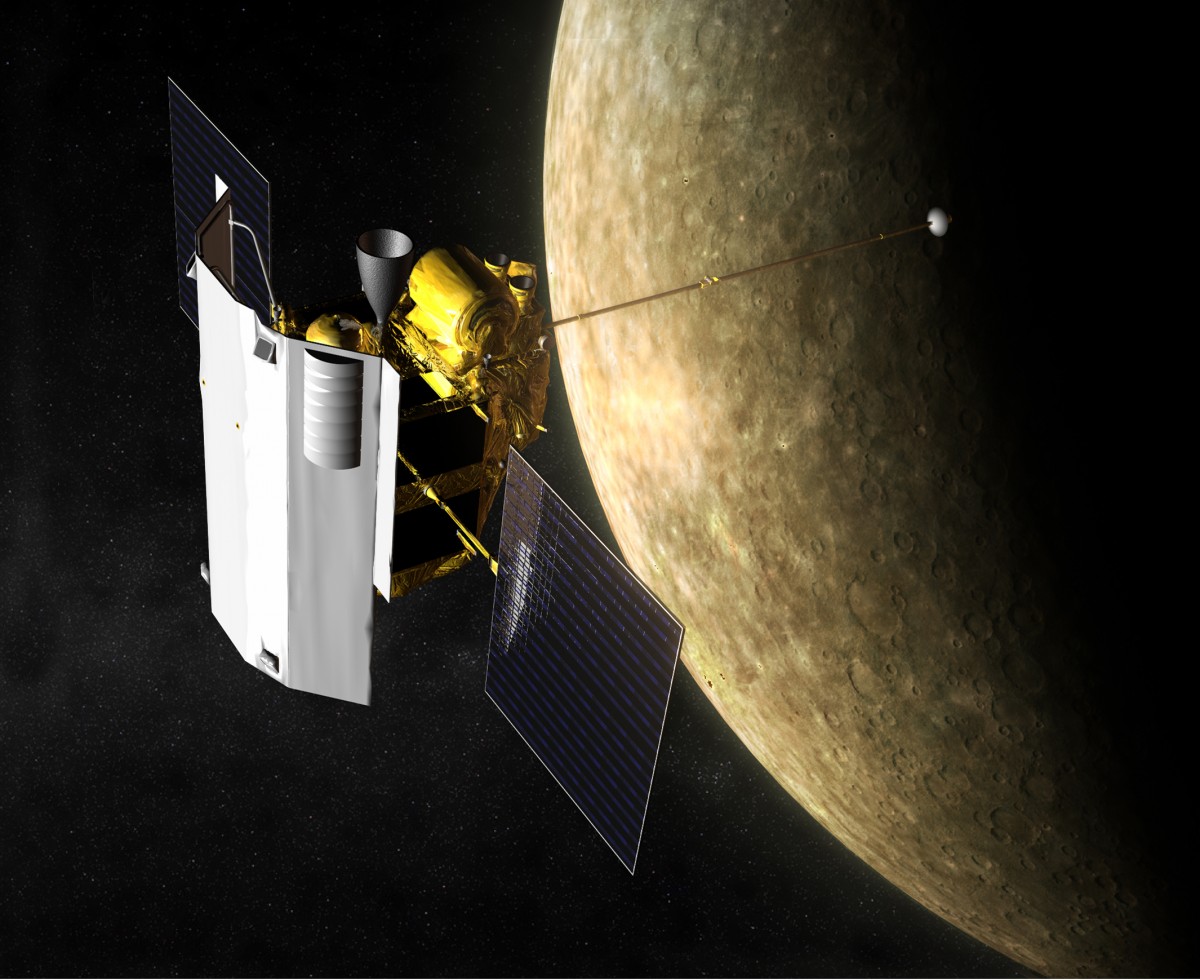
The Mercury Messenger space probe said its goodbyes on Thursday:
The probe, which is operated by a crew at the Johns Hopkins Applied Physics Laboratory, crashed into Mercury on Thursday afternoon after running out of fuel.
When it crashed, the probe was traveling 8,750 miles per hour, and created a crater about 52 feet wide.
The landing ended a four-year orbit of the first planet from the Sun, during which it took numerous close-up photos and data to help scientists learn new things. The craft itself has also been a site of innovation. The Hopkins engineers devised a series of ways to keep it flying on three occasions, including a December discovery that kept the spacecraft running on helium.
“Although Mercury is one of Earth’s nearest planetary neighbors, astonishingly little was known when we set out,” Sean Solomon, director of Columbia University’s Lamont-Doherty Earth Observatory, said at a Monday farewell briefing at NASA HQ. “Messenger has at last brought Mercury up to the level of understanding of its sister planets in the inner Solar System.”


