For Drexel physical therapist Margaret O’Neil, one big challenge is coming up with exercises that are both physically and intellectually stimulating for her cerebral palsy patients. Using active video games — games controlled by the body — is relatively new and unproven territory for her. Although, from 30 years of experiences, she knows it’s possibly a better option than simply handing a child with cerebral palsy a list of exercises to do at home.
“We know anecdotally, in talking to kids with cerebral palsy and their families, that giving somebody a list of exercises is not necessarily very motivating, and oftentimes isn’t done,” said O’Neil, an associate professor in Drexel’s physical therapy and rehabilitation sciences department. “What I’m trying to do is find those treatment ideas that will engage kids and teens and keep them active, or get them active, in a fun, motivating way.”
But commercial body-controlled video games (think Microsoft Xbox Kinect or Nintendo Wii games) don’t meet a lot of the physical therapy needs of kids with cerebral palsy. Some games are too difficult, while others are too overwhelming with noisy special effects.
So in 2013, O’Neil turned to Paul Diefenbach, fellow Drexel professor and cofounder of the school’s RePlay Lab, for help in creating a game that met her physical therapy requirements, was easy to learn, and would keep the interest of her patients. Three years later and Kollect was born. It’s the first video game from Enable Games, a company Diefenbach and O’Neil cofounded to create video games specifically for physical therapists and their patients.
https://vimeo.com/63972578
“The concept is essentially a game portal, a website for active video games for people with disabilities,” said Diefenbach, who runs the RePlay Lab and is now in his 12th year at Drexel. “Our initial target is children with cerebral palsy, but then we’ll expand to adults with cerebral palsy and adults with neural motor conditions like multiple sclerosis or Parkinson’s.”
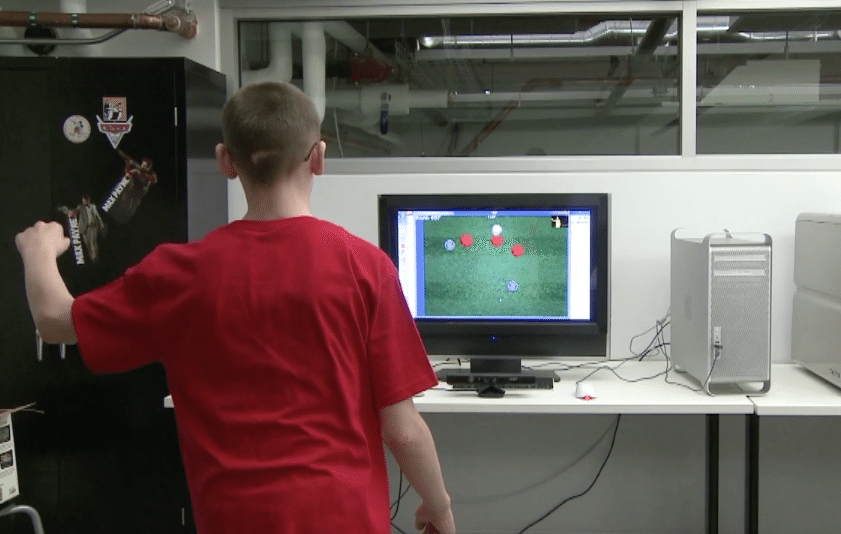
In Kollect, players stand in front of a Microsoft Xbox 360 Kinect motion-capture device, then move their hands and legs around to literally collect rotating, multi-colored blocks on the computer screen. Games can be played standing or sitting, for wheelchair-bound patients. Most games don’t last longer than five minutes, and therapists can change the speed and intensity of the game through a back-end portal. In that way, therapists are able to structure game conditions to reach the heart rate and level of physical mobility individual patients need, as well as collect actual data through the game on how well a patient’s physical therapy is moving along.
“The idea of flexible gaming parameters allows the therapist to adjust the game to address therapeutic goals,” O’Neil said. “We have kids wear heart-rate monitors and activity monitors during gameplay to see if they’re reaching the aerobic level we know is health-producing.”
So far 12 kids have played three games of Kollect each for 20 minutes each game. According to O’Neil, patients who have tried Kollect in Drexel’s RePlay Lab have enjoyed playing, and that’s key. As children with cerebral palsy age, she says, they become sedentary. Having a fun way to not only keep her patients active, but also give her insight into how much exercise her patients are getting, is something that can’t be achieved through the active video games on the market today.

Diefenbach says Enable Games has raised “well over a quarter of a million” dollars, some of that directly from Drexel, in its 18 months’ of existence. The company licenses Drexel technology that’s developed by undergraduate and graduate students who are programming the games themselves.
The next step for Enable Games and Kollect is a series of clinical trials sometime later this month. Ten new children with cerebral palsy will try playing Kollect in a clinical setting, and the goal will be making sure therapists are able to use and understand the game — and that the game continues to hold the interest of patients.
“Therapists do use games right now in therapy, but as a mechanism or reward for getting through exercises,” said O’Neil. “There are no commercial games right now that have the flexibility we’re trying to build into Enable Games’ products.”
How a video game company from Drexel is helping kids with cerebral palsy
Cofounded by a pair of professors, Enable Games uses video games for physical therapy.