

After more than four years shaping UpSurge as a key force in Baltimore’s tech scene, Kory Bailey is now moving on.
His departure comes eight months after the nonprofit merged with the Greater Baltimore Committee (GBC), a move that shifted his role from CEO of UpSurge to a member of the executive team within the economic development organization.
“This is a bittersweet moment,” Bailey told Technical.ly. “But we’ve really built a cohesive startup community that did not exist before UpSurge.”
Bailey was one of UpSurge’s founding members when it launched in 2021 as an equity-focused ecosystem builder for Baltimore’s startup community. He helmed several of the organization’s key initiatives, including Equitech Tuesdays, a gathering for the city’s founders and supporters that met more than 200 times before it ended in June.
“It’s imperative that we work on both the condition setting and infrastructure building, while also being able to focus very tactically on outcomes-based activities.”
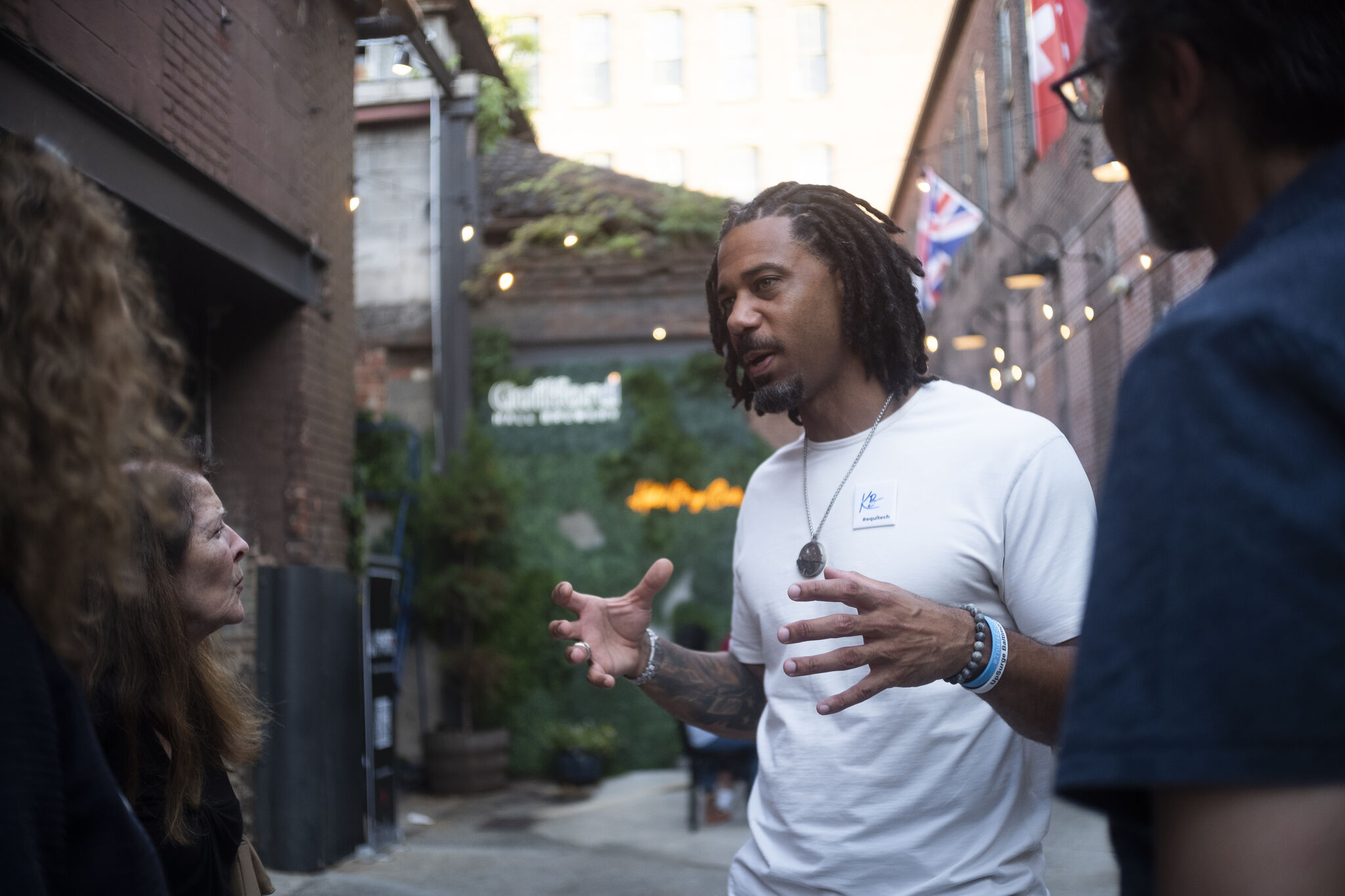
Kory Bailey, former executive at GBC
He also helped establish the Equitech Accelerator in partnership with the national Techstars network and collaborated with the GBC to establish Baltimore as one of the Economic Development Administration’s 31 Tech Hubs — despite the city being excluded from federal funding through the program twice.
Since UpSurge’s integration into the GBC, the focus has shifted away from some of the priorities Bailey helped establish. The organization is now more concentrated on developing a comprehensive data framework to identify high-growth potential startups that can create jobs in the region, rather than serving as a community-building resource.
“It’s imperative that we work on both the condition setting and infrastructure building, while also being able to focus very tactically on outcomes-based activities,” Bailey said.
Technical.ly spoke with Bailey about his time at UpSurge and the challenges of integrating different visions for economic development.
This Q&A has been edited for length and clarity.
Why are you leaving the UpSurge team?
I’m an ecosystem builder. I like to build things around big ideas and big visions and bring people into that work.
UpSurge’s work is now moving more toward that precise, economically driven focus. I also know there are plans to get the team back out into the market to really engage the ecosystem.
For me, it felt like a natural point to pass the torch, wish the team well and now be able to participate as a member of the ecosystem.
When someone from outside the region asks about the Baltimore tech community, what do you tell them about UpSurge?
I usually lead with how connected it is now, and that’s largely due to the work we’ve done at UpSurge for the last four and a half years.
When we started in early 2021, there were a lot of great startup programs. There were different pockets of startup activity, but there was no one organizing principle or organization that was bringing the startup community together.
When we set out to bring that community together, we really were intentional and focused on making sure that everyone had access to the startup community.
What are you most proud of accomplishing at UpSurge?
Building an ecosystem where ideas have a place to be socialized and tested was pivotal for us.
Equitech Tuesdays were a big thing that we stumbled upon, born out of my desire to meet people in person, get off of these Zooms, and get back out into the world.


Slowly but surely, we started learning the faces and names of the people doing exciting things in the startup community. Eventually, it wasn’t just from the startup community. Civic leaders were joining, cultural and arts community leaders were joining and people in economic development were also coalescing around the idea.
Why did Equitech Tuesdays end?
During the integration process with GBC, it was apparent that Equitech primarily engaged early-stage entrepreneurs. People who needed that network, access to those resources and to just socialize the product or company that they were working on.
But now, we want to identify companies that have grown out of that early stage and are starting to experience growth, create more jobs and create more revenue.
In order to identify that set of companies, we paused the convening strategy and focused on the data that we’ve been collecting over the course of four and a half years to try to build some models to identify those growth-stage companies.
I was of the mindset that we could continue to do both, maybe slow down the pace of Equitech Tuesdays, but in the integration, the focus became the data and identifying more high-potential companies for growth.
The second friction point is that a lot of people didn’t know how to differentiate UpSurge from our mission statement or our vision, which was Equitech.
Equitech was a galvanizing force for some and a source of division for others. Because there was friction around that word and the vision it represented, especially in the current federal landscape, the decision was made to sunset the program and distance UpSurge from that terminology from a marketing and branding perspective.
I don’t fault anyone for that. It is just the environment that we live in and the tensions that have to be managed between shifting landscapes.
A strong focus of your work is uplifting founders of color, especially women of color. What progress has been made and what else needs to be done?
There are so many phenomenal women founders here, and I think we did a great job of elevating that as a reality of our ecosystem, with the data supporting that investing in these founders is a force multiplier that generates the greatest return.
What I wish we could have done more of is more intentional investment around that. If you go downstream, you can’t just highlight that there are more female founders.
There are still not enough female investors. We need more female VCs. We need more female angel investors. So in our ecosystem-building work, what we continue to do is peel back the layer of the activities that need to happen in order to generate more growth.
How did UpSurge and your role at the org shift during the merger with GBC?
We had two very different cultures, two very different value systems. Making sure that we were advocating for that startup culture and that value system, and that my team was still aligned around those goals, was really important.
In a startup, you have to be flexible, willing to pivot and able to read the market ahead of time. In corporate America, those changes happen much more slowly.
The “what” became: How do we bring these two bodies of work together? Traditional economic development is very sequential and very reactive. It’s: We have this opportunity, let’s wrap this set of activities around it and try to get to this outcome, whether a site visit, a bid or a company relocation.
Anyone who knows the differences between the inertia and gravity of corporate America and the fluidity and iteration that exist in startups understands the contrast.
In a startup, you have to be flexible, willing to pivot and able to read the market ahead of time to say, “Here’s where the market is going, and these are the directions we need to take the company.” In corporate America, those changes happen much more slowly.
I think we did a great job of modeling how two different modalities can operate together. Of course, the goal is to reach a place of synergy, where collaboration across teams, morale and all of those factors are in sync. I believe there is still work to be done in that area.
What’s next for you?
I’ve started having conversations with people working on different initiatives, and they really stirred something in me.
One of these conversations I’ve been having is around the ecosystem of leadership in the Baltimore region, whether within corporate structures or through leadership programs.
The other thread that has really been pulling at my heartstrings, and that I want to explore further, is the economy of the arts and cultural community.
People from the innovation and tech community have been coming to me about projects connected to culture and creativity, and I want to help bring those people together.


