This story is published as part of the Baltimore News Collaborative, a project exploring the challenges and successes experienced by young people in Baltimore. The collaborative, of which Wide Angle Youth Media is a member, is supported by the Annie E. Casey Foundation. News members of the collaborative retain full editorial control.
Kat Hausauer spends her afternoons learning how to apply her passion for drawing to game design.
At Code in the Schools’ after-school program, she’s channeling her love for first-person shooter games like UltraKill and Titanfall 2 into creating her own worlds and characters.
“If a piece of art holds importance because the artist is Black or because the artist is queer, all of that gets washed away, and it just becomes this one thing.”
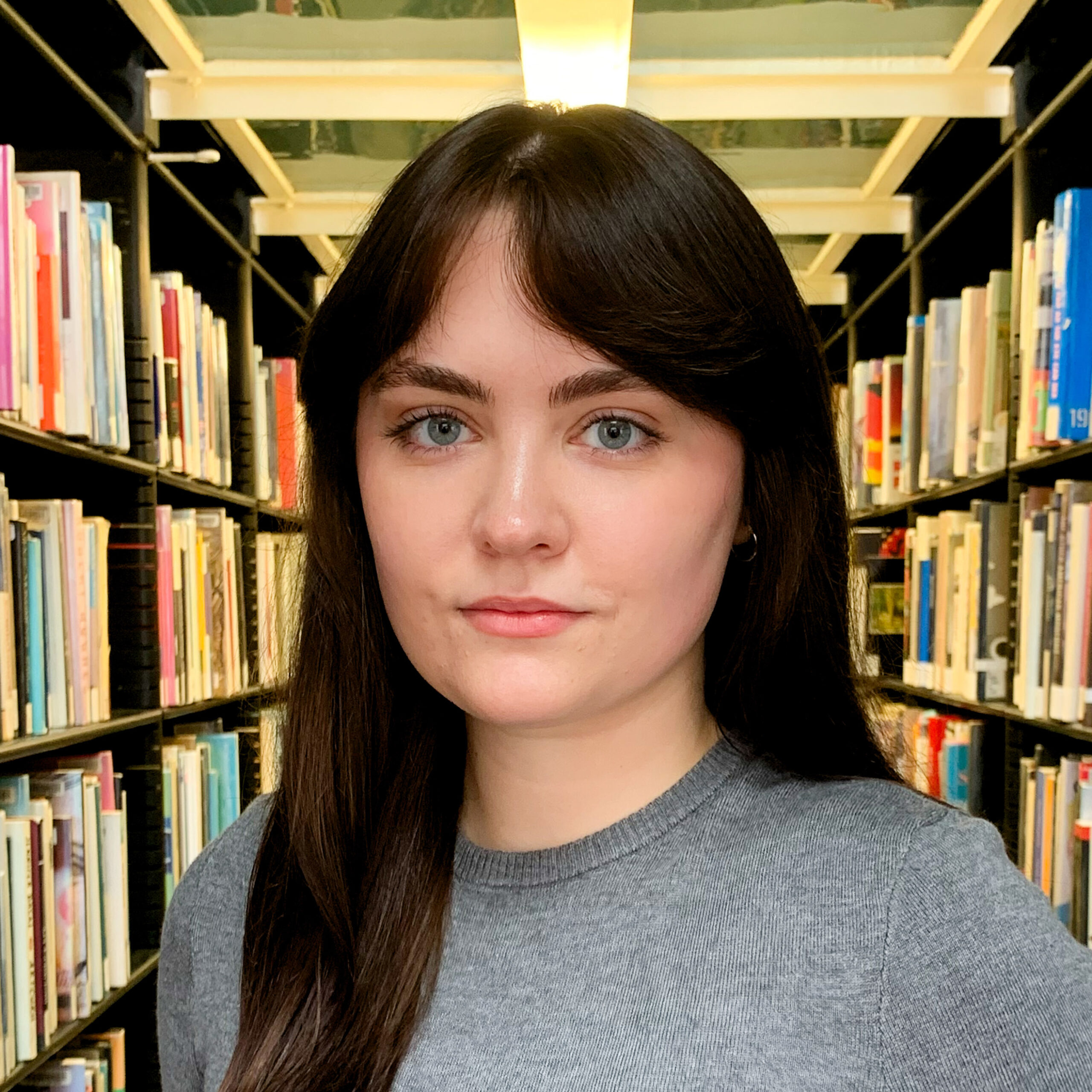
Ali Thomas
But when it comes to her artistic process, Hausauer can’t imagine letting artificial intelligence take the reins. She’s concerned that AI-generated art trains off human artists’ work without giving proper acknowledgment.
“It’s the kind of thing that makes AI art go from something that’s just soulless to something that’s soulless and stealing,” Hausauer said.
It also bothers her to see AI art creeping into subcultures she’s interested in — like the artists who used AI in a Pokémon trading card illustration contest. And when it comes to school work, Hausauer also hesitates to use AI for assistance.
“If I’m gonna fail, I’m gonna fail by myself,” Hausauer said.

Max Huck, also enrolled in the program, has experimented with AI tools to help fix coding bugs. So far, he hasn’t found them particularly effective, though he’s open to trying as the tools improve. With designing visuals, he doesn’t see AI becoming a major part of the practice for himself or others.
“AI is focused on just the product of art,” Huck said. “You enter a prompt, and then AI creates the art for you. But part of art is the process.”
Huck feels uneasy about how rapidly AI-generated visuals are improving. He recently came across anime fight clips on social media and didn’t realize they were AI-generated until a disclaimer popped up at the end.
“It was scary because of how easy it could be used to make misinformation,” Huck said.


Jada Butler sees AI as a helpful tool for generating ideas. At a Dent Education program, Butler has used AI to create rough images of sticker concepts, which she then refined and turned into her own designs.
“It really breaks things down to you on a different level,” Butler said. “It serves as a tool to take what’s in your brain and really helps you visualize it in real time.”
Aaliyah Clark, a member of Wide Angle Youth Media’s student council, also incorporates AI tools, like Microsoft Copilot and Canva AI, into her creative process. AI “helps guide me through all of my creative ideas,” she told Technical.ly via email, “and gives me suggestions and tips on things that could improve the way that my work looks.”
But Butler also emphasized the importance of learning how to use AI properly. She hasn’t received much instruction in school at Baltimore Polytechnic Institute, where most of her teachers ban its use in class. While some teachers provide a more structured approach, she wishes schools fostered more ongoing discussions about it.
“I feel like it could be integrated into schools in a healthy way, but it’s also important to teach people how to not misuse it,” Butler said.

The situation differs at the city’s biggest public college. Ali Thomas, a student at Morgan State University and social media intern at Wide Angle, says her professors established guidelines for proper AI use from day one. She uses AI occasionally as an organizational tool or grammar checker, but isn’t interested in applying it to creative work.
Thomas finds it unsettling how AI-generated art can strip meaning from the original pieces it draws upon.
“If a piece of art holds importance because the artist is Black or because the artist is queer, all of that gets washed away, and it just becomes this one thing,” Thomas said.
Thomas also worries about the environmental toll of the data centers powering the AI boom, from rising energy demands to heavy water use. She’s additionally concerned that Black communities will bear the brunt of the environmental and economic consequences. A recent Tech Policy Press article noted that data centers in California often cluster in areas already burdened by pollution — communities that are largely Black or Latino, a pattern linked to historic redlining policies.
“It’s just going to continue to go under wraps,” Thomas said. “More regulation needs to be mandated.”