
Any member of group chat and my wonderfully patient advisor knows that during my final year of college, in my dreams, I frequently saw a world where I failed my statistics final and didn’t graduate. If you bumped into me at the time the flu was making its rounds through my campus, I would’ve said it was a cosmic joke that I didn’t get sick and a fever wouldn’t be granting me a reprieve. I know it’s dark, but I’m not alone in my aversion.
In anticipation of Duolingo Math, Duolingo’s first departure from its typically linguist-based learning apps, the Pittsburgh edtech company conducted a survey to gauge just how prevalent math anxiety was. Researchers found that a third of survey respondents would rather have dental surgery than solve algebraic equations and that roughly 30% of people would rather join a real-life “Squid Game” than take a three-hour college math test.
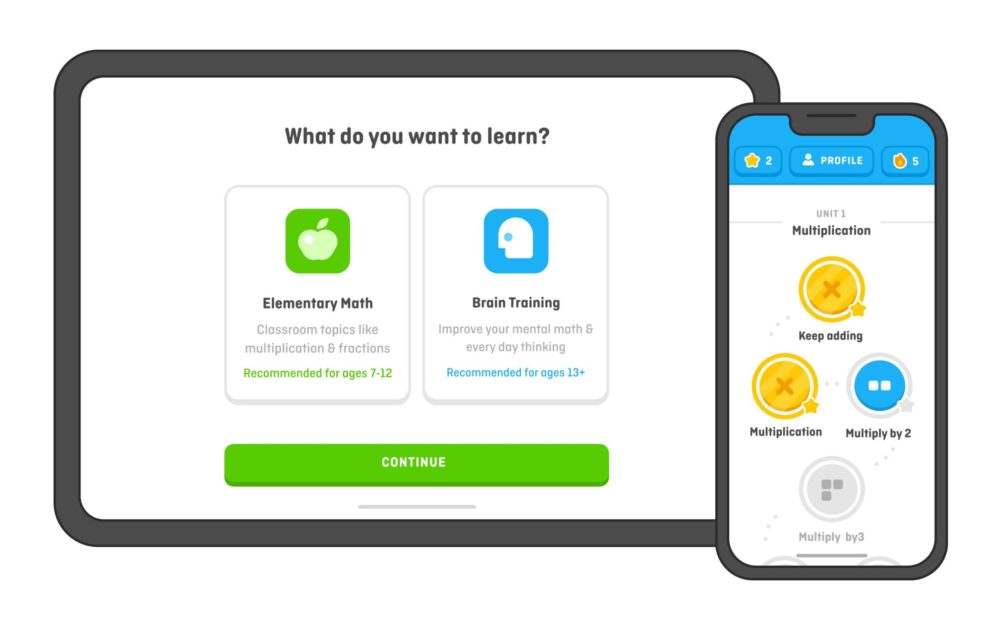
For those people, the East Liberty-based company dropped its Duolingo Math app today. The app was made with a team of engineers and math scientists whose job it was to make sure that the lessons were relevant to what a student would need to know. More than that, the team involved wanted to help make learning less stressful, while confronting pandemic-related learning loss.
This app is over a year in the making and includes a “brain training” course designed to help users employ mental math in everyday settings by practicing basic math concepts. Part of the app is meant for kids between the ages of 7 and 12, but the company says anyone looking to hone their math skills can use it.
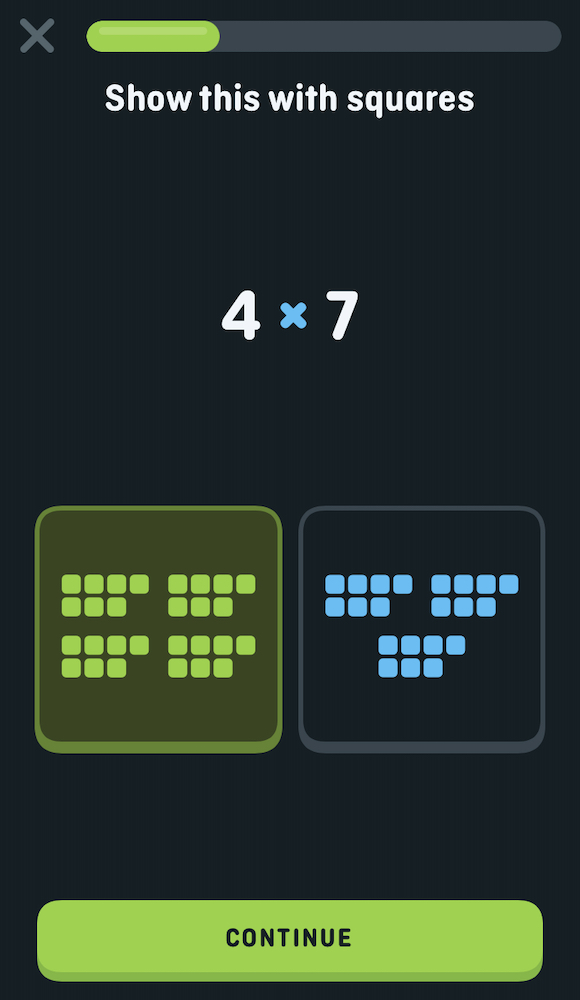
The app succeeds in feeling more like a video game than the flash card sessions and work sheets most people hated in elementary school. You can start with the easiest concepts of multiplication problems, division, shapes and decimals and then slowly level up to the trickier concepts. This approach allows you to practice and build on skills that will serve you later, without letter grades hanging over your head. Additionally, I appreciated that the app avoids being obnoxious when telling you that you’ve made a mistake.
Probably the wisest design choice was avoiding making things too repetitive by switching up testing approaches, from asking users to write out the answers to problems to having them match multiplication problems with their additional problem counterparts. As someone who’s had her share of math-related ups and downs, there are teaching strategies used that almost any user can get something out of.
If you’re curious, I did end up passing the statistics class. Still, despite having met my math requirement by some miracle, every once in a while visions of an F in statistics haunt my nightmares. Which is why, it’s no small feat that Duolingo’s newly released Math App gets an A from this mathphobe. Just please don’t ask me about normal distributions or standard deviation, ever.
If you’re curious and math has been the stuff of nightmares for anyone you know, Duolingo Math is available in the App Store as of today.