UpTrend, a mobile app focused on employment access for youth of color, won last weekend’s Thriving Cities Innovation Showcase + Hackathon. The hackathon aimed to tackle issues facing the Black community.
UpTrend was a group effort to built on an existing project in development called LegUp. According to cofounder and National Urban Fellow Devon Hawkins-Anderson, LegUp aims to help underprivileged youth ages 16 to 22 gain the access and social capital needed to join the workforce.
“It’s not that they don’t have resources to look for help to get access,” said Thomas Calhoun, group member and cofounder of opportunity network company Nafasi. “The problem is that these resources are very fragmented.”
Hawkins-Anderson also suggested using the app to help get kids into college, “because college is a kind of social capital incubator.”
Saturday’s hackathon, organized by nonprofit IMPACT, drew almost thirty attendees to the K Street office of hotelworkers union UNITE HERE Local 25. Participants split into four groups with three hours to prepare a pitch to the judges. Following each pitch presentation, judges led a 10-minute Q&A.
Here’s a look at the projects developed at the hackathon.
College Campus Safety “Stoplight” App
College campus safety is a top priority for University of Maryland undergrads Banks Agaruwa and John Aderetoye.
“No one wants to pay $46,000 to go to a school where they don’t feel safe,” said Agaruwa. “What do you do when you’re a physics major who knows they’re going to be at lab late every night?”
Together, Agaruwa and Aderetoye brainstormed a “stoplight” mobile app that they described as a kind of next-gen Amber Alert. The app would sync with user’s social media accounts to send out distress posts if a user pressed the app’s red or yellow buttons. The red button would also notify campus security and local police department.
Aderetoye saw this as an improvement from relying on blue light poles and campus security.
“You don’t want to be escorted everywhere,” he said.
Together with Chike Aguh, CEO of digital access program EveryoneOn, Agaruwa and Aderetoye devised a funding plan that would make the app free to download, with colleges paying for the the backend safety-alert interface.
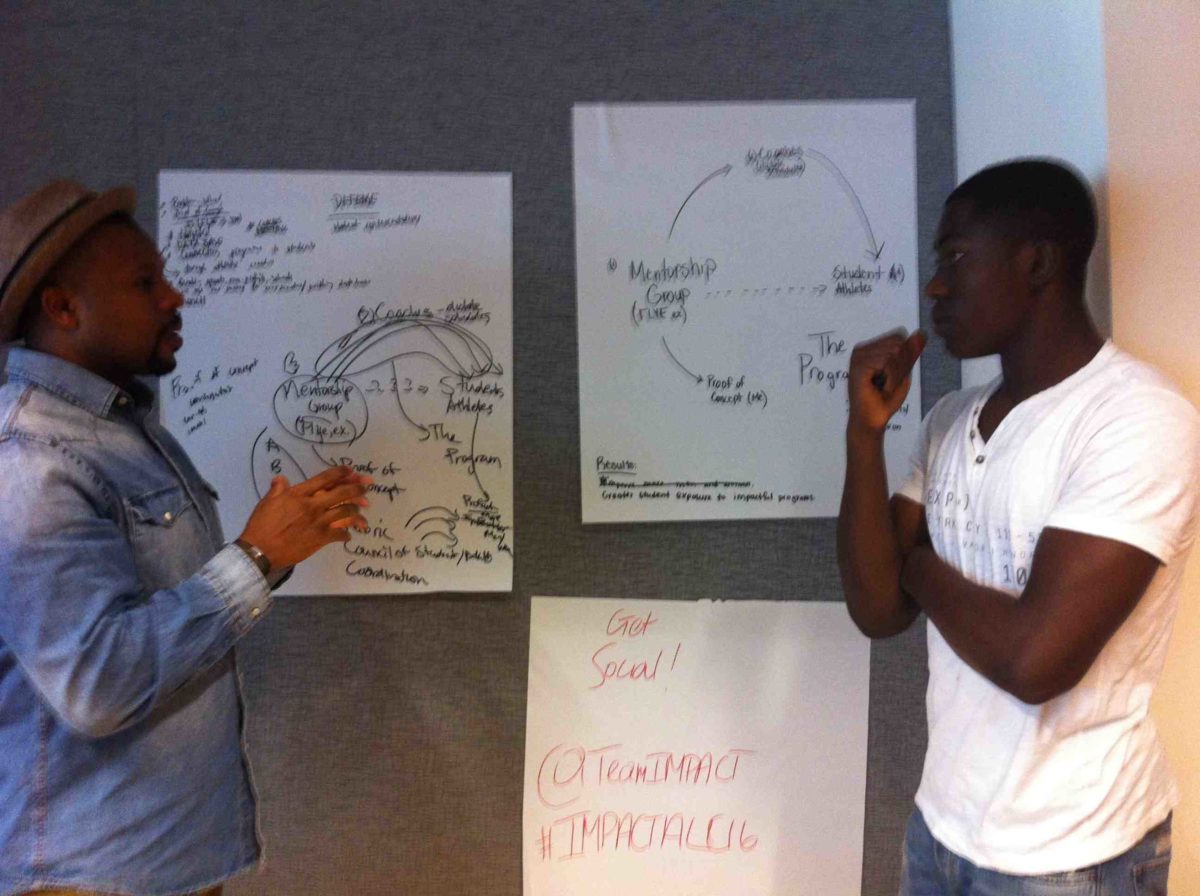
Mentor-to-Athlete Pipeline Project
Bob Okoroajuzie, a freshman at Montgomery College, told the judges: “I’m a proof of concept for this mentorship program.”
Okoroajuzie told them that being mentored through Future Leaders and Young Entrepreneurs (FLYE) when he was a high school football player changed him for the better. He wants to build a service that incorporates mentoring programs into high school sports teams because sports players “sometimes need help prioritizing school.”
Okoroajuzie said that success with these students means expansion.
“This is our gateway into the rest of the school,” he said.
Hackathon mentor and FLYE founder Cortni Grange told the judges that the possibility of incorporating a review system to the service solves another community problem: “There is no program which vets mentoring programs that visit schools.”
The plan is to leverage school districts for funding, as well as nonprofits mentoring programs who will pay to be included.

SwatApp
Brandon Anderson came to the hackathon for input on his mobile police reporting app, the SwatApp.
“The app lets users anonymously rate their experience with police and share it directly with local officials,” Anderson told us.
Saturday’s brainstorming was focused on making sure the app connected people to justice resources in their communities after reporting police misconduct. The group designed an addition – called “Your Voice Matters”— to recommend mediation services, City Council members and pro-bono legal counsel.
The project was the hackathon’s runner-up.
Group members agreed the app should be free to download. Anderson’s funding plan is to appeal for grant money to the Department of Justice and local police departments who have vested interests in police accountability.
###
In his closing remarks for the event, hackathon co-organizer Bernard Holloway said, “We came here to show how Black people can use technology to do good. And this work doesn’t stop here.”
Holloway, together with the judges and the mentors, lingered afterwards to give more tips and networking suggestions to participants.
Earlier that day, hackathon creator Nina Smith, who runs nonprofit IMPACT, surveyed the busy groups and told us, “The best part is that all these ideas are going to have a place to live after today.”
IMPACT is currently designing a digital portfolio for the projects and a support network of mentors to help participants continue their work.