

This article appears as part of This Week in Milwaukee Rising, a weekly newsletter from Technical.ly highlighting the innovators bringing a more just, equitable and dynamic Milwaukee economy. Subscribe here. The series is underwritten by American Family Insurance Institute for Corporate and Social Impact.
Matt Cordio’s entrée into the startup tech scene happened like so many others: in college over a beer.
After participating in an incubator program at Marquette University, the young founder began searching for new avenues to cultivate his entrepreneurial ambitions, starting with a monthly meetup. But outside of the small circle, he was frustrated to find a fragmented startup scene.
“It was hard as an outsider to break into the community,” Cordio told Technical.ly about his early days as an entrepreneur. “There were dozens of groups, [but] there really wasn’t a network where I could find likeminded individuals to share resources with, network and learn from. There wasn’t much of a startup ecosystem to support entrepreneurs.”
That was in 2011. Over the past decade, Cordio has worked as a tireless advocate for Milwaukee’s tech scene, founding Startup Milwaukee and serving as a growth partner at Skills Pipeline, among many other startup initiatives, in an effort to pool resources, connect founders, and attract capital to develop a flourishing startup ecosystem.
“Trying to bring tech to the region has been really, really important to me,” Cordio said. “It has been a passion of mine to bring people together to bring ideas together to grow Milwaukee.”
The early growth of a Milwaukee startup community: ‘You really need a lot of people championing the growth of the ecosystem’
Following the success of Startup Milwaukee, Cordio launched Startup Milwaukee Week — now Milwaukee Tech Week — to help bring together technologists and showcase Cream City’s position as an emerging tech hub.
It wasn’t easy getting the weeklong celebration of innovation off the ground, he said.
“Historically, it was challenging to get the attention of business leaders [and] civic leaders and get their support,” he said. “When we started Startup Milwaukee, there was no media talking about startups — they were talking about small businesses and didn’t really understand why tech startups were important. It really took the corporate community rallying around startups and providing their support.”
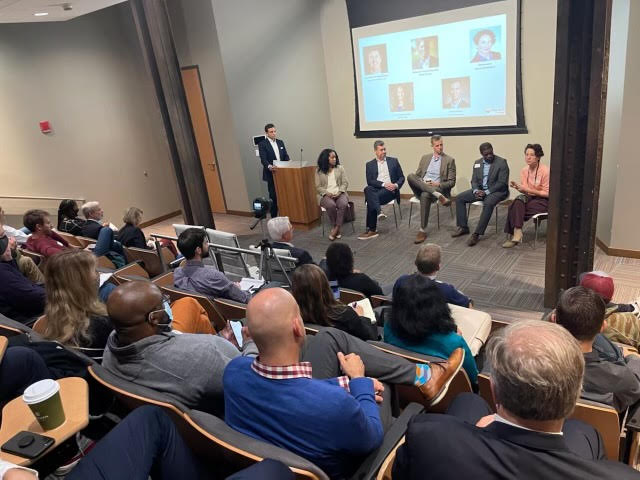
OpenGov President David Reeves leads a recent discussion with local policy makers on the importance of tech to the Milwaukee region’s economy. (Courtesy photo)
Cordio originally cofounded the event with Ed Javier, now the entrepreneurship and innovation program director at WEDC, after the pair thought about the startup weeks they’d seen taking place in other cities and saw a prime opportunity to bring the model to Milwaukee. The first Startup Milwaukee Week launched in 2015 with a handful of events and a few hundred attendees.
Today, the event is spearheaded by the Milwaukee Tech Hub Coalition, led by CEO Kathy Henrich. This year, the event attracted more than 1,800 participants to its roughly 50 events through a collaboration of more than 45 partners. Cordio, who sits on the Coalition’s board, sees the event’s success as a small sign of progress.
“Part of getting a functioning ecosystem was to bring organizations that wanted to collaborate to show the rest of the region what we had,” Cordio said. “Milwaukee has been slow to learn that from an economic development perspective, so helping to drive those conversations in the community is important. You really need a lot of people championing the growth of the ecosystem.”
Challenges for a young tech hub: ‘There’s been a long-held resistance to betting on new ideas here’
Despite these improvements to Milwaukee’s tech scene, Cordio says Milwaukee continues to face challenges in attracting the same level of attention, capital or scale as other mid-sized cities, adding that issues such as fragmentation haven’t “necessarily gotten better.”
While he credits groups such as the Coalition, Young Enterprising Society, The Commons (a skills accelerator he founded that works with area schools, universities and businesses to develop tech talent pipelines), startup accelerator gBeta, and funds such as Gateway Capital for advancing the region’s promise, he says more collaboration is needed on the policy front to shape the sector’s growth, especially in the early-stage.
The gap is one of the reasons Cordio cofounded the Wisconsin Startup Coalition in 2020. The group aims to connect with policymakers and serve as the “advocacy voice of Wisconsin’s startup founders,” to support funding, growth and innovation in the state’s economy.
Some of that work includes pushing entrepreneurs, corporations and policymakers to get comfortable with risk — a challenge in Wisconsin’s conservative business environment. Milwaukee has seen far less venture capital than cities of comparable size, per the latest PitchBook-National Venture Capital Association Venture Monitor, with $32 million invested across eight deals; compare that to Baltimore, which captured more than $75 million across 13 deals.
“There’s been a long-held resistance to betting on new ideas here,” explained Cordio. “There’s about six-times more venture capital in the Twin Cities compared to what’s happening here in the Milwaukee metro area, and we’re very similarly sized. We’re clearly not hitting on all cylinders.”
Opportunity in the work left to do: ‘Emerging and evolving’
Building out Milwaukee’s tech scene also requires actively promoting the city’s potential outside of the region. Cordio points to a viral Twitter thread from Miami Mayor Francis Suarez that promoted the city as the latest innovation hub and ignited millions of dollars in investment in the process. He said Milwaukee’s next mayor will be integral to generating the same level of excitement.
Other steps, like creating a more vibrant nightlife to attract young founders, improving diversity and inclusion efforts, and building out a stronger talent pipeline starting in schools, would also help to spur growth, he added.
Like so many others in the tech scene, Cordio believes a unicorn venture or successful exit may help others embrace the city’s startup scene and accelerate its pace — it’s done so recently for fellow Rust Belt tech hub Pittsburgh — so long as the founders are invested in contributing back to the growth of the city.
Until then, “we have a lot of catching up to do,” Cordio said.
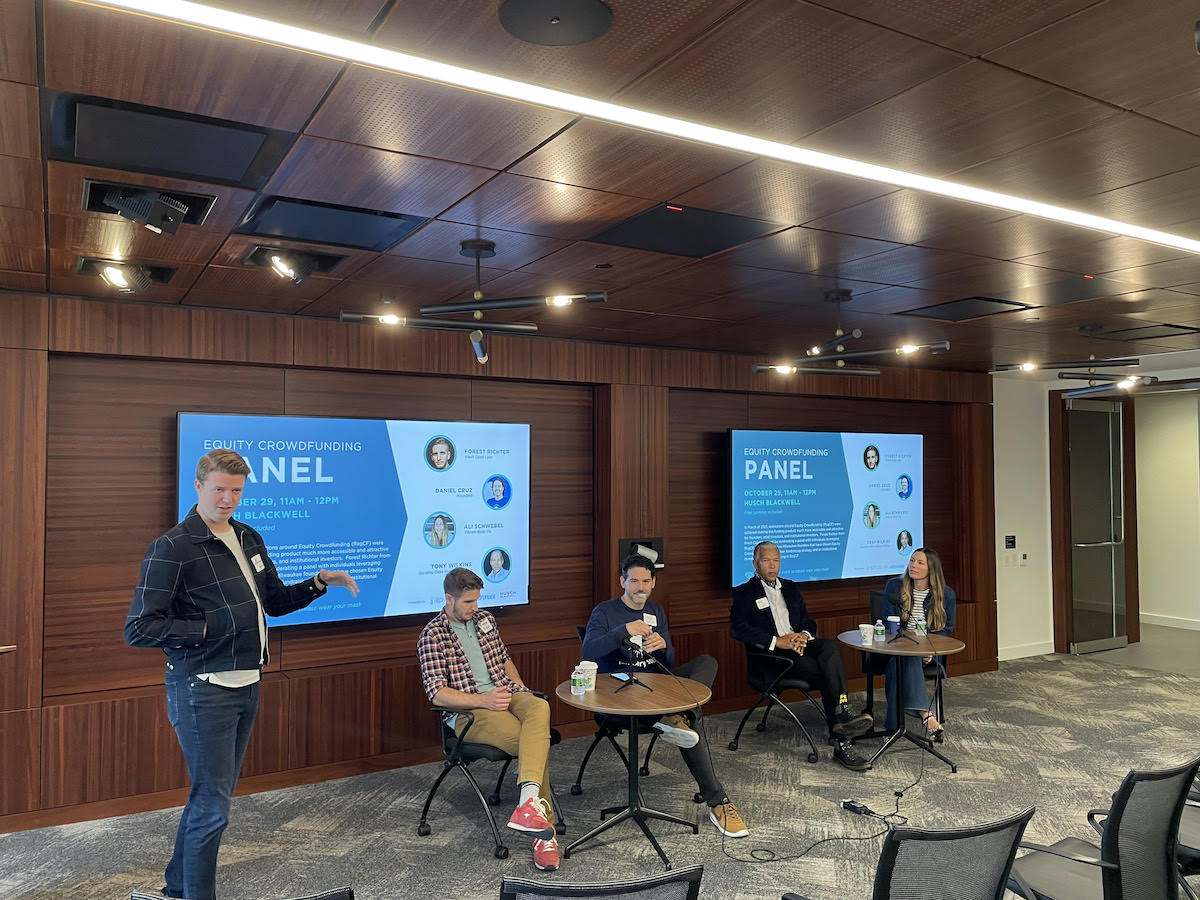
WeFunder hosts a discussion with Milwaukee entrepreneurs and investors who have successfully raised capital using the equity crowdfunding platform. (Courtesy photo)
Despite its challenges, Cordio said Milwaukee’s startup community hasn’t lost its luster for him.
He is as motivated as ever to support the city’s entrepreneurial class and continue to elevate the role of tech across the region, even as he steps back to return to his roots as a startup founder: Earlier this year, Cordio participated in a management-led buyout of CAREDirect, a medication security and tracking startup for healthcare facilities, where he oversees growth and operations.
“Technology is really changing the way people do business and the way people live,” Cordio said. “Seeing the evolution of the ecosystem [in Milwaukee] has been pretty amazing. It’s emerging and evolving, and we’ve seen more companies realizing that Milwaukee has the talent. We’ve been under the radar but we’re definitely seeing some momentum.”
It’s amazing what can come from a chat over a beer.
Subscribe to This Week in Milwaukee Rising:

Join the conversation!
Find news, events, jobs and people who share your interests on Technical.ly's open community Slack
Philly daily roundup: Minecraft in a Philly school; PTW kicks off; Tech and art happy hour

Delaware daily roundup: 20+ things to do in May; Technical.ly's Dev Conference; Dupont earnings
DC daily roundup: April's biggest DMV funding stories; VCs head to Hill and Valley Forum; AI lobbying tripled