
On the list of buzzwords for 2016, bots and artificial intelligence (AI) are surely near the top. But recent hype is not the reason why Center City-based web services company Stuzo is putting its money on bots.
“Bots are better from an end-user experience perspective, and more seamless from a brand experience perspective,” said CEO and cofounder Gunter Pfau on the potential bots have as customer service solutions and more.
But to reach a broader number of users as service providers, bots must jump over a first hurdle: they must be easier to find.
That’s what led the company to create Bot Finder, a directory for bots that houses 2,462 artificial intelligence creations for platforms like Slack, Telegram, Skype and Facebook’s 900-million-user-strong Messenger.
For the latter platform, Stuzo — which has three satellite offices and a staff of 45 — created an in-house bot that allows users to contact the company and find out more about their what they do.
“We also built a prototype for a customer service bot using Comcast as an example,” said Pfau. “Customers can receive billing information, perform speed tests and reset their routers through the platform.”
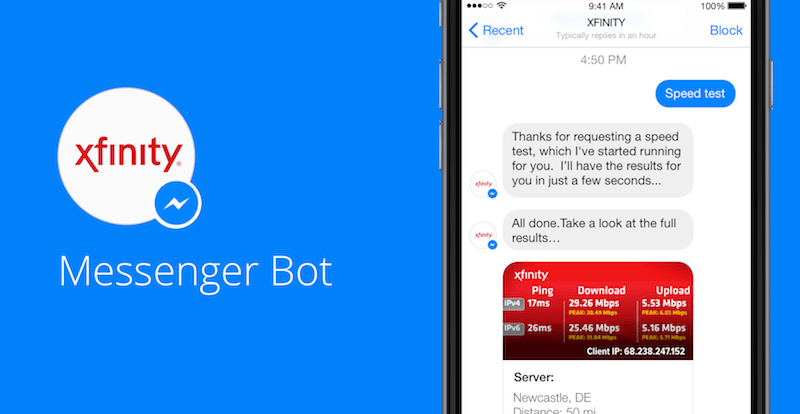
What an Xfinity Messenger bot might look like. (Image courtesy of Stuzo)
One advantage for companies taking this approach to customer service: bots could better reach millennials, who are said to prefer text-based communications over phone conversations.
So, where’s the money in all of this?
Pfau says that right now the goal isn’t making money from a product release. “It’s more about showcasing a new platform to be built on top of,” he said. “We see Messenger as a platform that will provide a great deal of flexibility and can handle several functions within its space. It’s not just a simple lightweight thing: experiences can be built around this.”
Stuzo’s CEO goes even further, and bets the future of artificial intelligence for customer service lies not only in one bot helping users get stuff done, but several bots talking to each other and feeding off each other’s intelligence.
“Today, really good customer service is 20 percent led by bots and AI, with 70 percent of processes still done in person. That ratio will be reversed over the next five years,” he said. “Human interaction will be a lot less, if anything at all.”

Join the conversation!
Find news, events, jobs and people who share your interests on Technical.ly's open community Slack