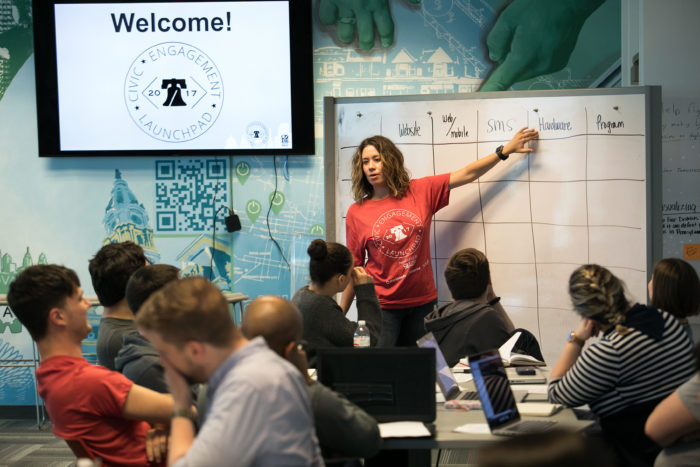
When we announced our Civic Engagement Launchpad (CELaunchpad), I discussed how Philadelphians aren’t the kind of folks that like to sit around, waiting for someone else to fix things. We’re a city of action. What we saw over the weekend of March 24-25 affirmed what I said: Philly is eager to drive change.
We chose the theme for this event based on two items.
Reading the news lately, it’s evident that all sides are not happy with the way the government is working for them. Civic tech is nothing if it’s not addressing this core relationship between government and citizens.
Our spring hackathons over the last couple years were called “Democracy Hackathon.” The name was catchy, but participants always focused on voting and elections. Engaging with government, especially at the local level, is not a once-a-year occasion. We wanted to address how government and citizens interact, and how they do that on a systemic, everyday way. With that in mind, Civic Engagement Launchpad was organized.
This event is the second iteration of our new format. For City as a Service Hackathon (CaaSH), we took the concept of a hackathon and combined it with a development sprint. This gave projects time to work on the parts of their projects that aren’t just code. We were struck by the maturity of projects so quickly, but we knew there were screws that needed tightening and bugs that needed attention. After the beginning of our CELaunchpad, we’re already seeing the changes pay off.
The most effective change came by way of the Office of Innovation and Technology (OIT). OIT Program Manager Eliza Pollack and her crew completely knocked this one out of the park. An emphasis was placed on updating our Saturday morning programming to help teams focus their energies on their project’s needs. We couldn’t be happier with the results. There were even participants from evergreen projects participating! (Evergreen meaning projects from previous events that haven’t launched, but are still working.) Teams are now Post-it masters.

Feeling great about this event is one thing, but we’d like to back that up with some numbers. The metrics we’re using to measure if this event has been a success so far?
- More than 30 government employees participated over Friday and Saturday. Some came with ideas while other came to role up their sleeves. They also provided motivation when we heard from David Gould, Deputy Director of Community Engagement and Communications at the city’s Rebuilding Community Infrastructure initiative, and Stephanie Monahon, the city’s Chief Service Officer.
- We have seven project teams comprised of citizens and government employees. These teams have been meeting with local groups focusing on issues their projects are addressing, expanding the teams beyond the Code for Philly community.
- Over a dozen mentors are lending skills and expertise, starting on Project Day through to Demo Night.
- Our Slack chatter has surpassed what we saw during CaaSH, which was our busiest month prior and there’s plenty of other projects that can benefit from some assistance.
We sought a way to address the concern that government isn’t working for its citizens. With the help of the OIT’s programming, the participation of government employees and a band of hearty volunteers, we’re seeing meaningful dialogue. Teams are tackling ways for citizens to become engaged at the local level, where some of the most meaningful decisions get made.
If you’re interested in seeing what these teams can accomplish over the month, try to snag one of the few remaining spots available for our CELaunchpad Demo Night on April 25.
RSVPBut if you’re the type of Philadelphian I think you are, you don’t want to see what other people are doing. You also want to get involved with your local civic tech community. Here are a couple ways to engage with Code for Philly and our community:
- Check out our list of projects. We’re big on innovation over invention. See if there’s a project that you can get passionate about.
- Sign up to our Meetup group. We have weekly meetups. This includes our monthly open house, where you can pitch project ideas or be recruited by teams seeking help.
- Join our Slack. Creating an account on CodeforPhilly.org, you’re also creating a Slack account. This is where we do most of our communicating. Each project gets their own channel.
- Follow us on social media. We’re active on Twitter, Facebook, and Instagram.