


As Philadelphia celebrates its role in the founding of the United States, tech enthusiasts note that 2026 also marks a big year for the region’s role in computing history.
This Sunday marks the 80th anniversary of the Electronic Numerical Integrator And Computer (ENIAC), the first electronic, programmable and general purpose computer. The ENIAC, which was developed and unveiled at the University of Pennsylvania, is widely considered the start of modern computing.
“We’re kicking off the 80th anniversary of the launch of the computer age.”
Jim Scherrer, Philly’s Compuseum
Thanks to the country’s 250th anniversary, as well as various global and national sporting events and conventions, Philadelphia is expecting a million visitors this year. Tourists should know that not only are they visiting the birthplace of the nation, but also the birthplace of modern computers, said Jim Scherrer, a founder of Philly’s Compuseum, a nonprofit dedicated to sharing the region’s computer history.
“We call it a second revolution,” Scherrer told Technical.ly. “The 250th anniversary of the Declaration of Independence [is] on July 4, but here on February 15, we’re kicking off the 80th anniversary of the launch of the computer age.”
The impact of the ENIAC is simply the fact that computers are part of our everyday lives now, said Bill Mauchly, son of ENIAC creator John Mauchly.
At the time, Mauchly’s father’s idea to build a general purpose, programmable computer was crazy, he said. However, the timing lined up because the US Army was willing to fund the project. World War II was underway, and they wanted a machine that would create ballistic tables, reference charts that help predict where bullets will go.
Why the ENIAC was unique for the time
The ENIAC is just one of several innovations that came out of the Philadelphia region, noted Scherrer, the Compuseum founder.
“It’s undeniable how important technology is to us, because we carry around a cell phone,” he said. “It wraps around you all the time.”
The ENIAC was unique for the time because it could complete calculations faster than a purely mechanical device — at the rate of 5,000 additions per second, Vijay Kumar, dean of Penn Engineering, told Technical.ly. Modern technology can do trillions of calculations per second, but for the time, this was very fast.
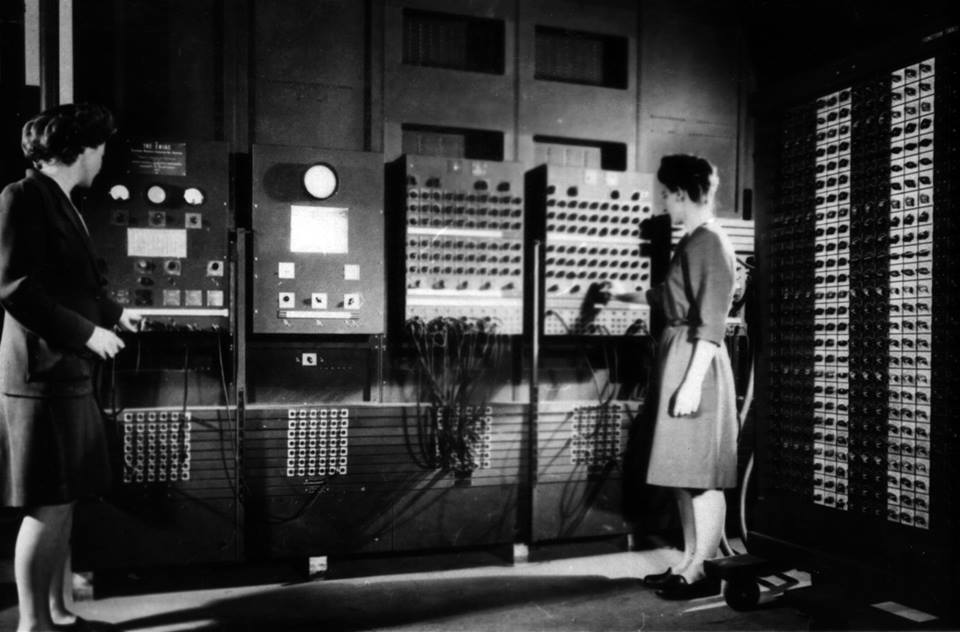

Being programmable meant that it could also be reconfigured to solve other problems, Scherrer added. This led to improvements in all aspects of computing, such as storage and user interface.
The machine was also special because it could do nontrivial calculations, a mathematical term for calculations that take multiple steps or aren’t easily solved with existing methodology. For example, Kumar said, it could track the trajectory of missiles or calculate weather predictions.
These capabilities started conversations that eventually led to modern tech like artificial intelligence, Kumar said.
“It sparked this idea,” Kumar said, “that you could get machines to not only do calculations, but think.”


