
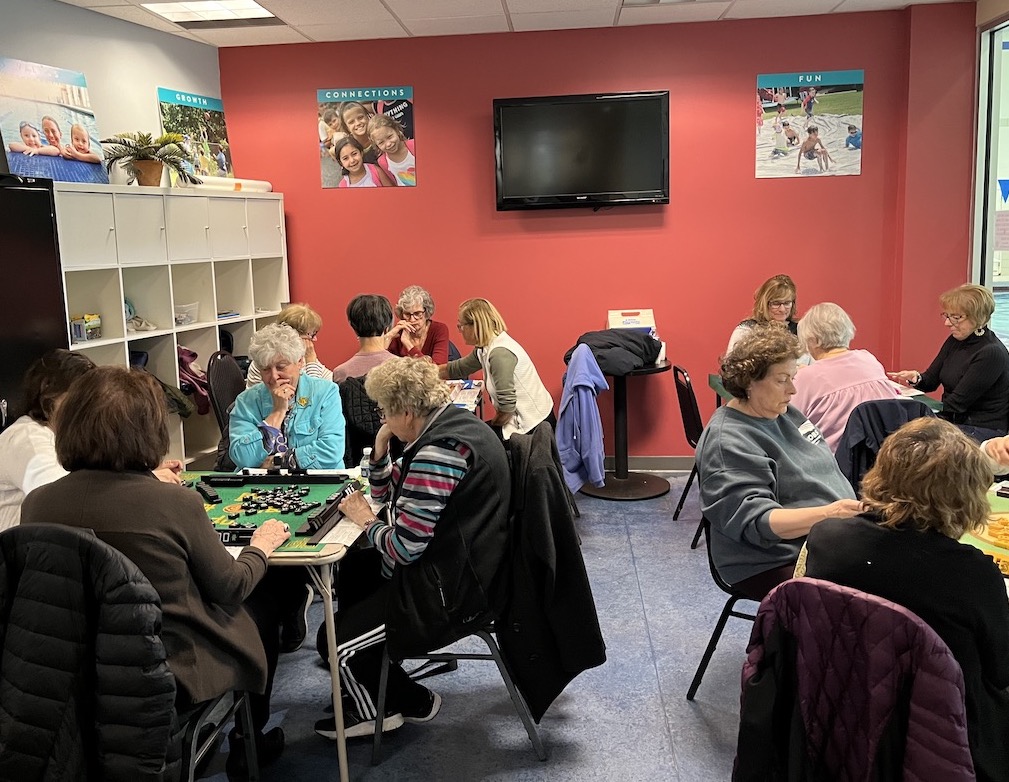
That’s how Laura Poskin, executive director of Age-Friendly Greater Pittsburgh, puts it, due in part to the city’s resources, tight-knit communities, and sheer size of the aging population, among other reasons.
Research out of the University of Pittsburgh’s Center for Social & Urban Research reveals an estimated 19.7% of the population of Allegheny County is 65 and over — the second highest concentration in the country, behind only Palm Beach County, Florida.
The American population, especially in Pittsburgh, is getting older faster than other demographic groups and represents one of the biggest shifts in the workforce, locally and nationally, as Boomers retire. While 65 is the standard retirement age, many aging Pittsburghers choose to continue working. Additional research out of the University of Pittsburgh shows that working 65+ employees are the only population to have fully bounced back to pre-pandemic levels in the region.
Pittsburgh’s older population can be attributed in part to the decline of the city in the 1980s when younger populations left the city seeking job opportunities. Many older residents stayed, and have continued to stay. While nationally, aging populations continue to grow, Pittsburgh has been ahead of this trend for several decades. In some ways, being ahead of this trend may have made Pittsburgh a more age-friendly city than many metro areas of a similar size. Residents live in their homes for longer, not only aging in Pittsburgh but aging in place.
‘There’s an opportunity for employers to embrace this older cohort’
Aging Pittsburghers choose to work for various reasons, said Poskin, whose East Liberty-based nonprofit works with neighborhoods and communities to make them livable for people of all ages.
As our communities age and life expectancy increases, many Pittsburghers work to supplement retirement income and social security benefits. But working also allows older populations to stay engaged with their community. According to Age-Friendly Greater Pittsburgh’s recent survey of aging Pittsburghers, 64% of those still in the workforce are extremely likely or very likely to continue work as long as possible.

Poskin believes this is driven, in part, by a desire for older residents to feel engaged in their community and build connections across age groups. In meetings with older community members, Age-Friendly Greater Pittsburgh often hears that the population feels “siloed,” and an overwhelming 80% in a recent survey responded, “they want to spend more time with people outside their age group.”
The willingness to work and desire for intergenerational experiences creates a unique opportunity for employers in the area to hire this workforce. Still, Poskin has found issues of digital access keep some older Pittsburghers from finding employment.
“There’s an opportunity for employers to embrace this older cohort,” she said.
While Pittsburgh may have a robust aging population, there’s a significant disparity in the quality of life for Pittsburghers of color, who make up about 20% of the county’s population. In the same Age-Friendly Greater Pittsburgh survey, just 39% of Black respondents over 65 agreed that the city was a very good or excellent place to live as they age, as compared to 67% of white respondents. This sentiment echoes the experiences of Pittsburghers of color across age groups: The city’s Gender Equity Commission revealed that Pittsburgh ranks among one of the worst cities for Black women due to factors including unemployment, lower pay, poor healthcare outcomes and poverty rates.
What does it look like to thrive in a city where the aging population is above average and the older workforce is back in full swing? For Technical.ly’s Thriving series, we explored what life looks like for an assortment of Pittsburghers 65 and older making $35,000 a year or less — just under the median non-family household income for Allegheny County, according to Census data.
Betty Douthett, 70: ‘I just feel I’m needed here’
Betty Douthett credits her upbringing for her love of working with people.
“I have to give credit to my parents, who were very loving people,” she told Technical.ly. Her father granted her a sense of humor, “to be happy and silly,” and talk to nearly anyone, while her mother instilled a sense of love and an open heart.
Finding a career taking care of people felt like a natural fit. A Brookline native, Douthett, 70, is an aide at the Seton Center’s Adult Day Services program. An intergenerational care space in Brookline, the Seton Center houses preschool, childhood, and adult care services, all of which Douthett has worked in during her 14-year career there.
When the Seton Center had an opening for an aide at the adult care center, transitioning to adult care felt natural for Douthett.
“I love people in general. It’s just who I am,” she said. “I love to learn.” But she still has daily interaction with the children, who make visits to the seniors as part of the intergenerational mission and programming.
Bridging interactions across age groups is largely why Douthett feels she’s thriving. Living nearby, she feels the Seton Center and her work contribute to her larger sense of purpose: “I just feel I’m needed here.”
Seeing everyone’s faces light up in the Adult Day Services center when the 3- and 4-year-olds come in is an exciting part of the work she does. The kids and seniors play games, craft, and even bowl together, creating a unique sense of community Douthett’s not sure she would find elsewhere.
“I think connecting is a nice word for thriving,” she said, “because it’s about a good connection.”
Dave Sobal, 71: ‘I’ve always looked forward to going to work’
If you’re looking for Dave Sobal, chances are you’ll find him on a bike. The 71-year-old Squirrel Hill resident has been leading downtown bike tours with Bike the Burgh two to three times a week for the past nine years.
For Sobal, who didn’t even own a car until his late 30s, spending his days on a bike doesn’t even feel like work.
“I’m still astounded when people hand me money at the end of the tour,” he said.
Getting paid to ride his bike around town and show off the sights aligns with Sobal’s approach to work over the years: “My philosophy on work for most of my life has been, ‘find something that you like to do and then find somebody to pay you for that.’ You don’t need a lot of money to lead a rich existence.”
That meant a variety of roles, including coaching long-distance running at Pitt, working at the Carnegie Science Center, coordinating pet adoptions at Animal Friends, and now leading tours. It’s that approach to filling his days that feels like thriving for Sobal.
Though his wife retired from her full-time position at Carnegie Mellon University five years ago, Sobal doesn’t have an intention of retiring any time soon from something he loves.
“I have never made a lot of money, but I’ve always looked forward to going to work,” he said.
His work keeps him active, while affording him plenty of time to take advantage of everything the city has to offer seniors. There’s always something to attend at the Jewish Community Center (JCC), a Carnegie Mellon Symphony performance to listen to, or a library to visit to brush up on local history.
Beyond cultural and social offerings, Sobal finds Pittsburgh an ideal place to age due to its medical offerings.
“The healthcare is incredible,” he said. “I tell people on tours we’re a city of meds, ed and high-tech.”
Joanne Asher, 79: ‘I don’t go to work, I go to school’
Joanne Asher found a calling to childcare by way of corporate America. It was a very “circuitous route,” said the 79-year-old teacher’s aide at Seton Center’s preschool.
She started her career working in corporate America, transitioning into various regional manager roles for several large companies, specifically in the retail space. When she married and had children, she had the brief opportunity to work as a teacher’s assistant at a preschool, but the corporate world kept calling.
Five years ago, when she heard about an opening at the Seton Center, she was “thrilled.” The opportunity felt like a perfect full circle moment for her second act, as she went to high school in the same building, back when it was an all-girls school. (“We had horrible uniforms,” she recalled. “I believe they were brown.”)
Now, she works with an age group she “really connects with” — 3- and 4-year-olds. “They’re not shy, and neither am I.”
For Asher, thriving isn’t just having somewhere to go every day. It’s filling days with something meaningful. Filling a need and taking care of the kids feels purposeful, especially during a time when childcare professionals are in short supply.
“You have a reason to get up in the morning,” she said. “It keeps me young.”
Asher also learns something new daily working with the children — “it’s really challenging in a very different way than ever before.” But she finds her past working in a corporate setting comes in handy from time to time. “A lot of adults are just like [the kids],” she said. “They have tantrums, they’re insecure, they miss their moms.”
While it’s not always easy, learning with the kids every day doesn’t feel like working for Asher.
“I just feel very privileged to be doing this job,” she said. “And it’s not, not really a job. I always say I don’t go to work. I go to school.”
Andrea Watson-Lindsey, 65: ‘It feels like I’ve been rejuvenated’
After a long career working for airlines and in customer service and customer service, Andrea Watson-Lindsey retired. Briefly.
“I was retired about four months,” she said. That’s when she took a part-time position in customer service at the JCC last year.
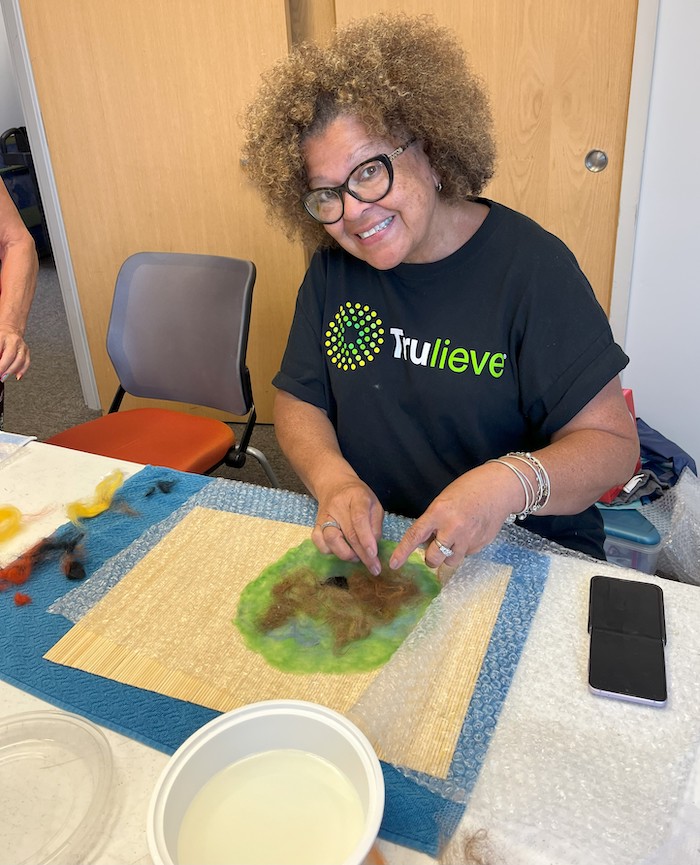
Soon, she took on the role of part-time program coordinator for JCC’s AgeWell program, which is run in collaboration with the Jewish Association on Aging and Jewish Family & Community Services to offer resources and events for aging Pittsburghers of all beliefs.
In retirement, and emerging out of the post-pandemic cultural haze, she felt isolated — “but once I started working again, I feel like I’ve been rejuvenated,” she said.
Watson-Lindsey helps run support services for the organization, including the daily lunch program, puzzle swap, and older adult fitness programming. Only a year old, the program’s offerings continue to grow based on community feedback.
“Working here at JCC, it’s never a dull moment. And I’m always finding new ways to reinvent myself as I’m helping [seniors] try to reinvent themselves,” she said. “I’m helping people and they’re helping me as much as I’m helping them.”
That connection is filling a need Watson-Lindsey feels she’s lost in her immediate community.
Growing up in West Oakland on the border of the Hill District, and returning to the neighborhood after living in DC, Watson-Lindsey’s seen her fair share of changes. Upon her return, she became deeply involved in the neighborhood, doing everything from hosting dinners to serving as judge of elections for 20 years. In those decades, she’s seen the neighborhood transform with the expansion of Pitt’s campus and the growing population of students.
“Our street was the last street to switch over to college students,” said Watson-Lindsey, and while her new neighbors are respectful, “there’s not a lot of camaraderie with the neighbors anymore.”
While she feels like she’s thriving, as a Pittsburgher of color, Watson-Lindsey is acutely aware of how the city is changing. Sometimes worries about the high-rise apartment buildings cropping up in Oakland, and her peers getting priced out of the city.
“I know this is where I’m supposed to be, but I just wanna make sure other people feel as comfortable as I do in Pittsburgh,” she said, “especially the senior population.”