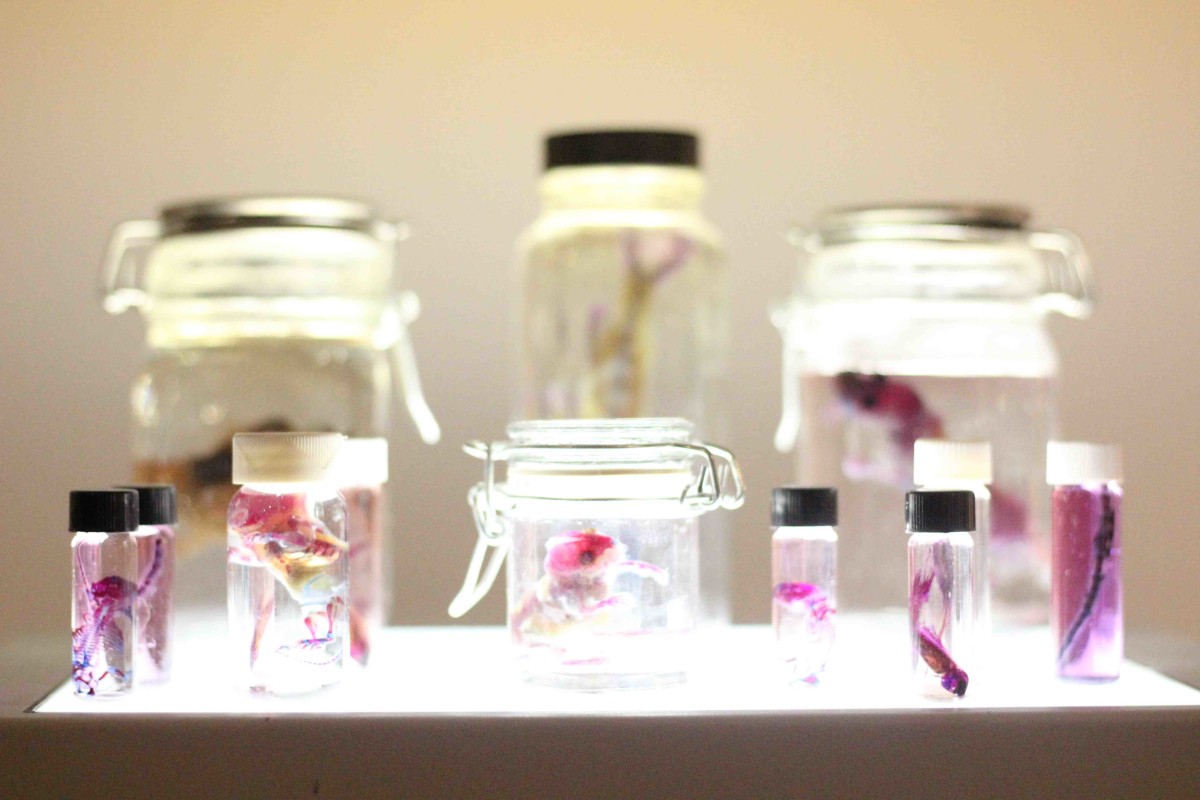
A taxidermied peacock proudly displays its brilliant tail feathers at the University City Science Center’s Esther Klein Gallery this month. Delicate animal skeletons dyed purple and red float in tiny vials and jars. A blue crystal-encrusted alligator skull gapes toothily on a pedestal.
This is “Methods of Collection.” It runs through March 25.
The curator of the exhibit, Angela McQuillan, said she chose the animal specimen theme because of her background in cancer research and the “necessary evil” of dissecting animals for science.
“It wasn’t something I necessarily liked to do, but it was intriguing,” she told us during the opening reception. “There is something aesthetically interesting about skeletons and animal anatomy.”
McQuillan knew some of the featured artists from the Philadelphia art scene and some she contacted online. The exhibit features work from the Sculpture Gym’s Darla Jackson and taxidermist Beth Beverly (who was a fan favorite at Ignite Philly 12 in 2013.)
Many of the pieces featured dead or dissected animals or parts of animals. McQuillan said she was apprehensive that viewers would be “grossed out” at some of the pieces but hoped they would spark curiosity.
“It’s an appreciation for animals,” she said, adding that’s it’s about “acquiring them and making them into something beautiful.”

One example of this? Beverly’s taxidermied peahen, which wore a tiny jeweled crown atop its imperiously cocked head.
Beverly said she obtains most of her specimens, all of which died of natural causes, from a farm in Vermont.
“When an animal starts out that beautiful, it’s hard not to want to touch it and recreate it,” she said. “They were just asking to be finished. This was the motivation.”
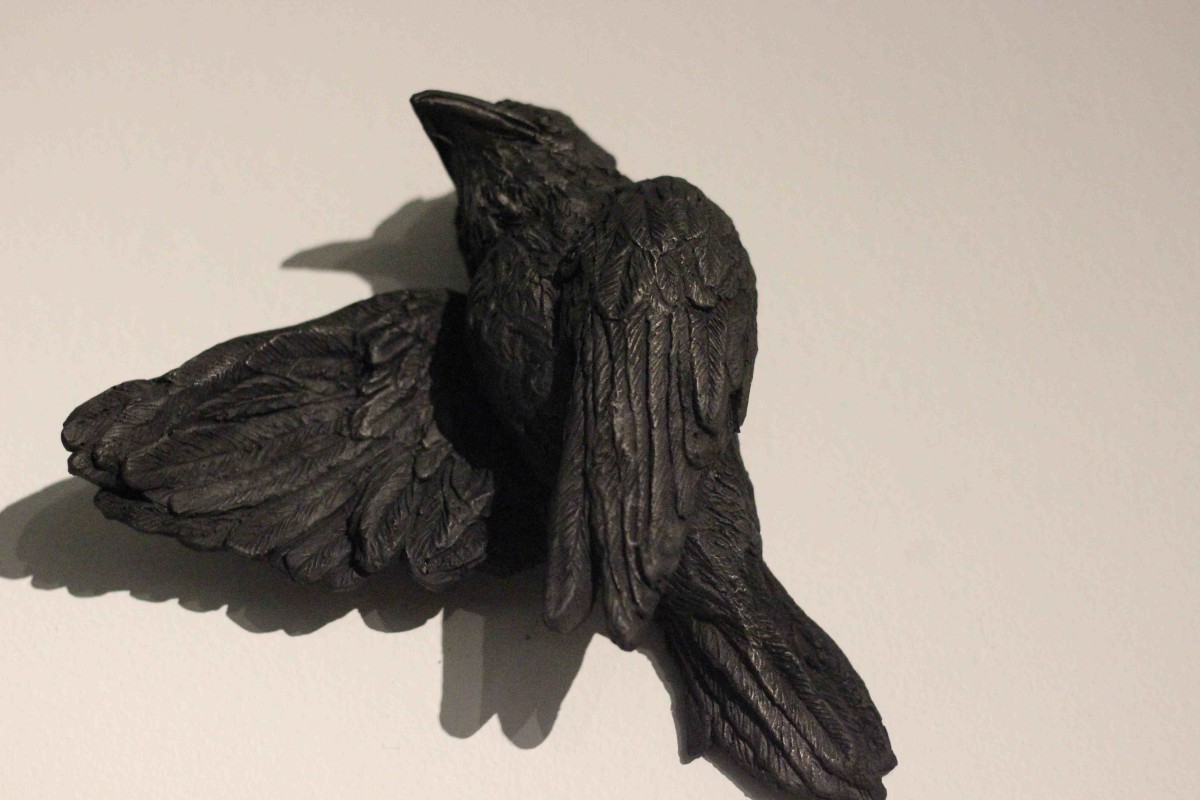
Jackson’s work also featured bird-like creations. Palm-sized black bird sculptures titled “We all fall down……I” and “We all fall down……II” perched on the wall, some in flight, some seemingly injured or at rest.
Jackson said she chose pieces specifically for the theme of the exhibition and wanted them to be “specimen-like,” while still maintaining her own goal of relating to people’s emotions.
“Everything I do is supposed to be an emotional portrait and human interaction,” she said. “People will come up to me and say, ‘I’ve felt that before.’ That always ends up being really important to me.”
Jerry Salem, 52, who used to work at the University of Pennsylvania, liked how the exhibit fused art and biology. For him, one of the highlights was Greg Eaton’s diaphanized specimens.
Eaton, an adjunct professor at Rowan University involved in osteoarthritis research, got involved in art a year and a half ago after he realized the process of diaphanizing animals — dyeing muscles and bones to study them more closely — had an artistic purpose as well as a scientific one.
Eaton’s subjects have mostly been donated, including a mouse (from his cat) and a bat that had been trapped in a friend’s air vent.
The specimens at the Science Center’s latest art exhibit are creepy and beautiful
Fourteen artists are featured in the Esther Klein Gallery until March 25.