

Technical.ly is a free news resource thanks to financial supporters like the Temple University Department of Geography, Environment and Urban Studies, a Technical.ly client, which sponsored this article. It was reviewed before publication. Learn more about the Temple University Department of Geography, Environment and Urban Studies here.
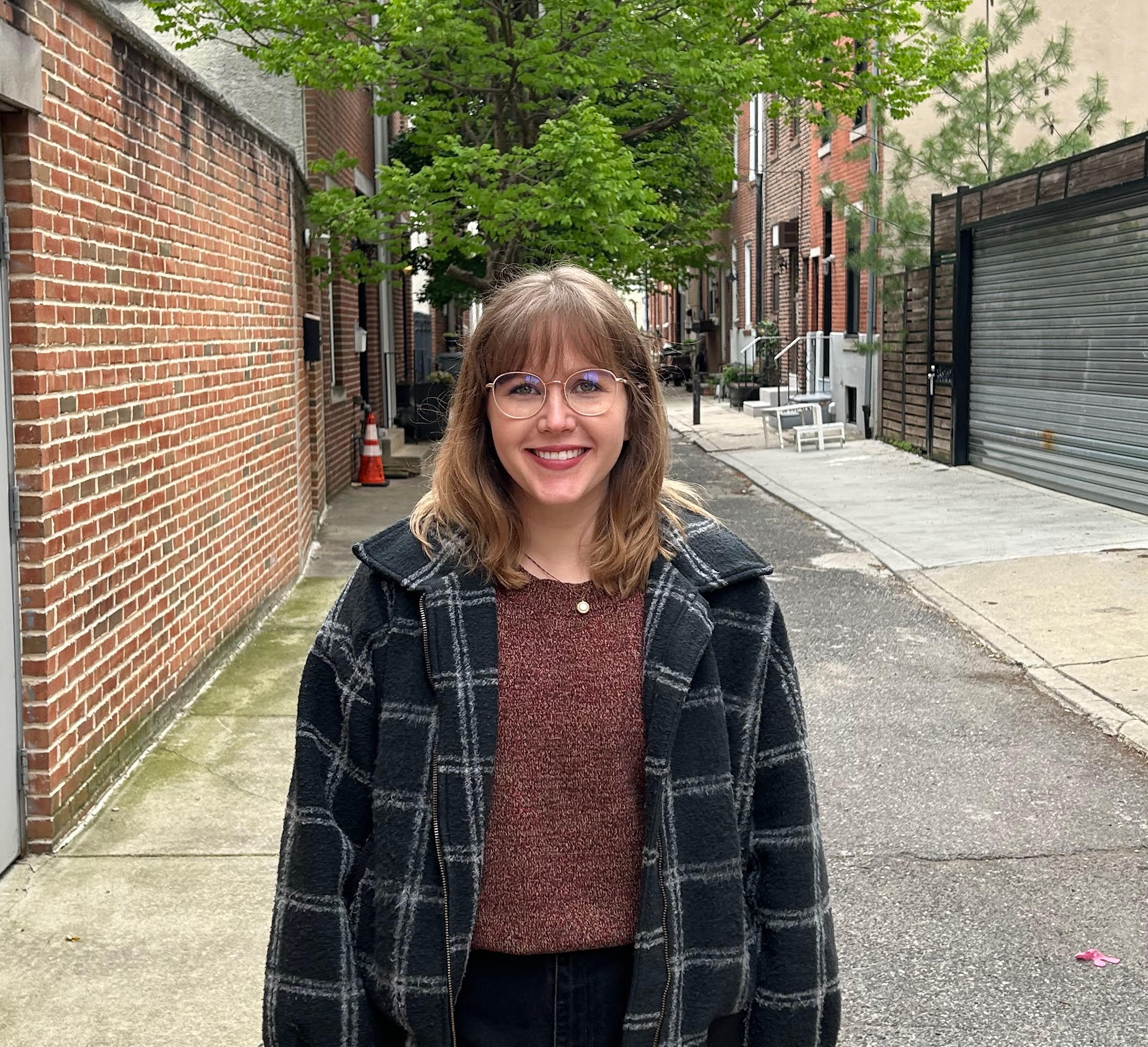
For years, Jillian Long’s career didn’t move in a straight line.
After earning a bachelor’s degree in geography and urban studies from Temple University, she spent her 20s traveling, bartending and teaching English abroad — experiences that sharpened her communication skills but didn’t add up to a long-term plan.
As she started thinking more seriously about what she wanted her career to look like in her 30s and 40s, Long knew she needed a pivot. In fall 2017, she spotted an ad for GIS Day at Temple. It was a reset button.
The event reintroduced her to geographic information systems (GIS), a field she had briefly explored as an undergraduate, and ultimately led her back to Temple’s Department of Geography, Environment and Urban Studies, where she enrolled in the Professional Science Master’s (PSM) in GIS program the following year.
“I didn’t take the straight and narrow path … It took me a while to get to this point.”
Jillian Long, Temple GIS Master’s student
Her detours had begun to feel like liabilities. “I didn’t take the straight and narrow path,” Long said. “That kind of haunted me. It took me a while to get to this point where I’m like, ‘Wait a second. All that stuff I did in my 20s that I didn’t think was valuable was super valuable.’ Diversity of thought and life experience and lived experience is important.”
Temple’s Professional Science Master’s in GIS, launched in 2015, is built as a career-focused graduate degree. Students learn spatial analysis, mapping software and data visualization, with room for coding fundamentals and spatial statistics along the way.
The program — housed within Temple’s College of Liberal Arts — can be finished full time in about a year, or part time over two. Night classes are designed to work around full-time jobs. And for students who want a smaller step first, there’s a four-course graduate certificate that can roll into the master’s.
A required capstone is the program’s centerpiece. Students work with a real organization — city agencies, nonprofits, engineering firms, public health teams and tech companies — and graduate with a portfolio they can show employers.
“Whether or not we want to be career changers, we’ll have multiple careers in our lifetime,” said Lee Hachadoorian, assistant director of Temple’s PSM in GIS program. “And it’s never really too late to decide that you want to take on a new challenge and do something that’s meaningful to you.”
For professionals already working with GIS who want to expand their technical and analytical skills — including advanced data science, programming and big-data spatial analysis — Temple also offers a Professional Science Master’s in Geospatial Data Science program designed to broaden career opportunities beyond traditional GIS roles.
This is a practical degree; it’s how you turn location data into decisions. To celebrate the 10-year milestone of the PSM in GIS program, here are 10 career directions Temple faculty and graduates pointed to, and what GIS work can look like in each.
1) Government
GIS is a core tool for government agencies at the local, state and federal levels.
Geospatial data helps public officials understand how people, infrastructure and the environment interact — and how policy decisions impact communities over time.
In the public sector, GIS professionals support city planning, housing, transportation, environmental monitoring and emergency response. By analyzing patterns in population, land use and risk, agencies can make more informed decisions about where to invest resources and how to deliver services.
For instance, several of Temple’s PSM in GIS students have worked with the US Department of Health & Human Services on projects that map barriers to care and other community health factors.
“Technology, in particular, can be powerful and can make people’s lives better, but it can also have unexpected impacts that can be harmful to people,” Hachadoorian said. “People are going to be faced with dilemmas that could not have been predicted, so you need to talk about figuring out what the best course of action is that takes into account the interests and needs of all parties involved.”
2) Nonprofits
Nonprofits use GIS to better understand the communities they serve and measure the impact of their work. Whether it’s identifying where services are needed most, analyzing demographic trends or visualizing complex social and environmental issues, GIS helps nonprofits turn limited resources into targeted action.
GIS professionals in this space can be involved in everything from community development and environmental justice to advocacy and humanitarian efforts. Temple PSM in GIS graduates have applied these skills in nonprofit settings by mapping service areas, building data portals and conducting spatial analysis that informs funding and program decisions.
3) Business, tech and engineering
In the private sector, GIS is used to guide decision-making, optimize operations and build new technologies. Companies rely on location-based analysis for site selection, infrastructure planning, logistics and product development.
Temple PSM in GIS graduates have gone on to work with engineering firms, consulting companies and geospatial technology organizations, applying spatial data to real-world problems in industries ranging from real estate to software development.
4) Urban and environmental planning
Urban and environmental planners rely on GIS to design sustainable, livable communities. Spatial analysis helps planners assess the long-term impacts of policy decisions and guide development that balances growth, equity and environmental sustainability.
Casey Smith, a 2022 graduate of Temple’s PSM in GIS and an associate GIS specialist with the NYC Department of City Planning, works at the intersection of planning and data infrastructure. Her role focuses on managing and improving data pipelines that support open data initiatives, while also partnering with urban planners on mapping and analysis.
“Not only does a person need to manage and organize that data and collect that data, but they also need to be able to help policy makers and subject matter experts analyze it with integrity,” Smith said.
In Temple’s program, students often gain similar experience through capstone projects with planning agencies — learning not only how to analyze spatial data, but also how to manage it so it can inform real-world policy decisions.

5) Public health
GIS plays a critical role in public health by tracking disease patterns, identifying health disparities and analyzing access to care. Spatial analysis allows professionals to visualize how environmental, socioeconomic and demographic factors affect health outcomes.
Temple PSM in GIS graduates have applied these skills in projects with health departments and research organizations, using mapping and data analysis to support initiatives ranging from disease prevention to community health planning.
6) Education
GIS supports education by teaching spatial thinking, enabling research and helping institutions analyze their communities. Professionals in this field may design curricula, assist with campus planning or create tools that make complex data accessible to students and faculty.
Many graduates of Temple’s PSM in GIS program have returned to teach in the program, supported K-12 and higher education research and helped institutions leverage geospatial data to improve learning and decision-making.
7) Design and data viz
GIS intersects with design through data visualization, mapping applications and 3D modeling, helping professionals communicate complex information clearly and effectively. Designers use geospatial tools to create interactive maps, dashboards and visualizations that inform decision-making across industries.
Participants in Temple’s PSM in GIS program have applied these skills in projects ranging from web-based mapping tools to visual analyses for urban planning, helping organizations present spatial data in intuitive, actionable ways.
8) Sociology and criminal justice
GIS allows sociologists and criminal justice professionals to visualize patterns in society, from crime trends to the long-term effects of policies like redlining. Spatial analysis can reveal disparities in housing, policing and access to resources, helping inform research and policy decisions.
Temple PSM in GIS students have completed projects focused on analyzing social equity, mapping crime data and studying historical and contemporary policy impacts on communities.
9) Communications and journalism
GIS helps journalists and communication professionals tell stories with data and place. Mapping tools and spatial analysis make complex trends — from election results to public health issues — more understandable and engaging for audiences.
Temple’s PSM in GIS program helps students develop these abilities through creating interactive maps, using visual reporting tools to support data-driven stories for media outlets, and completing research projects for advocacy organizations.
10) Ecology and climate adaptation
GIS is essential for studying ecosystems, tracking environmental changes and planning for climate change. Spatial analysis helps scientists and planners model flood risks, monitor habitat loss and develop strategies for sustainable development.
Temple PSM in GIS graduates have applied these skills to projects analyzing climate trends, designing natural buffers and supporting environmental planning initiatives that protect communities and ecosystems.
These aren’t the only career paths you can pursue with a GIS degree. Learn more about Temple’s programs and map out your future.