
• Economists have spent 30 years finding that pro sports franchises and mega-events deliver little measurable long-term growth—mostly civic pride and visibility, not jobs or income.
• Women’s leagues like the WNBA and startups like Unrivaled don’t require 70,000-seat stadiums or massive public subsidies; they fit into existing urban fabric with smaller venues, streaming revenue and community engagement.
• For cities like Pittsburgh, Philadelphia and Seattle that already have walkable density, the question isn’t whether sports can anchor a new district—it’s whether investments strengthen what already exists rather than remaking neighborhoods for a different audience.
Americans revel in spectacle.
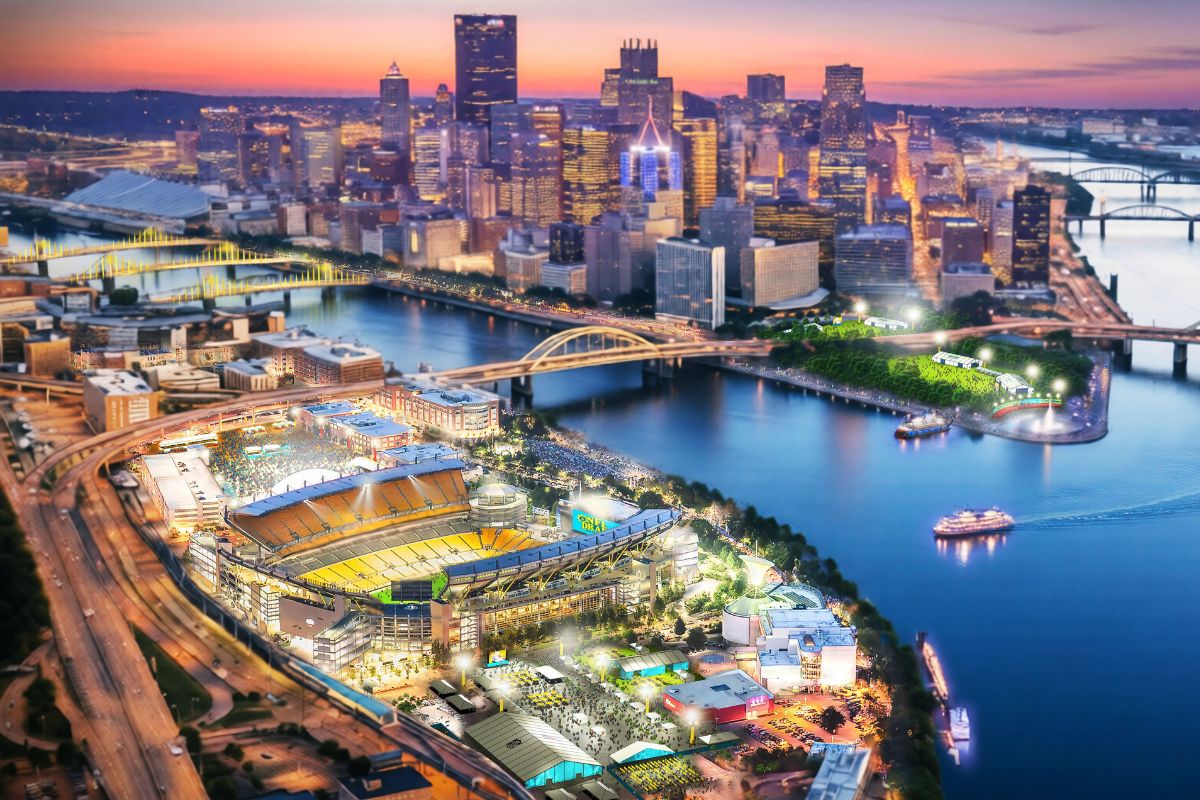
Pittsburgh this week hosts the NFL Draft, once an administrative process by which an industry of legal monopolies negotiated contracts with coveted employees. Organizers have since made it a marketing bonanza, and rotate it around host cities like a carnival of sport. Tens of thousands will attend, and city leaders hope to squeeze a bit more economic benefit from their foot traffic, and cheery memories.
Among the adjacent activities, Carnegie Mellon University is hosting a showcase of AI startups, replete with celebrity-investor Mark Cuban and remarks by Pennsylvania Gov. Josh Shapiro. Two Pittsburgh founders I asked recently were thankful the regional bombast included their technical-style of entrepreneurship.
Instead of concentrating value in team owners and large developers, there’s at least the potential (still unproven) for more localized spillovers.
In another way, it’s a new twist on a familiar strategy: the sports mega-event as an economic engine aimed at lasting effects.
Local organizers are hosting promotions and pop-ups, hoping to capture a wave of outside spending and attention. It’s the same instinct cities have followed for decades: tie economic development to sports, and hope the crowds translate into something lasting.
If history is any guide, they probably won’t.
For more than 30 years, economists have consistently found that professional sports franchises and major events deliver little measurable long-term economic growth. A landmark 2000 analysis in the Journal of Economic Perspectives found “no significant positive impact on income,” and a 2022 review reinforced that the benefits are mostly intangible: civic pride, visibility, a sense of belonging. That analysis is longstanding.
And yet, cities keep betting on sports. The difference now is what kind of sports they’re betting on.
When the WNBA last summer announced expansion to Cleveland, Detroit and Philadelphia, it wasn’t just another franchise reveal. It was a signal that women’s sports — long undercapitalized — are entering a new phase of investment, visibility and cultural relevance.
“The demand for women’s basketball has never been higher,” WNBA Commissioner Cathy Engelbert said.
At the same time, entirely new formats are emerging. The startup 3-on-3 league Unrivaled is positioning itself less like a traditional league and more like a media product built for digital audiences, with shorter games and star-driven storytelling.
This matters because the economic model underneath looks different too.
The old playbook, and its limits
The traditional model pairs stadiums with real estate. Firms now specialize in bundling arenas with mixed-use districts (hotels, apartments, retail) designed to extend economic impact beyond game day. The logic is simple: If the stadium itself doesn’t generate enough value, build an entire neighborhood around it that might.
That model is shaping projects across the country. But it also exposes a tension — especially in older, denser cities.
Philadelphia’s failed proposal to build a new arena in Center City is the latest example of a recurring pattern: attempts to “fix” a place by remaking it for a different audience. That region of downtown, called Market East, has long been targeted for reinvention by planners and investors who see underutilized space. But it’s also already a functioning, if imperfect, urban corridor. It’s dense, transit-connected and full of small businesses and everyday activity.
That creates a fundamental conflict. Is economic development about building something new where there appears to be nothing? Or is it about strengthening what already exists?
In many American cities, built around cars and sprawl, large-scale sports complexes can anchor new districts. Philadelphia, by contrast, already has the kind of walkable density those projects try to simulate. That makes the typical stadium-and-megadevelopment model a less obvious fit, and raises the stakes for getting it wrong.
What women’s sports might do differently
This is where women’s sports, and newer leagues more broadly, could shift the conversation.
Unlike legacy men’s leagues, they’re not locked into decades-old infrastructure assumptions. They don’t require 70,000-seat stadiums or acres of parking. They can fit more naturally into existing urban fabric with smaller venues, flexible spaces or multi-use environments.
They’re also building audiences differently. As The Economist reported in September, “niche” sports like volleyball, lacrosse, and even tag are booming thanks to streaming platforms and social media clips that reach younger, more digital audiences. Private equity firms now make up 45% of all sports industry deals, backing smaller, high-engagement leagues.
That approach aligns more closely with how modern local economies actually grow: through networks, visibility and participation — not just physical infrastructure.
Niche leagues, and for now, fast-growing women’s leagues, tend to operate at a smaller, more local scale. They rely less on massive public subsidies and more on distributed revenue from sponsorships and streaming. That shifts the question from “Does this stadium boost GDP?” to something closer to “Who actually benefits from this activity?”

For all the momentum, the core economic question hasn’t changed. Do these investments create new economic activity, or simply redirect existing spending? The answer is probably still a bit of both.
But the structure of newer leagues suggests a different distribution of benefits. Instead of concentrating value in team owners and large developers, there’s at least the potential (still unproven) for more localized spillovers: small businesses, community partnerships, youth programs, regional branding.
That’s harder to measure. It’s also closer to how economic development actually works.
It’s worth resetting expectations. Sports have always been good at creating moments; bursts of attention, pride and shared experience. They’ve been far less reliable at creating sustained economic growth.
Women’s sports won’t magically change that. But by operating at a different scale, with different incentives, they might offer something more realistic: not a transformational economic engine, but a tool for strengthening the places that already exist.