When Kenya Porter walks across Carnegie Mellon University’s campus, she sometimes sees more than one of the world’s most recognized centers of technology and innovation.
She sees her grandfather.
In the 1960s and early 1970s, Porter’s grandfather worked as a chauffeur for Paul Cross, the president of the Mellon Institute, which later merged with Carnegie Institute of Technology to form the university we know today as Carnegie Mellon University. His employment created an educational opportunity for his children, opening a door to an institution that, at the time, would have felt out of reach for many Black families.
“Every time I’m on [the CMU] campus, I can almost see my grandfather leaning against a car, waiting for the president to come out.”
Kenya Porter, Explore Pittsburgh Tech Week
Porter’s uncle, Audie Stokes, walked through that door. He graduated from Carnegie Mellon in 1976 with a degree in math and another in civil engineering, a significant accomplishment for a Black man entering the engineering field during that era.
Her mother’s story was different.
She attended Avalon High School with a graduating class of 56 students. Although she was among the top 10 students in her class, the percentage-based eligibility requirement put the opportunity to attend Carnegie Mellon just beyond her reach.
Decades later, Porter found herself walking onto that same campus under very different circumstances.
She had been invited to serve on the planning committee for Carnegie Mellon’s Startup PGH, helping contribute to conversations about Pittsburgh’s entrepreneurial tech and innovation ecosystem.
“It was very emotional for me,” Porter said. “Every time I’m on that campus, I can almost see my grandfather leaning against a car, waiting for the president to come out.”
For Porter, the moment represented more than professional recognition. It connected three generations of her family to a larger question that has followed her throughout her career.
That question is also at the heart of Explore Pittsburgh Tech Week, the citywide technology and innovation week Porter founded and now produces through her company, Explore Innovations.
Bringing tech to Pittsburgh’s K-12 students
Porter’s path to founding Explore was built through more than a decade of work spanning technology, financial services, city infrastructure, product and program management and operations.
At PNC Financial Services, she rose to Assistant Vice President and Senior CX Product Manager. She later joined Google as an Engineering Program Manager, where her work included helping lead and scale products and features such as YouTube Shorts, Reserve with Google and the quality and data infrastructure supporting the Google Shopping experience.
But some of the work that would have the greatest influence on Porter’s vision for Pittsburgh happened outside her formal job responsibilities.
As Google’s K-12 Pittsburgh lead, an executive volunteer role, Porter helped bring hundreds of Pittsburgh students into Google’s local offices each year. Students learned coding, toured the workplace and heard directly from Googlers about the paths that led them into technology careers. While at PNC, she was voted in and served as the president of the African American EBRG serving over 1,000 employees, another volunteer executive role, creating professional development workshops and experiences for PNC employees.
She also helped integrate the Google IT Certification into Pittsburgh Public Schools at no cost to students and launched a formal mentorship program through the K-12 initiative.
Those experiences reinforced something Porter had already learned through her own family’s history: Sometimes people need more than information about an opportunity. They need access to the room.
That thinking eventually helped shape Explore Pittsburgh Tech Week.
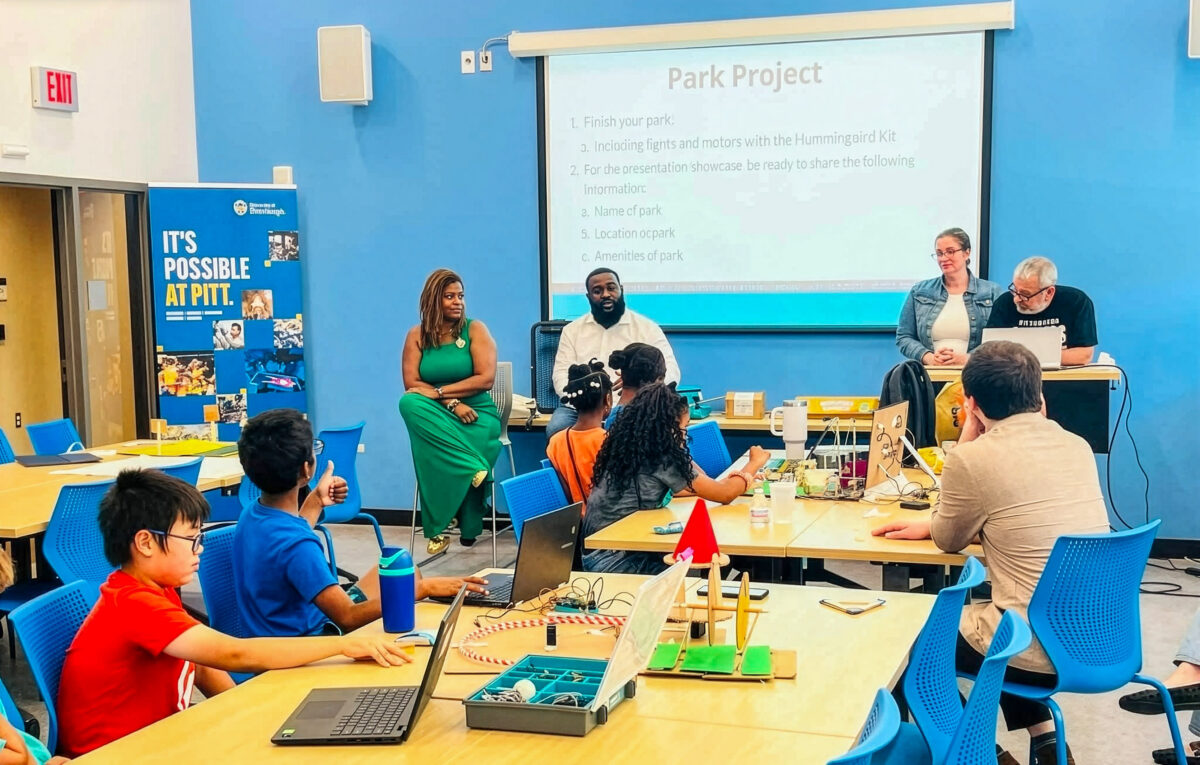
Now in its third year, the week returns Sept. 10 through 16, presented by Google. More than 20 activations across Pittsburgh will bring together students, entrepreneurs, educators, employers, workforce professionals and technologists around artificial intelligence, workforce development, entrepreneurship, education, health and other areas influencing the region’s future.
‘Where tech meets community’: More than just a tagline
For Porter, the week’s tagline phrase reflects a larger challenge facing a city internationally recognized for artificial intelligence, robotics, research and advanced technology.
Pittsburgh has the institutions. It has researchers, companies, universities and talent.
The question is whether enough Pittsburghers can see themselves as part of what is being built.
Porter believes the next chapter of Pittsburgh’s technology economy cannot be measured only by companies launched, investments secured, or innovations developed. Its success will also depend on how many people can find a path into that economy, including students and workers who may never have considered themselves part of the technology community.
That makes Explore more than a week of programming for its founder. In many ways, it is personal.
Her grandfather drove the car.
Her uncle earned two degrees.
And generations later, Porter is returning to some of those same institutions, this time as a leader, partner and builder working to widen the path for others.
“I feel that I’m literally standing on my ancestors’ shoulders,” Porter said.
Perhaps that is why walking across Carnegie Mellon’s campus still carries so much weight for her.
She walks across the campus her mother couldn’t.
She can picture her grandfather standing beside that car.
Only now, his granddaughter has a seat at the table.
Explore Pittsburgh Tech Week 2026 takes place Sept. 10-16. Learn more and register for events at TechWeekPittsburgh.com.