
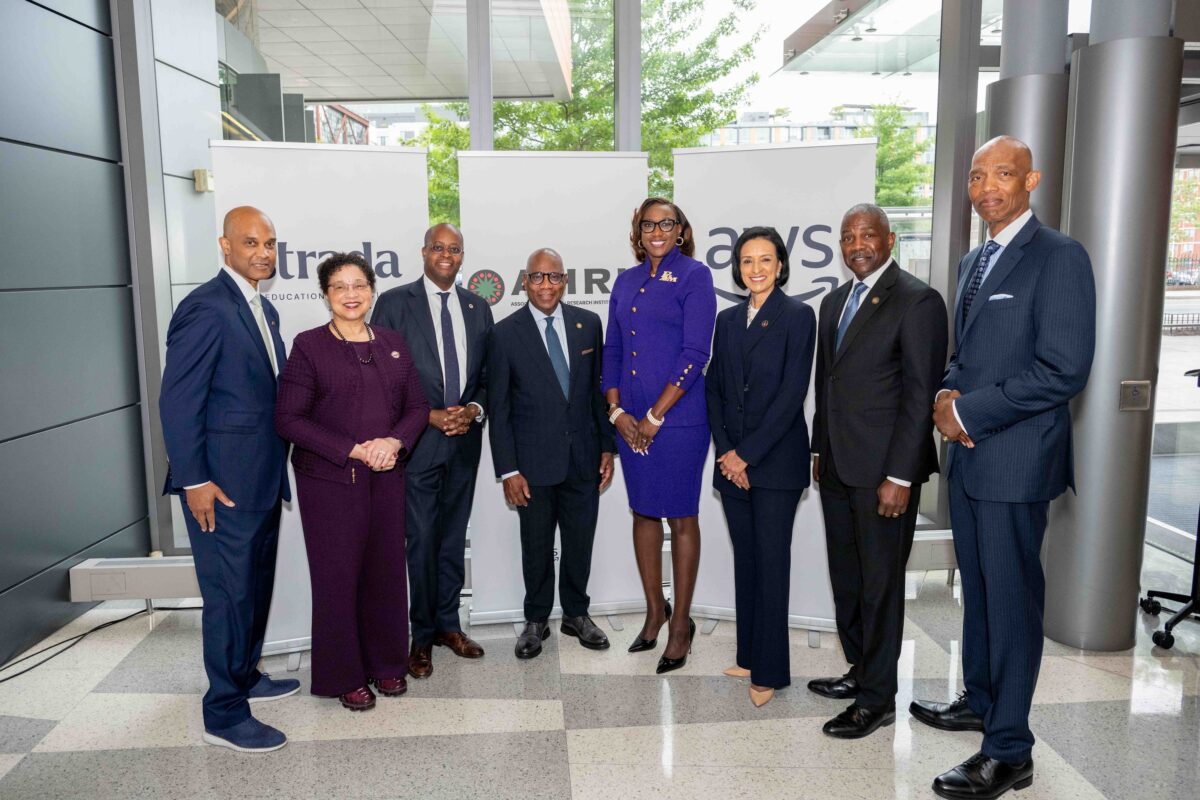
Fifteen historically Black colleges are partnering to collaborate on research, boost tech innovation and go after government grants.
Called the Association of HBCU Research Institutions, or AHRI, the new consortium is composed of the top historically Black research universities in the country. It launched this week with a three-year, $1 million grant from the Harvard & the Legacy of Slavery Initiative.
HBCUs already house many pioneers in research and innovation, said Tomikia LeGrande, president of Prairie View A&M University and vice chair of the AHRI board, but this move is intended to boost that work. It also aims to provide structure for sharing ideas that can inform policy.
“Together, we cover probably every industry, every sector … There’s power in us, collectively.”
Tomikia LeGrande, AHRI vice chair
“Together, we cover probably every industry, every sector — it can cover every federal agency there is,” LeGrande told Technical.ly. “There’s power in us, collectively.”
DC’s Howard University achieved its Research One classification about a year ago and is the only HBCU with that status. Most of the remaining schools in AHRI, including Morgan State University in Baltimore and Hampton University in Coastal Virginia, have the second tier of the classification.
The roughly 100 HBCUs across the country receive less than 1% of available federal funding for higher education, per a 2022 study, despite technological strides made by their faculty and students, like in prostate cancer research at Texas Southern University or radiation technology innovation at Hampton University.
“What we bring in research, what has not been widely recognized — this isn’t new,” said James Crawford, president of Texas Southern University. “What this does is give us the opportunity to expand that impact.”
The universities participating in AHRI also see the potential for more patents, startup spinouts and eventually jobs created, LeGrande said
“Each of our institutions is contributing to the economy,” she said, “in meaningful ways that is propelling the contributions of America.”
Strength in numbers, so people aren’t left ‘in limbo’
The Trump administration has repeatedly targeted higher education institutions, in lawsuits and budget cuts. Trump has also targeted DEI in education and government contracting. But there’s mixed messaging.
University leaders in AHRI noted they’ve experienced disruptions since Trump took office, but grants are still coming through. Last fall, the president announced a one-time allocation of $495 million for HBCUs after cutting hundreds of millions in other grants, mostly for colleges with large numbers of Hispanic students.
LeGrande of Prairie View A&M said her university was facing questions for nearly 10 federal grants at the height of DOGE. After appeals, seven didn’t get cut, she said. There’s also been a slowdown in requests for proposals from the federal government, but faculty are still submitting and going through the process.
Howard University, which has academic programs and research initiatives internationally, is still dealing with the gutting of USAID, per interim president Wayne Frederick. Leadership is currently figuring out if certain work is viable, including HIV testing projects in Zambia and Malawi.
As he’s talked to other university leaders, he’s realized it’s not a unique situation. “Payouts have been slow,” Frederick told Technical.ly. “Some people are in limbo.”
AHRI will apply together for grants, as well. Darrell Williams, president of Hampton University, believes being able to reference a larger organization will make proposals stronger.
“Instead of each individual institution advocating for additional funding,” Williams said, “we now have an organization that can assist us in doing that … as opposed to each of us approaching the same problem alone.”
Tracking success via funding and recognition
HBCUs involved in AHRI hope the number of participating universities in the association grows, as more obtain high research classifications.
LeGrande thinks more HBCUs will achieve R1 classification. Prairie View A&M surpassed the $50 million in annual research expenditures requirement in 2025, she said, and is now focusing on boosting its PhD programming including in mechanical and electrical engineering. (For R1 status, 70 research doctorates must be awarded annually.)
AHRI can also serve as an example for other minority-focused institutions, she said.
Leaders agreed that more grant proposals and making connections with the private sector will be important, in boosting innovation, but continuing to land money.
The association will seek different streams of funds, including from foundations, corporations and federal grants, per LeGrande. She looks at it like a business proposition.
“I like to call them investors,” LeGrande said, “because what we are saying to them is you will actually get a return on your investment.”