

Instead of looking at complex drawings, new shipbuilders at a government contractor are learning how to build through playing games.
General Dynamics Electric Boat, a subsidiary of Northern Virginia-headquartered General Dynamics, is one of several military-related companies and government agencies finding new ways to quickly train workers and retain them. The industry needs tech recruits — and faster, federal and tech leaders stressed at a recent event hosted by GDIT, the aerospace and defense giant’s IT division, even if some DOW branches are meeting recruitment goals.
Quicker clearances could encourage more fast-paced, private sector-oriented people to join the military and intelligence agencies.
Creating a gaming interface for teaching on the General Dynamics submarine assembly floor makes it more approachable to young people, said VP Dave Roberts, who oversees the company’s attack submarine division
“There are small things that we’re doing in submarine building technologically that are bringing the capability to these young shipholders in a way that they can understand it better,” Roberts said on a panel at the event at the Waldorf Astoria in DC, which was titled “Emerge: Battlespace of the Future.”
Federal contracts can provide lots of jobs, but they’re often dependent on renewal — no sure thing in a politically volatile environment. The day before the Tuesday conference, GDIT filed a WARN notice of 233 layoffs in Northern Virginia. That follows a notice about layoffs for 87 DC employees, which could take effect on June 15.
More flexibility on the government side would help recruitment, said Ben Kohlmann, assistant secretary for manpower and reserve affairs at the Navy, especially because younger generations are spending less time at each of their jobs.
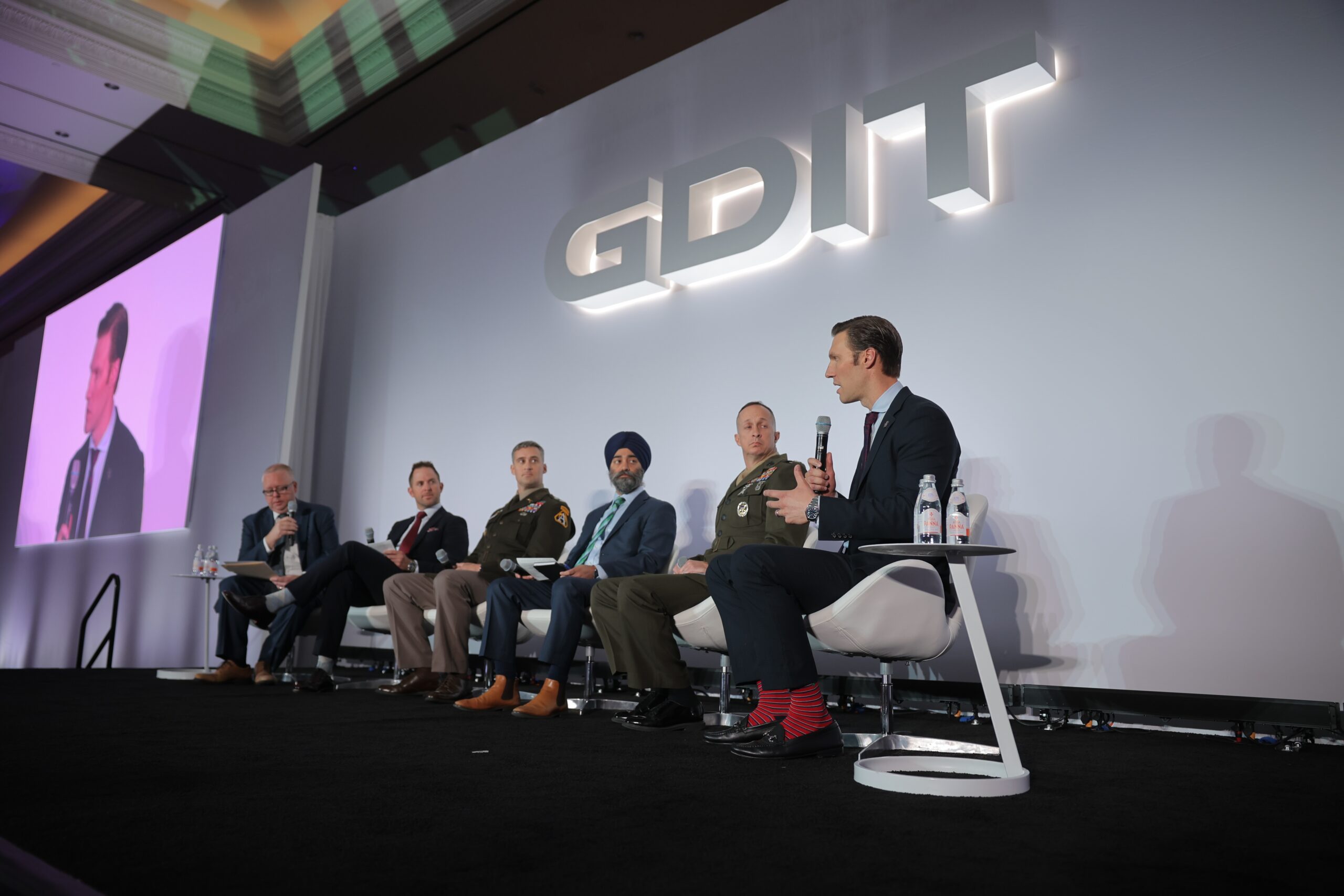
It’s a big issue in the reserves, he said, where tech talent is lacking. To bring in cyber and AI trained workers, he suggested the military look to the private sector and offer different ways to serve — like via telework or schedules that condense the service into a couple of consecutive weeks instead of several weekends throughout the year.
Quicker clearances could encourage more fast-paced, private sector-oriented people to join the military and intelligence agencies, offered Michael Grochol, vice president of technology at GDIT and an Air Force veteran.
He advocated for working with colleges to start putting interested students in training early.
A call to explore new materials and expand autonomous systems
In addition to workforce needs, private sector and federal leaders called for flexibility in how tech is built and approved, especially amid uncertainty in global supply chains.
US infrastructure and systems have a “very low operational risk tolerance,” said Chris Haynes, senior vice president at General Dynamics’ tactical systems subsidiary.
He blamed in part the drawn-out processes required to update government guidelines and standards, citing as example the qualification process for products like explosives and detonators, which has been updated with a computerized system but is still based on legislation passed in 1952.
“It’s dated. It’s not because there aren’t advanced capabilities,” Haynes told the crowd. “It’s just the nature of stagnation.” The government and its contractors need to be able to work with alternative materials, he said.
Several speakers brought up stabilizing critical minerals supply chains, which are used in everything from phones to planes. China controls 90% of processing and refining critical minerals, according to the Council on Foreign Relations. The White House has ramped up investment in critical minerals, including this week announcing a $1.6 billion deal for USA Rare Earth through funding under the CHIPS Act
Defense leaders continue to be eager to find ways to avoid putting military members directly in battle.



Robert Mantz, a senior logistics official with the Department of War, has been especially interested in autonomously delivering material, like parts to repair a truck. It simultaneously reduces chance of casualties and allows human power to be applied to other work, he said.
Overall, sending in an autonomous system rather than a person de-risks situations, said Matthew Ritchie, an operations branch head with the Marine Corp.
“That preserves combat power, preserves that human capital for other more important missions, Ritchie said. “It makes decision-making for commanders a lot easier.”