AI has no place in writing poetry. It does have a big role in journalism.
I came to my reporting career from an interest in creative writing first. I only later became a devotee to informing communities. So I have several rolling conversations with friends about what this era of generative AI means for something I’ve loved for as long as I can remember: assembling words in a particular order to create meaning for others.
Tech-forward friends tease me that my life’s work is being automated away. Writer friends joke that I’m crossing the picket line by even entertaining how this era’s new tools could fit into my practice.
Lots of problems come with any big paradigm shift, and artificial intelligence is no different.
As a news organization that employs human writers and community reporters, Technical.ly has plenty of internal debate. Our coverage remains open to good-faith perspectives across the spectrum, but I believe it’s unlikely that we will ever again hire someone who is opposed to the technologies across the board (as opposed to particular uses and models).
Lots of problems come with any big paradigm shift, and artificial intelligence is no different. Early on, Technical.ly established our own ethics policy for AI usage, and it will continue to evolve.
More recently, I got into a conversation with Danya Henninger, the Technical.ly editorial director overseeing our newsroom, about what defining rules are worth following when engaging AI for writing.
To me as someone who will likely always identify as a writer, I draw a bright line between different types of writing I do for different reasons. I do write poetry. I still create stories and order words with intention. AI never really comes to mind in those uses — it breaks the whole goal I have. These words in this essay were all written like I’ve written for decades, as a stream of consciousness and then tightened with an edit.
But my journalistic practice is something different. My first goal is not my enjoyment or self-discovery; My journalistic priority is to inform a community to the best of my ability. I routinely rely on a suite of AI tools for research, fact-checking and data analysis. I still write plenty, because I believe part of our distinction is that we’re real people.
Still, I wanted to share a few rules I follow, beyond ethics, and more to good writing when a generative AI tool lurks somewhere near.
Below, I humbly submit those I follow in the hopes you’ll follow them too. I’d love to hear your own.
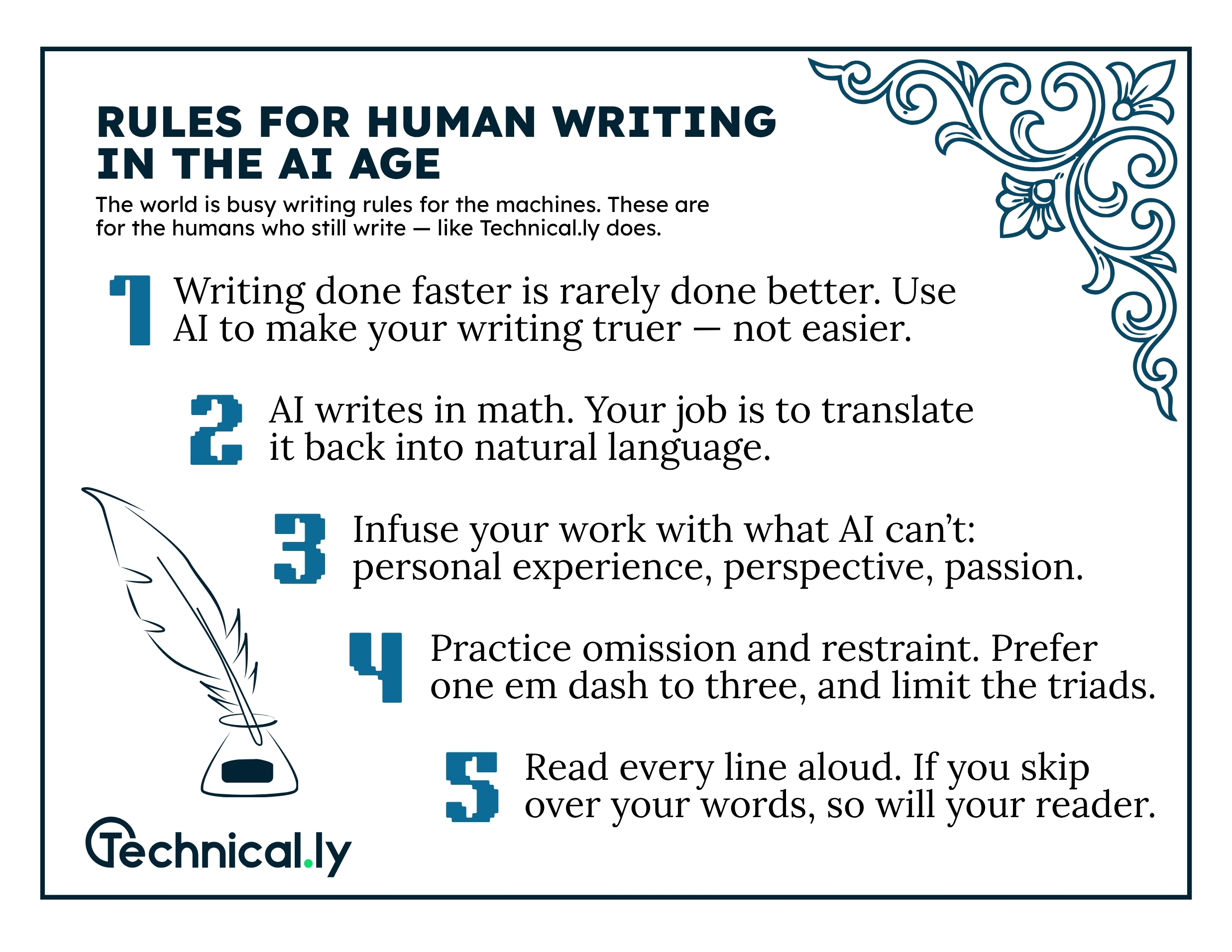
- Writing done faster is rarely done better. Use AI to make your writing truer — not easier.
- AI writes in math. Your job is to translate it back into natural language.
- Infuse your work with what AI can’t: personal experience, perspective, passion.
- Practice omission and restraint. Prefer one em dash to three, and limit the triads.
- Read every line aloud. If you skip over your words, so will your reader.