When federal layoffs hit Alex Zhu’s friend group, he wanted to do more than offer a shoulder to cry on.
The longtime community builder already knew plenty of people eager to help their neighbors, so he launched a grassroots effort to funnel extra cash directly to those who needed it. Inspired by ideas like former presidential candidate Andrew Yang’s universal basic income proposal, the Baltimore Guaranteed Income Club was born.
“The hope is that we can perfect the platform, get our community running on it and then give it away for others to use.”
Alex Zhu, Baltimore Guaranteed Income Club
Each month, members pledge 7% of their after-tax income to the fund. Zhu uses a formula to calculate the group’s average earnings and determine who falls above and below that line.
Then, higher earners send money directly to lower earners through apps like Venmo.
Since launching in April 2025, the club has grown to 50 members and redistributed more than $20,000. Beyond just coinciding with a difficult moment for Maryland’s federal workforce — the state has experienced some of the nation’s steepest federal job losses — Zhu also lost his own job as a Johns Hopkins public health worker six months after the initiative took off.
Now, he’s focused on growing the income club and leading Baltimore’s chapter of the national Chamber of Connection, which supports community-building efforts across the US.
You may have already crossed paths with him around Baltimore. He runs a silent book club, a Spanish-language happy hour and a rock-climbing group.
This edition of How I Got Here explores his path into public health, organizing and the future of the Guaranteed Income Club.
This Q&A has been edited for length and clarity.
Why did you pursue public health?
I became interested in public health partly through this community of effective altruism, which I had heard about from one of my roommates when I was in undergrad, thinking about how you can do the most good in the world with the limited resources and capacities that we have. How do you prioritize?
Public health was one of the ways I felt that you could have the most impact in saving people’s lives.
What was your first job after completing your master’s degree?
I worked as an analyst at the Johns Hopkins Center for Health Security. That role was partly doing research on various things — like indoor air quality to prevent infectious disease and ways to improve the learning and organizational capacity for outbreak response — with the Centers for Disease Control and Prevention and other groups that are interested in preventing pandemics.
What’s your focus at the Baltimore Chamber of Connection?
So many people come to Baltimore for school or work, and they don’t really get to experience the things they need to fall in love with the city and stay. That’s a really important aspect of it.
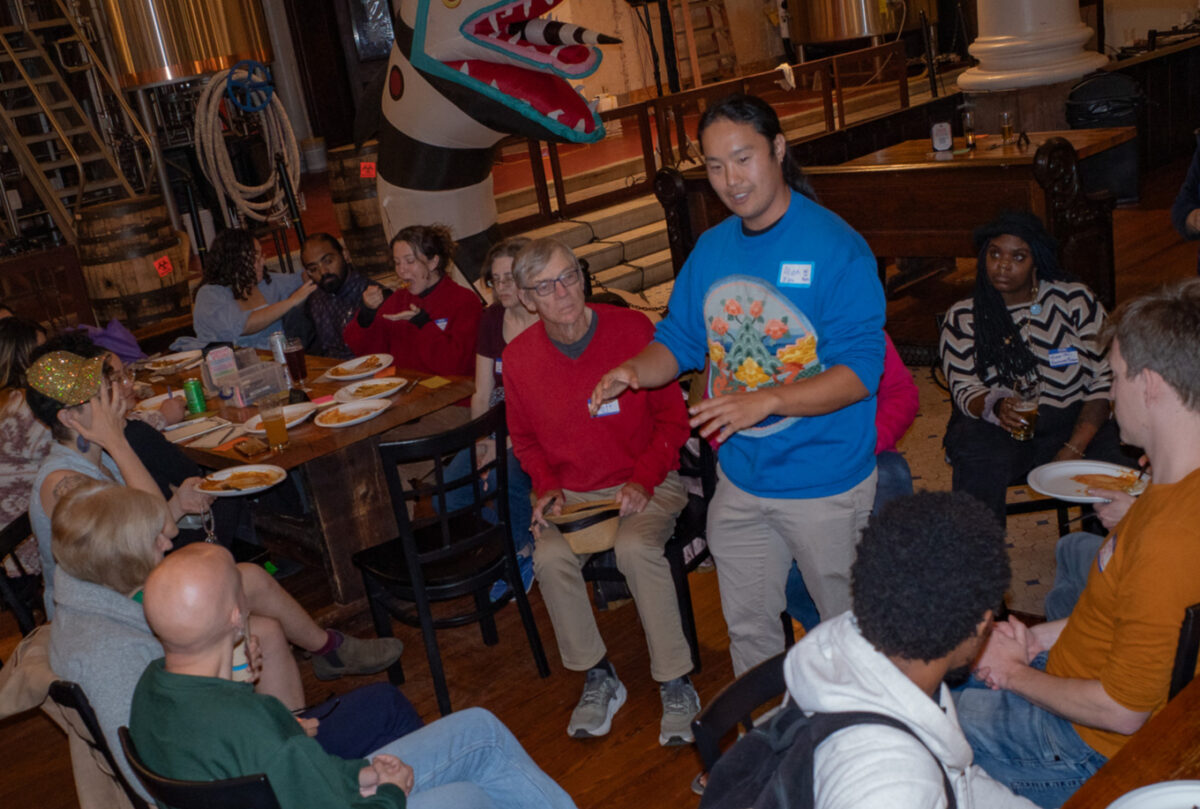
We’ve been doing monthly dinners for community builders to help build out that ecosystem and field. Most people don’t think of community building as an industry or field, so we don’t prioritize it or resource it, but it’s super important.
Many people are doing the same types of things, learning the same lessons and making the same mistakes. If we could get together and share some of that, it would make our lives easier and create more belonging and inspiration.
What’s next for the Baltimore Guaranteed Income Club?
My hope for the Baltimore chapter is to grow it to 150 people. I’m also working with a group called the Relational Tech Project to build a website version that handles a lot of the logistics — not the transactions themselves, but things like telling people who to send money to, automating email introductions and notifying people about incoming payments.
We also want to make the platform open source and available to anyone else who wants to do this type of thing themselves. The hope is that we can perfect the platform, get our community running on it and then give it away for others to use.
What advice would you give someone navigating a career transition?
One of my previous mentors, when we were talking about my interest in applying for the Peace Corps, said that you should just write the application and see how you feel after having written it — whether you’re excited or terrified or something like that.
Another friend of mine would ask, when he was in a period of transition, to consider: if you knew that you couldn’t fail, what would you do? I think those are useful guiding questions.